

Views: 222 Author: Loretta Publish Time: 2026-01-23 Origin: Site


Content Menu
● Core Keywords and Search Intent
● What Is a Single Braided Hydraulic Hose?
● What Is a Double Braided Hydraulic Hose?
● Key Differences: Single vs Double Braided Hose
>> Performance Comparison: Single vs Double Braided Hose
● Braided Hose Standards and Designations (R1 vs R2, 1SN vs 2SN)
>> Typical Single-Braid Standards
>> Typical Double-Braid Standards
● How to Choose Between Single and Double Braided Hoses
>> Step 1: Define Pressure and Safety Margin
>> Step 2: Evaluate Environmental Conditions
>> Step 3: Check Flexibility and Routing Constraints
>> Step 4: Balance Cost Versus Lifetime
● Common Applications for Single and Double Braided Hoses
>> Typical Uses for Single Braided Hoses
>> Typical Uses for Double Braided Hoses
● Where TPU Layflat Hoses Fit in the Picture
● Expert Insights: Failure Modes and Safety Considerations
>> Burst Failure Due to Overpressure
>> Abrasion and External Damage
● How a TPU Layflat Hose Manufacturer Adds Extra Value
● Actionable Checklist: How to Specify the Right Hose
● Final Call to Action: Get a Tailored Hose Solution from Sunmoon
● FAQ: Single vs Double Braided Hydraulic Hose
>> 1. Is a double braided hydraulic hose always safer than a single braided hose?
>> 2. How do I know if R1 (1-wire) hose is sufficient for my system?
>> 3. Can TPU layflat hoses replace steel braided hoses in hydraulic systems?
>> 4. What happens if I bend a double braided hose too tightly?
>> 5. How often should hydraulic hoses be inspected and replaced?
Understanding the difference between single and double braided hydraulic hoses is critical for safety, reliability, and cost control in any hydraulic system. This guide explains how they are built, how they perform, where each type is best used, and how an engineering-driven TPU layflat hose manufacturer like Sunmoon can support TPU layflat hose demanding projects.

Users searching terms like - difference between single and double braided hydraulic hose or “R1 vs R2 hydraulic hose” generally want clear, practical answers that help them make buying or design decisions. This article is structured to match that intent while providing deeper, engineering-level guidance.
Understand the structural differences and pressure ratings of single vs double braided hoses.
Learn how to choose the right hose for specific hydraulic, industrial, or fluid transfer applications.
Balance safety, durability, flexibility, and cost for long-term performance.
Main target keyword: - difference between single and double braided hydraulic hose
Supporting keywords include: single braided hydraulic hose, double braided hydraulic hose, 1-wire vs 2-wire hydraulic hose, R1 vs R2 hydraulic hose, braided hose pressure rating, and hydraulic hose reinforcement selection.
A single braided hydraulic hose uses one layer of braided reinforcement, usually high-tensile steel wire or synthetic fiber, applied over a flexible inner tube. The inner tube is commonly made from oil-resistant rubber or thermoplastic material compatible with hydraulic fluids.
Typical examples are EN 853 1SN and SAE 100R1, which feature a single layer of steel wire braid, and SAE 100R6, which uses a single fiber braid. These hoses offer a practical balance of strength, flexibility, and weight, making them suitable for low- to medium-pressure applications where operating conditions are not extremely harsh.
Because of their lighter construction, single braided hoses are easier to route in tight spaces and simpler to handle during installation. However, they provide less protection against external damage and high-pressure spikes compared with double braided designs.
A double braided hydraulic hose has two separate layers of braided reinforcement wrapped around the inner tube. The second braid significantly increases mechanical strength and improves resistance to pressure, impulse, abrasion, and external damage.
Common examples include EN 853 2SN and SAE 100R2, which have two layers of steel wire braid, and SAE 100R3, which uses two fiber-braided layers. These hoses are designed for medium- to high-pressure applications and are widely used in heavy construction, mining, and industrial machinery that demand a higher safety margin.
The added reinforcement layer allows the hose to maintain its shape and structural integrity even under extreme pressure and dynamic loads. The trade-off is reduced flexibility, larger minimum bend radius, and higher cost compared with single braided alternatives.
The primary difference between single braided and double braided hydraulic hoses lies in reinforcement structure and the working conditions they can safely withstand. Single braid offers lower pressure capability but higher flexibility and lower cost, while double braid prioritizes strength, durability, and safety.
The comparison table below summarizes the most important distinctions for engineering and purchasing decisions.
Aspect | Single Braided Hydraulic Hose | Double Braided Hydraulic Hose |
Reinforcement layers | One braid (wire or fiber) | Two braids (wire or fiber) |
Typical standards | EN 853 1SN, SAE 100R1, R6 | EN 853 2SN, SAE 100R2, R3 |
Pressure rating | Low to medium; suitable for moderate operating pressures | Medium to very high; suitable for high-pressure environments |
Flexibility | High flexibility, smaller bend radius, easier routing | Stiffer due to extra braid, larger minimum bend radius |
Weight | Lighter, easier to handle and install | Heavier because of additional reinforcement |
Abrasion & impact resistance | Lower external protection in harsh environments | Better resistance to abrasion, impact, and mechanical damage |
Temperature capability | Adequate for standard ranges but with lower safety margin | Better suited to elevated temperature and severe duty when correctly specified |
Typical applications | Agriculture, light construction, general hydraulics | Heavy construction, mining, high-pressure power units |
Cost | Lower production and purchase cost | Higher cost but longer service life in demanding conditions |
Industry standards define minimum performance requirements for braided hydraulic hoses and help engineers match hose design to pressure, temperature, and fluid type. Two commonly referenced systems are SAE (Society of Automotive Engineers) and EN 853 standards.
- SAE 100R1 / EN 853 1SN: Single layer of steel wire braid, designed for medium-pressure hydraulic applications.
- SAE 100R6: Single fiber-braided hose, often used for low-pressure return lines and general-purpose hydraulic service.
- SAE 100R2 / EN 853 2SN: Two layers of steel wire braid, designed for high-pressure applications with demanding impulse performance.
- SAE 100R3: Two layers of fiber braid, used in specific low- to medium-pressure applications that prioritize flexibility.
R1 hoses are 1-wire reinforced and suitable for moderate pressure, flexible routing, and controlled environments.
R2 hoses are 2-wire reinforced and capable of higher working pressures and greater resistance to pressure spikes and mechanical stress.
When selecting between R1 and R2, always compare the rated working pressure and impulse performance in the specific diameter you require, and then apply an appropriate safety factor for your application.
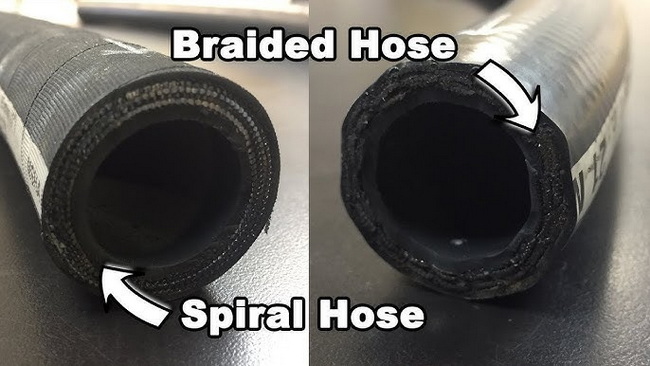
Selecting between single and double braided hydraulic hoses should follow a structured, engineering-driven process. Instead of assuming “stronger is always better,” it is more effective to match the hose design to real operating conditions, safety requirements, and cost targets.
Determine the maximum system working pressure, including possible transient spikes.
Check the relevant SAE or EN standard for the rated working pressure of each hose option in the required size.
Apply a suitable safety factor, commonly 4:1 in many hydraulic applications, or follow your industry and corporate guidelines.
If a single braided hose meets your pressure needs with adequate safety margin, a double braided hose is not automatically required. However, in systems with frequent pressure spikes or extreme impulse loading, double braided designs often provide significantly longer service life and a higher safety reserve.
Next, analyze the operating environment and the type of stress the hose will face daily.
Is the hose exposed to abrasion from rocks, metal edges, concrete, or ground dragging?
Will it operate in corrosive atmospheres, be exposed to chemicals, or be stored outdoors for long periods?
Does it face frequent impact, vibration, or heavy traffic in mobile machinery?
In harsh environments, double braided hoses offer more robust protection and can better withstand external damage and fatigue. In controlled indoor environments with protected routing, single braided hoses often provide sufficient performance at a lower total cost.
Single braided hoses are usually more flexible with smaller minimum bend radius, which helps when routing through confined spaces or around tight corners.
Double braided hoses are stiffer and require more generous bend radii, which must be accounted for in system layout and clamp positioning.
In highly dynamic systems with frequent movement or vibration, both flexibility and fatigue resistance matter. The best choice may be a single braided hose with appropriate protection, or a double braided hose if pressure and impulse loads are particularly severe.
While double braided hoses generally have higher unit cost, they can significantly extend service life where conditions are harsh or failure consequences are severe. When calculating cost, consider the full lifecycle: downtime, maintenance labor, replacement frequency, fluid loss, and potential environmental or safety incidents.
In many critical applications, the long-term value of a more robust hose design outweighs the small initial price difference per meter.
Matching hose construction to application ensures both safety and cost efficiency. Below are typical usage scenarios for each type.
Agricultural machinery such as implements, steering lines, and auxiliary hydraulic circuits.
Light construction equipment where operating pressures are moderate and routing is relatively short.
General industrial equipment, test benches, and factory automation where hoses are protected and easily inspected.
Heavy construction machinery, including excavators, loaders, cranes, and drilling rigs operating at high pressures.
Hydraulic power units, presses, and industrial systems that run continuously or at high duty cycles.
Mining, quarrying, and other environments where hoses face abrasion, mechanical impact, and demanding impulse cycles.

While steel wire braided hoses dominate many hydraulic circuits, TPU layflat hoses offer a high-performance solution for long-distance fluid transfer, dewatering, fire-fighting, and oil and gas operations. TPU (thermoplastic polyurethane) combines high abrasion resistance, excellent flexibility, and strong chemical resistance.
Engineering-driven manufacturers such as Sunmoon focus on TPU layflat hoses and related products that provide lightweight, high-strength hose systems for demanding energy and industrial applications. When used in combination with braided hydraulic hose at connection points or equipment interfaces, TPU layflat hoses can significantly reduce handling effort and logistics costs in large projects.
For example, a system may use double braided hydraulic hose at the pump and manifold, while long-distance water or slurry transfer lines are handled by TPU layflat hose. This hybrid approach leverages the strengths of each hose type.
Understanding common hose failure modes helps engineers select the right product and design safer systems.
Burst failures typically occur when system pressure exceeds the hose's rated working pressure or when the safety factor is inadequate. Using a single braided hose where a higher-pressure double braided hose is required significantly increases this risk.
Pressure spikes from sudden valve closure, load changes, or water hammer can cause damage even when nominal system pressure appears within specification. Correct hose selection and pressure control components are both essential.
Dragging hoses along the ground, contact with sharp edges, and repeated rubbing against machine structures can quickly wear through the outer cover. Once the braid is exposed, corrosion and mechanical damage accelerate failure.
Double braided hoses provide additional structural reserve once the outer layers are compromised, and supplemental protection such as guards, sleeves, and clamps can further improve durability.
Bending a hose beyond its minimum bend radius can cause kinks, flattening, and internal damage, eventually leading to leaks or bursts. This is particularly critical for stiffer double braided hoses, which require careful routing.
Proper hose routing, adherence to minimum bend radius, and using elbows or adapters where needed are key strategies for reducing fatigue and extending service life in both single and double braided designs.
An engineering-focused TPU layflat hose manufacturer such as Sunmoon can provide more than just standard product supply. By combining deep application knowledge with flexible production capabilities, such a partner can help optimize the entire hose system.
Application-specific hose configurations that integrate braided hose segments, TPU layflat sections, and suitable couplings for mining, fire-fighting, offshore, or energy markets.
Technical support on standards, pressure ratings, hose layering, and system design so each section uses the right level of reinforcement.
Guidance on testing, inspection, and replacement schedules tailored to your duty cycle and safety requirements.
This consulting approach reduces lifetime cost and risk while helping global customers meet local and international standards.
Use the following checklist to translate theory into practical hose selection for your project.
- Define operating conditions: Document maximum working pressure, potential pressure spikes, fluid type, temperature range, and expected flow rate.
- Describe environment and duty: Clarify whether the hose will be used indoors or outdoors, fixed or mobile, and note any exposure to abrasion, chemicals, UV, or impact.
- Select reinforcement level:
Use single braided hydraulic hose for moderate pressures, protected routing, and applications that demand high flexibility.
Choose double braided hydraulic hose for higher pressures, severe duty conditions, or critical safety applications.
Consider TPU layflat hose solutions for long-distance transfer, dewatering, or fluid logistics in harsh environments.
- Verify compliance with standards: Confirm that your chosen hose types meet the relevant SAE and EN 853 standards and any industry-specific requirements.
- Engage a technical manufacturer: Share drawings, operating data, and performance goals with an engineering-driven partner such as Sunmoon to refine hose type, fittings, and testing strategy.
Choosing between single braided, double braided, and TPU layflat hoses has a direct impact on safety, uptime, and total lifecycle cost in your hydraulic or fluid transfer systems. Instead of relying on guesswork or generic catalog data, you can work with an engineering-driven TPU layflat hose manufacturer like Sunmoon to match each hose type to real-world loads, environments, and standards.
If you are planning a new project or upgrading an existing line, gather your basic system parameters (pressure, fluid, temperature, hose length, and environment) and share them with Sunmoon's technical team. You will receive a tailored, engineering-backed hose configuration that helps you reduce risk, extend service life, and improve the performance of your entire system.
Contact us to get more information!
Double braided hoses are designed for higher pressure and more severe operating conditions, but they are not automatically safer in every scenario. A correctly specified single braided hose with adequate safety margin can be completely safe in moderate environments, while an undersized double braided hose can still fail if misapplied.
To determine if R1 hose is sufficient, compare your system's maximum working pressure (including spikes) to the hose's rated pressure in the required size. If there is a comfortable safety margin and the environment is not excessively harsh, R1 may be suitable; otherwise, consider upgrading to R2 or a higher-spec design.
TPU layflat hoses are excellent for fluid transfer, dewatering, and similar applications, but they are not a direct replacement for every high-pressure hydraulic circuit. In many systems, steel braided hose is still required near pumps, cylinders, and manifolds, while TPU layflat hoses can be used for long-distance or temporary lines.
If a double braided hose is bent beyond its minimum bend radius, it may kink, flatten, or suffer internal damage, which can lead to leaks or bursts over time. Always follow manufacturer bend radius guidelines and use proper routing, clamps, and fittings to avoid excessive bending stress.
Inspection and replacement frequency depends on pressure, environment, duty cycle, and safety requirements. As a general rule, perform regular visual inspections, look for signs of abrasion, cracking, or leakage, and adopt time-based or impulse-based replacement intervals that follow your manufacturer's recommendations and internal safety policies.
1. https://www.strongflex.com/what-is-the-difference-between-single-and-double-braided-hoses/
2. https://www.sunmoonhose.com/tpu-lay-flat-hose/
3. https://www.sunmoonhose.com/top-10-frac-hose-manufacturers-in-china.html
4. https://www.sunmoonhose.net
5. https://www.sunmoonpipe.com/tpu-layflat-hose/


