

Views: 235 Author: Sunmoon Publish Time: 2026-05-25 Origin: Sunmoon Hose Manufacturing


Content Menu
● The Anatomy of Failure: Diagnostic Scenarios
>> Scenario 1: Low-Pressure, Significant Puncture (The "Road-Crossing" Failure)
>> Scenario 2: High-Pressure, Near-Pump Abrasion (The "Vibration" Failure)
>> Scenario 3: Bulging or Leaks Near Couplings (The "Installation" Failure)
● Proactive Maintenance Strategy
● Why "Integrated Solutions" Matter
● Frequently Asked Questions regarding Repair of TPU Layflat Hoses
Thermoplastic Polyurethane (TPU) layflat hoses are engineered for the most rigorous industrial applications—from large-scale shale gas development to critical mining dewatering operations. Their success relies on a unique composite construction: a seamless, high-performance TPU inner and outer layer bonded to a high-strength circular-woven synthetic reinforcement.
While designed for durability, even the highest-quality TPU hose is not immune to operational hazards. Understanding how to detect, diagnose, and repair leaks is essential for reducing downtime and maximizing the return on your industrial investment.
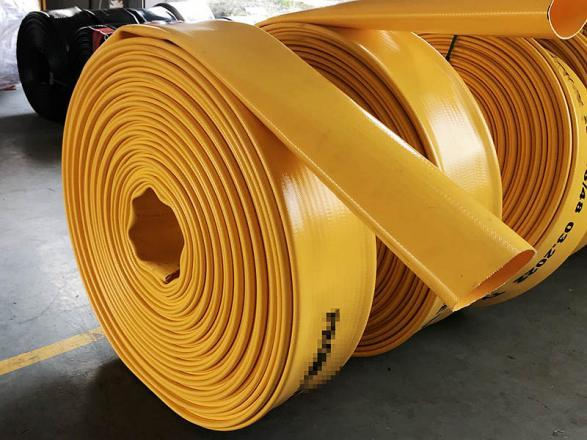
When a leak occurs, the immediate reaction is often to patch it. However, the *type* of failure dictates the *technique* of repair. Below are three primary scenarios based on field diagnostics.
Commonly caused by unprotected deployment over active job site access roads, heavy vehicle traffic can crush or pierce the hose, leading to large-diameter holes.
Diagnosis: Visible, jagged piercing; significant localized fluid loss.
Expert Repair Protocol:
1. System De-pressurization: Immediately shut down the pump. Never attempt a live repair under pressure.
2. Sectional Isolation: Utilize heavy-duty hose clamps to secure the hose at both ends, at least one meter from the puncture to prevent further tearing.
3. Surgical Removal: Cut out the damaged section cleanly using a sharp, non-serrated blade.
4. Integrated Reconnection: Install high-pressure quick-release couplings to bridge the cut ends.
5. Operational Validation: Slowly bring the line back up to pressure, checking for "weeping" at the newly installed coupling joints.
Often found near pump outlets, this failure arises from intense mechanical vibration combined with high-pressure internal expansion, causing the hose to chafe against concrete, gravel, or sharp industrial hardware.
Diagnosis: Localized wear, thinning of the outer layer, or pinhole leaks.
Expert Mitigation:
Emergency Stabilization: If operations must continue, place a non-abrasive protective mat (or a split PVC pipe) under the friction point.
Tension Reduction: Adjust hose routing to introduce a "buffer loop" or "S-bend" to absorb vibration.
Permanent Fix: During the next scheduled shutdown, replace the affected segment. Do not attempt to "tape over" high-pressure leaks, as the underlying structural reinforcement is likely compromised.
Often misidentified as material failure, "bulging" near a coupling usually indicates an internal breach. Water has penetrated the textile reinforcement and is traveling along the yarn layer.
Diagnosis: Visible swelling (bulging) near the coupling sleeve or fluid "weeping" from the fitting area.
Root Cause:
Improper Assembly: The coupling insert was forced into the hose, cutting the inner TPU liner.
Unfinished Edges: The coupling sleeve or insert was not properly de-burred during manufacturing or field installation.
Expert Correction:
1. Immediate Replacement: The coupling must be removed.
2. Surface Inspection: Examine the hose end for internal lacerations.
3. Refurbishment: If the hose length allows, cut the end back to fresh material, de-burr the coupling hardware, and re-install following strict assembly torque specifications.
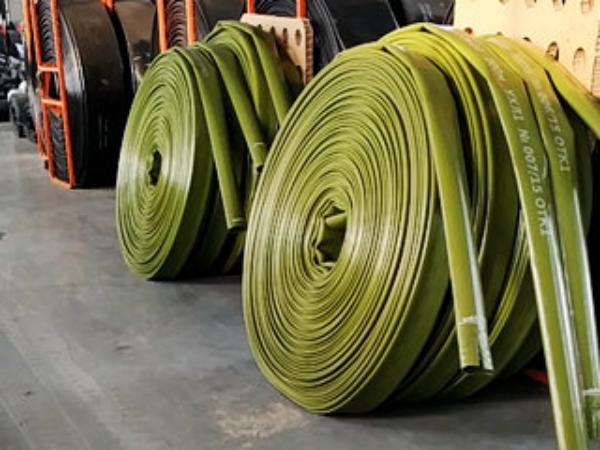
A structured maintenance regimen can prevent the vast majority of these failures.
| Maintenance Task | Frequency | Objective |
|---|---|---|
| Visual Inspection | Per deployment | Detect early abrasion or "kinking" signs |
| Coupling Torque Check | Monthly | Ensure no movement or slow-leak weeping |
| Thorough Rinsing | After each use | Remove debris/chemicals to stop degradation |
| Cool-Storage Protocol | Post-operation | Prevent UV damage and material embrittlement |
Pro Tip: Always drain and coil the hose before storage. Trapped water—especially if it contains chemical contaminants or minerals—can accelerate internal liner degradation.
At Sunmoon Hose Manufacturing, we advocate for integrated systems. A hose is only as strong as its weakest connection. When you source the hose, couplings, and integrated reel systems from a single expert manufacturer, you ensure that component tolerances are perfectly matched, significantly reducing the risk of coupling-related failures and "bulging" issues.
Leak management for TPU layflat hoses is a disciplined process of identification, surgical repair, and proactive protection. By classifying failures into mechanical, vibrational, or installation-based categories, operators can implement lasting repairs rather than temporary "band-aids." Invest in proper routing, regular training for field crews on coupling installation, and a rigorous storage protocol to ensure your equipment remains operational for years.
Q1: Can I repair a TPU layflat hose with duct tape?
A: No. Duct tape lacks the structural integrity to withstand industrial pressures. Only use authorized field repair kits that include internal patches and high-tension reinforcement wraps.
Q2: What is the most common cause of "bulging" at the fitting?
A: Improper coupling installation, specifically failing to de-burr the metal fitting before inserting it into the hose, which slices the inner TPU lining and allows water to enter the reinforcement layer.
Q3: How do I know if my hose is "worn out"?
A: Look for signs such as significant thinning of the outer layer, deep lacerations that reveal the inner reinforcement textile, permanent kinking, or structural bulging that does not disappear after de-pressurization.
Q4: Should I use a "buffer loop" near the pump?
A: Absolutely. Incorporating a buffer loop or slack in the line near the pump helps decouple high-frequency vibrations from the hose length, drastically reducing abrasive wear.
Q5: How does UV exposure affect TPU hose longevity?
A: Prolonged UV exposure can cause TPU materials to become brittle and eventually crack. Always store hoses in shaded areas or within covered reel systems to protect the polymer matrix.
1. [AlienFrac: What is a Fracturing TPU Hose? The Ultimate Guide]
2. [AllHose: Understanding, Preventing, and Troubleshooting Hose Failures]
3. [Marshall Equipement: 10 Common Hydraulic Hose Failures & How to Solve Them]
4. [Midwest Hose: Preparing Layflat Hoses for Winter: Cold-Weather Storage]
5. [OrientFlex: The safe use of petrochemical dock oil hose]
6. [Penflex: Hose Handling Guide - Installation Recommendations]
7. [StrongFlex: How to prevent hydraulic hose burst? 6 key points]
8. [SunHose: TPU Hose Guide: Benefits, Applications & Selection Tips 2025]


