

Views: 222 Author: Sunmoon Publish Time: 2026-05-20 Origin: Site


High-altitude mining operations on steep slopes face unique pressure surge challenges in their dewatering systems, and choosing and operating the right dewatering hose is critical for safety, uptime, and total cost of ownership. Drawing on field experience with layflat hoses in mountainous pits and insights from dewatering and hose-engineering literature, this guide explains how to manage pressure surges effectively and how a specialized Chinese manufacturer like Sunmoon can help you engineer a robust solution. [highermaterials]
High-altitude, steep-slope mines must move large volumes of water vertically and over long distances, which amplifies static head, friction losses, and transient pressure waves. These factors make pressure surges—also called water hammer—a top reliability and safety concern for dewatering hoses and connected equipment. As a manufacturer of TPU and rubber dewatering hose and other layflat hoses, Sunmoon has seen that most failures in these environments are not due to average pressure, but to short, intense spikes caused by fast valve operations, pump trips, or sudden changes in flow. [slideshare]
From an operator's perspective, the real problem is not just a burst hose; it is unplanned downtime, flooded benches, equipment loss, and safety incidents that follow a surge-induced failure. This article offers a practical, engineering-driven approach to designing, selecting, and operating steep slope dewatering systems that can survive those spikes—while remaining flexible, easy to deploy, and cost-effective. [beaverprocess.com]
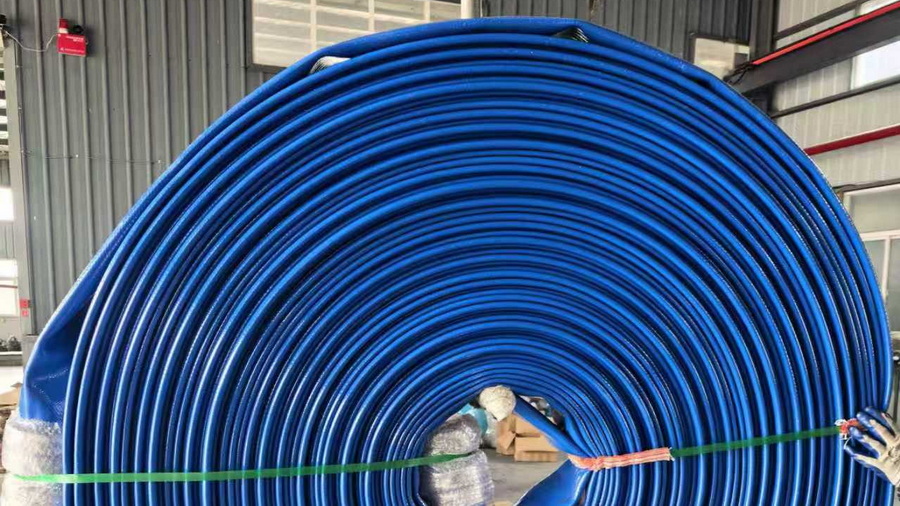
In a typical open-pit or underground mine, dewatering relies on submersible pumps, wellpoints, or sumps connected via layflat hoses to discharge water away from the working face. On steep slopes at high altitude, three factors combine to make this much more demanding: [imwa]
- High static head from long vertical drops
- Dynamic surges from pump start/stop and valve operations
- Harsh terrain that abrades and pinches hoses on rock edges and bench transitions [hoseflex]
From an EHS and reliability standpoint, a sudden surge can rupture a hose near a vertical drop, dumping water back into haul roads or active benches, with knock-on effects for traffic, slope stability, and productivity. That is why high-altitude mines increasingly specify high-pressure layflat dewatering hose with carefully engineered working and burst pressure ratings instead of generic industrial hose. [jafirehose]
In steep-slope dewatering, static head from elevation difference sets the baseline pressure in the hose string, while friction from long runs and fittings adds further loss. On top of that, pressure surges appear as short-lived peaks when the flow changes rapidly, for example when: [slideshare]
- A pump trips or restarts
- A check valve slams shut
- A control valve closes too quickly
- A section of hose suddenly collapses and re-opens [linkedin]
These surges can easily exceed 2–3 times the normal working pressure and are the hidden reason why hoses that look "oversized on paper" still fail in the field. [hoseflex]
High-altitude conditions also affect pump and system behavior. Lower air density impacts air release, priming, and the behavior of compressible pockets trapped in the system. Those air pockets can amplify or damp pressure surges depending on where they sit, making system behavior less predictable unless the layout is carefully engineered and deaeration is taken seriously. [imwa]
Based on real-world mine case studies, typical risk patterns include: [highermaterials]
- Vertical drops with underspecified hose rating
Static head plus surge exceeds hose working pressure, leading to longitudinal splits or burst at couplings.
- Abrasion on sharp rock outcrops
Pressure spikes occur just as the hose flexes over a rock edge, where wall thickness is effectively reduced.
- Kinked or pinched hose sections
Kinks on bends cause local pressure increases and rapid fatigue when pumps cycle.
- Poor end connections and clamps
Inadequate fittings fail during transient spikes, causing leaks and blow-offs.
In one gold mine dewatering program, switching from standard industrial hose to abrasion-resistant mining hose increased service life from a few months to several years by combining higher pressure rating with tougher outer layers and improved end connections. This illustrates that surge management is as much about hose construction and layout as it is about pump control. [beaverprocess.com]
From a practical engineering perspective, managing pressure surges in steep slope dewatering involves a structured design process:
1. Define elevation profile and routing
- Map all vertical rises and drops, bench transitions, and likely kink points along the slope.
- Identify sections where hose is exposed to rocks, haul roads, or machinery traffic. [jafirehose]
2. Calculate static and dynamic pressures
- Estimate maximum static head between pump and discharge.
- Add friction loss for the full hose length and fittings.
- Consider likely surge factors based on pump type and control philosophy. [linkedin]
3. Select hose with adequate safety margin
- Choose working pressure comfortably above maximum expected operating pressure plus surge allowance.
- Verify burst pressure is at least 2–3 times the working pressure for mining duty. [highermaterials]
4. Engineer connections and supports
- Use compatible couplings and flanges with appropriate torque and anchoring.
- Support hose at bends and transitions with saddles, rollers, or protective sleeves where possible. [beaverprocess.com]
5. Implement surge-control and operating procedures
- Configure soft-start and controlled stop on pumps.
- Specify minimum valve closure times.
- Train operators on start-up and shutdown sequences to avoid "slam" events. [slideshare]
Modern TPU layflat dewatering hose is widely used in mining because it offers high abrasion resistance, flexibility in cold conditions, and good pressure capacity relative to weight. For ultra-demanding steep-slope applications, reinforcement with high-tensile fibers (including aramid in some designs) improves collapse resistance and surge tolerance while keeping the hose lightweight for manual handling. [m.made-in-china]
From an expert's standpoint, a good rule of thumb is to treat surge-heavy steep-slope lines as high-pressure mining hose applications, even if average pressures look moderate on paper. [hoseflex]
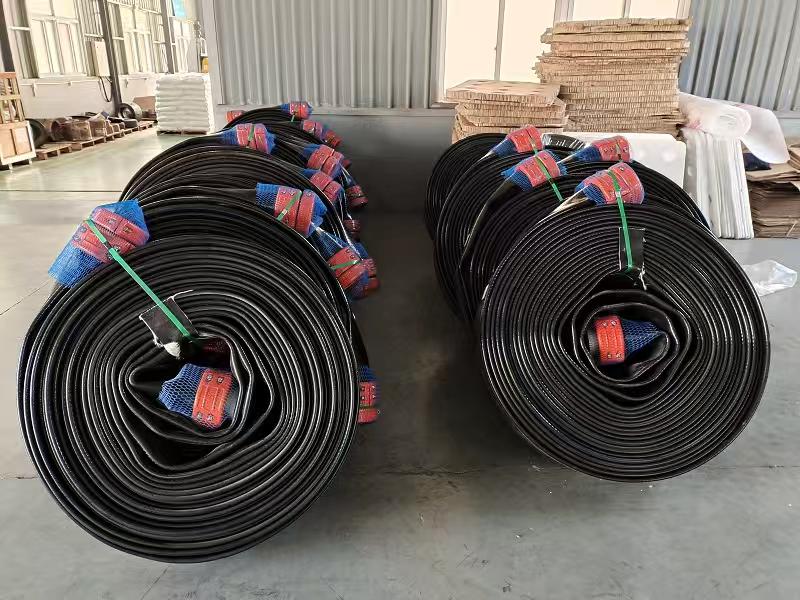
Sunmoon (Jiangsu Sunmoon Shale Gas High Pressure Hose Co., Ltd.) is a Chinese manufacturer focused on TPU and rubber high-pressure layflat hoses for mining, shale gas, water discharge, flood control, and industrial applications. The company integrates R&D, production, and sales, with a product range that includes high-pressure TPU hoses and aramid-reinforced layflat hoses designed for harsh, high-pressure environments. [m.made-in-china]
This mix of materials, reinforcement options, and in-house engineering allows Sunmoon to customize hose diameter, wall thickness, textile reinforcement, and working pressure rating to match the actual head and surge profile of a steep-slope dewatering system. Rather than offering a one-size-fits-all hose, Sunmoon can work backwards from the mine's elevation profile and pump duty to specify an optimized hose construction. [m.made-in-china]
From a steep-slope dewatering perspective, the most valuable customization levers include: [jafirehose]
- Working and burst pressure rating tailored to static head plus surge margin
- Reinforcement design (e.g., high-tenacity or aramid fibers) to improve surge tolerance
- Outer cover hardness and abrasion resistance for contact with rock faces and haul roads
- Temperature and chemical resistance for cold, high-altitude climates or process-contaminated water
- Length and coupling configuration to reduce connection points along the slope
By combining these parameters, Sunmoon can help mine operators build a hose string that is both surge-resistant and easy to deploy, improving uptime and lowering replacement frequency.
Industry case studies show that upgrading dewatering hose specification and layout can dramatically extend hose life and reduce maintenance load. For example, one open-pit operation that had been experiencing hose splits every few months switched to a mining-grade hose with a tougher outer layer and improved end connections, achieving service lives of several years and significantly reduced downtime. [beaverprocess.com]
Similarly, high-pressure dewatering hose specialists report that mining hoses engineered for higher working and burst pressure reduce the risk of catastrophic burst and sudden pressure release, helping mines avoid flooding and safety incidents. When combined with better pump control and inspection routines, these upgrades translate into fewer unplanned shutdowns and lower total cost of ownership—a particularly important outcome where access is difficult and weather windows are short in high-altitude environments. [hoseflex]
From a user-experience standpoint, crews need clear, simple routines, not abstract hydraulic theory. The following daily checklist is effective in steep-slope mining dewatering:
1. Visual hose inspection before start-up
- Look for kinks, pinches, obvious abrasion points, and exposed hose on sharp edges.
- Check end connections, clamps, and flanges for leaks or damage. [jafirehose]
2. Controlled start-up sequence
- Start pumps with valves partially open to avoid rapid acceleration of water.
- Use soft starters or variable speed drives where available to ramp speed gradually. [linkedin]
3. Avoid sudden valve movements
- Instruct operators to open and close valves slowly, especially near vertical drops.
- Establish minimum closure times for critical valves and include them in SOPs. [slideshare]
4. Monitor pressure and flow changes
- Watch for unusual pressure fluctuations or hose movement during operation.
- Investigate and correct recurring surge events, rather than just restarting equipment. [linkedin]
5. Controlled shutdown
- Reduce pump speed gradually before stopping where possible.
- Avoid shutting valves at the same time as pump trip to minimize compounded surges. [slideshare]
These practices require minimal investment but significantly reduce the risk of surge failures, especially when combined with correctly rated, mining-grade layflat hoses.
Advanced mining operations are experimenting with sensor-equipped hoses and real-time monitoring to better understand and manage pressure spikes. By measuring pressure pulsation, temperature, and strain along key hose sections, operators can identify surge hotspots and adjust pump control logic or hose routing to reduce stress before failures occur. [linkedin]
Data-driven approaches have demonstrated substantial gains in hydraulic and hose reliability in other mine systems, including reductions of unscheduled downtime by more than half when predictive maintenance replaces fixed-interval replacement. While not yet standard for all dewatering lines, integrating pressure data into dewatering design is a logical next step for high-altitude mines where access is difficult and failure costs are high. [linkedin]
The table below summarizes key criteria when evaluating dewatering hoses for steep-slope, high-altitude mining applications.
| Selection factor | What to look for | Why it matters for surges and steep slopes |
|---|---|---|
| Working pressure rating | Higher than maximum static head plus expected surge allowance highermaterials | Ensures hose can safely accommodate normal operating pressure with margin for transients |
| Burst pressure rating | Typically 2–3× working pressure for mining-grade hoses highermaterials | Reduces risk of catastrophic failure if unexpected spikes occur |
| Material and reinforcement | TPU or rubber with high-tenacity or aramid reinforcement for demanding slopes m.made-in-china | Balances flexibility with strength and surge tolerance |
| Abrasion resistance | Tough outer cover optimized for rock contact and dragging beaverprocess.com | Prevents wall thinning that would otherwise become weak points under pressure spikes |
| Flexibility and kink resistance | Designed for tight bend radii and repeated flexing on benches highermaterials | Minimizes local stress concentrations and surge amplification at kinks |
| Temperature and environment | Rated for low temperatures and UV exposure at altitude m.made-in-china | Maintains mechanical properties in harsh climates |
| Customization and OEM support | Ability to tailor ratings, reinforcement, lengths, and couplings m.made-in-china | Aligns hose design with actual mine-specific surge and layout conditions |
For Sunmoon's customers, these criteria guide the choice between standard TPU layflat models and custom heavy-duty, high-pressure mining variants intended specifically for steep-slope dewatering.
From my experience supporting mine dewatering projects, the most successful sites treat hoses as critical infrastructure, not consumables. Sunmoon's role is to help you:
- Translate elevation, pump, and flow requirements into the right hose rating and reinforcement.
- Customize lengths and coupling configurations to reduce surge-prone joints and simplify deployment.
- Provide technical documentation and guidelines for installation, operation, and inspection.
By combining properly engineered dewatering hoses with disciplined operating practices, high-altitude mines can significantly reduce the risk of pressure-surge failures, improve safety, and keep production on track in steep, challenging terrain. [highermaterials]
If you are planning or upgrading a steep-slope dewatering line, contact Sunmoon's engineering team to review your elevation profile and pump data so we can recommend a tailored high-pressure dewatering hose solution for your site.
Q1: What is the main cause of pressure surges in steep-slope dewatering systems?
A1: The main causes are rapid changes in flow or pump operation—such as sudden valve closure, pump trip, or quick start-up—which create transient pressure waves on top of static head. [hoseflex]
Q2: How do I know if my current dewatering hose is under-rated for my high-altitude mine?
A2: Warning signs include frequent hose bursts, leaks near couplings, visible kinks or flattening under load, and measured operating pressures close to the hose's rated working pressure. A detailed review of elevation, pump curves, and surge events is the best way to confirm. [beaverprocess.com]
Q3: Are TPU layflat hoses suitable for very steep slopes and high heads?
A3: Yes, when specified with appropriate wall thickness, reinforcement, and working/burst pressure, TPU layflat hoses are widely used in mining dewatering and can handle high heads and surges while remaining flexible and lightweight. [m.made-in-china]
Q4: What operational practices have the biggest impact on reducing surge damage?
A4: Gradual pump start/stop, slow valve operations, avoiding kinks and sharp bends, and regular inspections for abrasion and damage make the biggest difference for controlling surge-related hose failures. [jafirehose]
Q5: How can Sunmoon customize hoses for my specific mine?
A5: Sunmoon can adjust working pressure rating, reinforcement structure, hose diameter and wall thickness, outer cover hardness, and length/coupling configurations based on your actual static head, surge expectations, and site conditions. [m.made-in-china]
1. Higher Materials – "Mining – HM Flex Mine High Pressure Hose for Dewatering Applications." [Link] [highermaterials]
2. Mine Dewatering Techniques – Groundwater Control Overview. [Link] [slideshare]
3. Beaver Process Equipment – "Newmont Gold Mine – Longer Lifespan Hoses for Dewatering Program." [Link] [beaverprocess.com]
4. Pacific Hoseflex – "The role of high-pressure hoses in safe dewatering on mine sites." [Link] [hoseflex]
5. Jiangsu Sunmoon Shale Gas High Pressure Hose Co., Ltd – Company Profile. [Link] [m.made-in-china]
6. Special Mining Outer Dewatering Hose – Selection, Maintenance, Applications. [Link] [jafirehose]
7. Andrew Cao – "Advanced Hydraulic Hose Solutions for Ultra-High Pressure Pulsation in Mining." [Link] [linkedin]


