

Views: 271 Author: Sunmoon Hose Manufacturing Publish Time: 2026-07-15 Origin: Site


Content Menu
● Why Leakage Points Are a Critical Issue in Fracturing Operations
● What Defines a Long Run Fracking Hose System?
● How Long Runs Reduce Leakage Points
>> 1. Fewer Connections, Lower Risk
>> 2. Improved Structural Integrity
>> 3. Reduced Mechanical Stress Concentration
>> 4. Faster Deployment, Less Handling Damage
● Engineering Perspective: Material and Design Innovations
● Field Case Insight: Reducing Downtime in Permian Basin Operations
● Installation Best Practices for Long Run Hose Systems
>> 1. Pre-Deployment Inspection
>> 3. Secure Coupling Techniques
● Integrated Systems: Hose, Couplings, and Reels
● Environmental and Regulatory Implications
● Cost-Benefit Analysis: Are Long Runs Worth It?
● Emerging Trends in Frac Water Transfer Hose Technology
● Why Manufacturing Capability Matters
● Final Thoughts: Efficiency Through Simplicity
In modern hydraulic fracturing operations, long run fracking hoses—especially high-performance frac water transfer hoses—have become essential for reducing leakage risks, improving flow efficiency, and lowering operational costs. From shale basins in North America to remote oilfields in the Middle East, operators increasingly rely on engineered layflat hose systems to transport large volumes of water over extended distances with minimal failure points.
Drawing from field experience, engineering insights, and industrial feedback, this article explores how long-run hose systems optimize fluid transfer while minimizing leakage, and why manufacturers like Sunmoon Hose Manufacturing are redefining reliability standards in this segment.
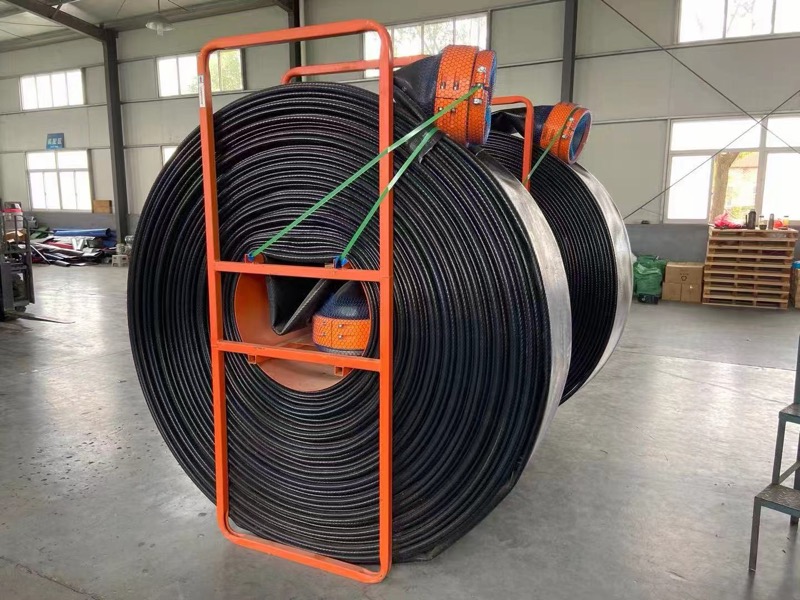
Leakage in fracking operations is not just a maintenance concern—it directly impacts operational efficiency, environmental compliance, and safety performance.
Each connection point in a traditional pipeline or short-hose system represents a potential failure zone. These risks typically arise from:
- Improper coupling installation
- Pressure fluctuations causing seal fatigue
- Abrasion and mechanical stress at joints
- Thermal expansion and contraction
Field engineers consistently report that connection points account for over 70% of fluid transfer failures in temporary water infrastructure systems. Reducing the number of these points is therefore a primary engineering goal.
A long run fracking hose system refers to the deployment of extended-length layflat hoses—often exceeding 200 meters per segment—designed to reduce the need for multiple couplings.
Key characteristics include:
- High tensile strength reinforcement layers
- Abrasion-resistant outer jackets
- Low friction inner linings for high flow rates
- Integrated or factory-tested coupling systems
Compared to rigid pipelines or short hose assemblies, long-run systems are more adaptable to uneven terrain and faster to deploy.
The most direct advantage is simple: fewer joints mean fewer opportunities for leaks.
Example comparison:
- Traditional setup: 1 km requires ~20 segments (50 m each) → 19 connection points
- Long-run setup: 1 km requires ~5 segments (200 m each) → 4 connection points
This represents nearly an 80% reduction in potential leak sources.
Long hoses are manufactured under controlled conditions with uniform wall thickness and consistent reinforcement, which enhances durability compared to field-assembled systems.
Each coupling introduces a discontinuity in the system. Long runs:
- Distribute pressure more evenly
- Minimize vibration-induced wear
- Reduce bending stress at joints
Fewer segments mean:
- Reduced installation time
- Less handling and dragging
- Lower risk of accidental damage during setup
Modern frac water transfer hoses are not just longer—they are smarter in design.
- Thermoplastic polyurethane (TPU): Exceptional abrasion resistance and flexibility
- Nitrile rubber blends: Enhanced oil and chemical resistance
- High-tenacity polyester yarns: Provide structural reinforcement
- Circular woven jackets for pressure stability
- Multi-layer extrusion for improved sealing
- Anti-kinking design for consistent flow
Manufacturers like Sunmoon Hose Manufacturing leverage automated production lines to ensure consistency across long hose segments, reducing variability that often leads to failure.
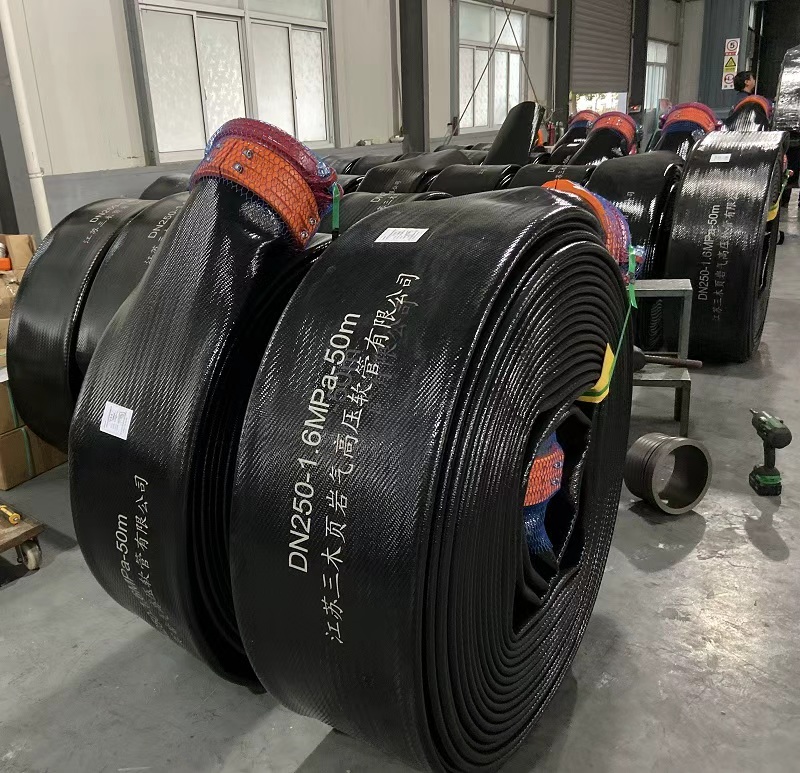
A mid-sized oilfield service provider in the Permian Basin transitioned from short hose segments to long-run layflat hoses for water transfer.
Results observed over a 6-month period:
- Leak incidents reduced by 65%
- Setup time decreased by 40%
- Maintenance costs dropped by 30%
- Improved compliance with environmental safety standards
Operators noted that the biggest advantage was not just fewer leaks, but predictable system performance under high pressure conditions.
Even the best hose design requires proper handling. Based on field experience, the following practices significantly enhance performance:
- Check for visible abrasions or cuts
- Verify coupling integrity
- Confirm pressure rating compatibility
- Avoid sharp bends and elevation extremes
- Use protective mats in high-friction zones
- Maintain gradual directional changes
- Use torque-controlled tightening
- Ensure gasket alignment
- Conduct pressure testing before operation
- Gradually ramp up pressure
- Avoid sudden surges
- Monitor flow rates continuously
One of the most overlooked aspects of leakage prevention is system integration.
Instead of sourcing hoses, couplings, and reels separately, leading operators now prefer integrated solutions, which offer:
- Factory-tested compatibility
- Reduced installation errors
- Faster deployment cycles
- Improved lifecycle management
Sunmoon Hose Manufacturing provides custom-engineered packages, combining:
- Long-run frac water transfer hoses
- High-performance couplings
- Automated hose reels
This integrated approach ensures that all components function as a unified system, minimizing mismatch-related failures.
Leakage is not just an operational issue—it carries significant environmental consequences.
- Groundwater contamination
- Soil degradation
- Regulatory penalties
- Project shutdown risks
Long-run hose systems help operators meet stricter environmental standards by:
- Reducing spill probability
- Improving containment reliability
- Supporting rapid response in case of failure
While long-run hoses may have a higher upfront cost, the total lifecycle value is significantly better.
- Initial investment: Higher
- Installation cost: Lower
- Maintenance cost: Significantly lower
- Downtime losses: Reduced
- Replacement frequency: Lower
In most large-scale operations, return on investment is achieved within one operational cycle.
The industry is evolving rapidly, with innovations focused on efficiency, monitoring, and sustainability.
- Smart hoses with embedded pressure sensors
- Lightweight composite materials for easier handling
- Enhanced UV and chemical resistance for extreme environments
- Modular quick-connect systems
These advancements further reinforce the value of long-run systems in modern operations.
The reliability of long-run hoses depends heavily on manufacturing precision and quality control.
Sunmoon Hose Manufacturing operates:
- A 35,000 m² production facility
- 8 automated production lines ensuring consistency
- A team of 80 technical specialists focused on design and testing
This scale allows for:
- Customization based on project requirements
- Strict quality assurance protocols
- Scalable production for global supply
At its core, the shift toward long-run fracking hoses reflects a simple engineering principle: reduce complexity to improve reliability.
By minimizing connection points, enhancing material performance, and integrating system components, operators can achieve:
- Higher efficiency
- Lower risk
- Better environmental outcomes
For companies managing large-scale fluid transfer operations, long-run hose systems are no longer optional—they are becoming the industry standard.
1. What is the typical length of a long-run fracking hose?
Long-run hoses typically range from 150 to 300 meters per segment, depending on application requirements and terrain conditions.
2. How do long-run hoses compare to steel pipelines?
They are more flexible, faster to deploy, and require fewer connections, though pipelines may offer longer-term durability in fixed installations.
3. Are long-run hoses suitable for harsh environments?
Yes, especially those made with TPU or reinforced rubber materials designed for abrasion, UV exposure, and chemical resistance.
4. How often should frac water transfer hoses be inspected?
Inspection is recommended before each deployment and periodically during operation, especially under high-pressure conditions.
5. Can these hoses be customized for specific projects?
Yes, manufacturers offer customization in length, diameter, pressure rating, and coupling types to match project needs.


