

Views: 268 Author: Sunmoon Hose Manufacturing Publish Time: 2026-07-16 Origin: Site


Content Menu
● Understanding Oilfield Hose Requirements
● What Is High-Pressure Polyurethane Layflat Hose?
● What Are Flexible Rubber Pipes for Oilfields?
● Mechanical Performance: Pressure, Strength and Durability
>> Abrasion and Chemical Resistance
● Flexibility, Handling and Deployment in the Field
>> TPU Layflat Hose Handling Advantages
>> Flexible Rubber Pipes Handling Characteristics
● Temperature and Environmental Performance
● Safety Considerations: Static, Leakage and Field Repairs
>> Static and Electrical Grounding
● Application Profiles in Oilfields
>> High-Pressure Polyurethane Layflat Hose Applications
>> Flexible Rubber Pipes Applications
● Market and Cost Considerations
● How Sunmoon Hose Manufacturing Fits Into This Landscape
● FAQs
High-pressure polyurethane hose and flexible rubber pipes may look similar on the surface, but they perform very differently in modern oilfield operations, especially for long-distance fluid transfer, high-pressure pumping and mobile field deployments. From an engineering and field-operations perspective, choosing between these two options can make the difference between stable production and chronic maintenance issues. [hoseinc]
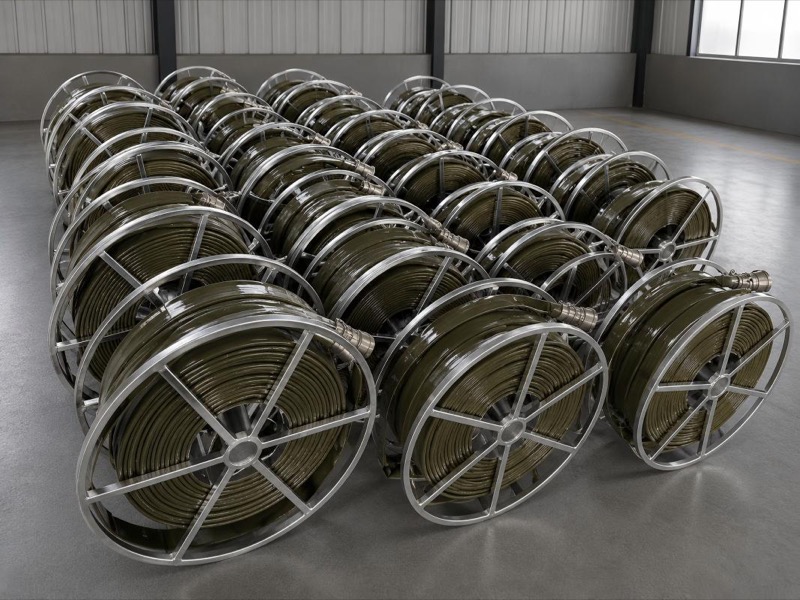
Oilfield environments demand hose systems that can handle high pressure, abrasive media, aggressive chemicals and rapid deployment across difficult terrain. At the same time, operators increasingly expect flexible pipelines that support fast setup, relocation and large-volume transfer for fracturing water, drilling fluids, fuel and produced water. [pmeindustrial]
For a manufacturer like Sunmoon Hose Manufacturing, which focuses on TPU layflat hose and integrated couplings and reels, the core design goal is to provide engineering-grade flat hoses that align with these demanding conditions across oil, gas, mining, construction and agriculture. [biaohuihose]
High-pressure polyurethane layflat hose is an extruded thermoplastic hose, usually based on polyether TPU, reinforced with circular woven polyester filaments and manufactured using an "extrusion-through-the-weave" process. This creates a single homogeneous structure with the cover and lining encapsulating the reinforcement, drastically improving bonding strength and resistance to delamination. [somaxflex]
Modern TPU layflat hoses for oil and gas are engineered for:
- Working pressures up to several hundred psi for fracking water transfer and mine dewatering. [mastertubi]
- Long, continuous lengths (typically 100–200 m per section and longer on request) that can be coiled on reels and deployed rapidly. [hoseinc]
- Abrasion, chemical and UV resistance sufficient for offshore fuel transfer, brackish water, hydrocarbons and aggressive slurries. [mastertubi]
These properties make high-pressure polyurethane layflat hose an ideal flexible pipeline solution rather than just a traditional "hose" for short-distance connections. [pmeindustrial]
Flexible rubber pipes for oilfields typically use synthetic rubber compounds with textile or steel reinforcement, designed for drilling mud circulation, fuel transfer, well-service operations and multipurpose utility lines. They are widely used in: [biaohuihose]
- Short to medium-length connections between pumps, manifolds and rigs.
- General-purpose fluid transfer where moderate flexibility and conventional coupling systems are sufficient. [biaohuihose]
Rubber hoses can be highly robust, but they are often heavier, less compact when stored, and more challenging to handle over very long distances compared with layflat polyurethane pipeline solutions. [hoseinc]
From a mechanical standpoint, both high-pressure TPU layflat hose and flexible rubber pipes can achieve high working pressures, but they do so with very different weight and handling characteristics. [pmeindustrial]
Typical offshore-grade TPU flat hoses for hydrocarbons show:
- Oil pressure ratings around 11–20 bar, other fluids up to 40 bar. [mastertubi]
- Burst pressures up to 80 bar depending on diameter, with tensile strengths reaching 35 kg for large bore hoses. [mastertubi]
Heavy-duty fracking TPU layflat products commonly operate at working pressures up to roughly 610 psi, engineered for aggressive water pumping and mine dewatering. Flexible rubber pipes used in similar applications can reach comparable pressure ranges, but often at higher wall thickness and weight. [pmeindustrial]
Thermoplastic polyurethane is widely regarded as one of the most abrasion-resistant elastomeric materials, making layflat hoses suitable for highly abrasive surfaces, mining drainage and harsh offshore environments. TPU layflat hose maintains performance when exposed to: [biaohuihose]
- Seawater, brine and contaminated industrial liquids.
- Many hydrocarbons, oils, greases and chemicals across pH 3–10. [pmeindustrial]
Rubber hoses can also provide strong chemical resistance, especially specialty compounds, but they are more prone to external abrasion damage and scaling/corrosion in certain environments compared with homogeneous TPU layflat constructions. [mastertubi]
One of the biggest practical differences in oilfields is how these hose systems are deployed, retrieved and moved.
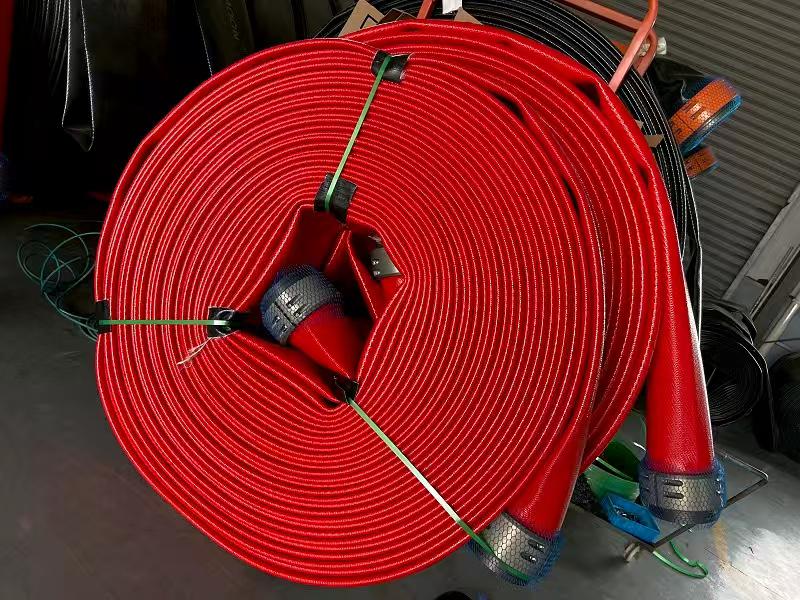
High-pressure TPU layflat hose is totally flat when depressurized, which enables:
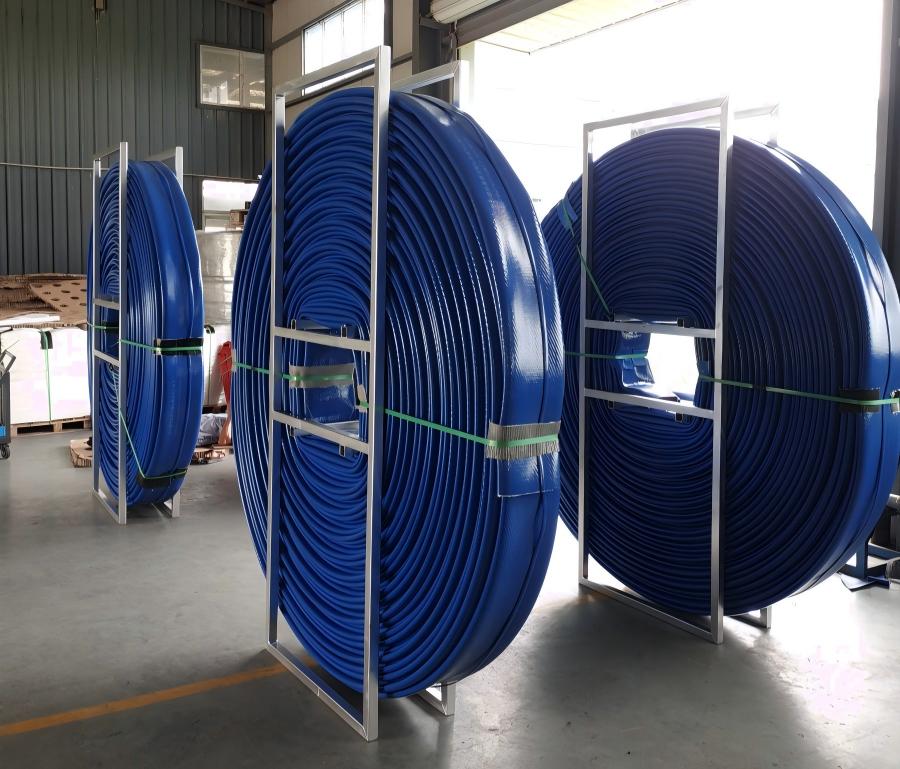
- Rapid layout and retrieval—in some water transfer setups, operators can deploy or recover up to a mile of layflat hose in around 30 minutes using reel systems. [hoseinc]
- Compact storage and transport, with long continuous sections coiled onto reels that fit on trucks or trailers. [hoseinc]
- Easy relocation of pumps and equipment, especially in fracking sites and mine dewatering where routes change frequently. [pmeindustrial]
Because the hose is lightweight and flat, field teams can reconfigure pipelines in hours rather than days, significantly improving operational flexibility. [hoseinc]
Flexible rubber pipes:
- Maintain a round cross-section even when empty, making them bulkier to coil and store.
- Are generally heavier per meter, particularly with steel reinforcement, which increases manual handling demands and transport costs. [biaohuihose]
- Are more suitable for fixed or semi-fixed connections, rather than rapid long-distance deployment and recovery.
For large-volume, long-distance water or hydrocarbon transfer, rubber systems often require more joints, more supports and more time to assemble compared to continuous TPU layflat lines on reels. [hoseinc]
 x
x
Operating temperature ranges and environmental exposure are key factors in oilfields, especially offshore and desert environments.
High-performance TPU layflat hoses typically operate from about -40 °C to 70 °C, with certain offshore-grade hoses rated from -50 °C to 65 °C, with peaks up to 80 °C. TPU maintains: [ly-plastic]
- Excellent resistance to atmospheric agents and UV radiation, with no visible ozone cracking. [mastertubi]
- Stable performance under seawater, brackish water and a wide range of chemicals and hydrocarbons. [mastertubi]
Conventional flexible rubber pipes can also cover wide temperature ranges, but rubber compounds are more susceptible to ozone, UV and aging, which may lead to cracking and hardening over long exposure periods. In offshore and desert operations, TPU layflat hose generally offers superior long-term environmental stability. [biaohuihose]
Safety in oilfield pipelines is closely connected to static electricity, leakage control and the ability to repair hoses on site.
Advanced offshore TPU flat hoses integrate encapsulated electrical ground wires within external straps, designed to prevent static electricity build-up during fuel and oil transfer. These ground wires are connected to conductive joints and properly grounded during operation, which helps reduce the risk of spark-related incidents in hydrocarbon handling. [mastertubi]
Rubber pipes usually rely on external grounding and anti-static compounds, which can be effective but may not offer the same fully integrated static-control design found in modern TPU layflat constructions. [mastertubi]
High-quality TPU layflat hoses are designed to be leak-proof and chemical-resistant, even with chemical-laden waters that other transfer systems struggle to handle. When accidental damage occurs: [hoseinc]
- Field crews can repair TPU layflat hose quickly using repair sleeves, restoring service without full section replacement. [hoseinc]
Rubber hoses can be repaired but often require:
- Cutting, coupling changes or more extensive intervention, especially if internal reinforcement is compromised. [biaohuihose]
For long-distance transfer lines where downtime is costly, fast layflat hose repair is a significant operational advantage. [pmeindustrial]
Both hose types have clear niches in oilfield operations.
High-pressure TPU layflat hose is widely used for:
- Fracturing water supply and pit-to-pit water transfer during shale oil and gas extraction. [ly-plastic]
- Mine dewatering and aggressive water pumping around drill sites and pit walls. [pmeindustrial]
- Ship-to-shore fuel transfer, offshore bunkering and bulk fuel unloading/loading, using specialized offshore flat TPU hoses. [mastertubi]
Manufacturers like Sunmoon Hose Manufacturing design engineering-grade layflat hose systems with integrated couplings and reels to support these applications in oilfields worldwide. [sunmoonhose]
Flexible rubber pipes remain common in:
- Short-run connections between pumps, separators and storage tanks.
- Drilling fluid circulation and well-service lines that require heavy-duty rubber compounds.
- Utility and auxiliary lines where high flexibility over short distances matters more than rapid long-distance deployment. [biaohuihose]
In many projects, the most efficient design uses TPU layflat hose as the backbone for long-distance, high-volume transfer, complemented by rubber hoses for local connections.
Industry data indicates that TPU layflat hose for oil transfer is a rapidly growing market. One forecast places the market value around USD 614.87 million in 2025, growing to USD 653.70 million in 2026 at about 6.18% CAGR, with projections to USD 935.68 million by 2032. Another analysis highlights a broader TPU layflat hose space reaching USD 8.89 billion by 2025 with a 13.72% CAGR driven by oil transfer and related applications. [giiresearch]
This growth reflects several trends:
- Migration away from rigid and semi-rigid piping toward flexible, layflat pipeline systems for dynamic oilfield layouts. [datainsightsreports]
- Increasing need for fast deployment, reduced manpower and lower life-cycle costs, especially in large-scale water and hydrocarbon transfer. [pmeindustrial]
While initial unit pricing for high-pressure TPU layflat hose can be higher than some rubber alternatives, total cost of ownership often decreases due to:
- Reduced installation time and labor.
- Longer service life in abrasive, UV-intensive and chemically aggressive environments.
- Lower transport and storage costs thanks to compact reels. [hoseinc]
From a field-engineer and operations-planning perspective, the decision between high-pressure polyurethane layflat hose and flexible rubber pipes for oilfields typically comes down to three practical questions:
1. Distance and volume: For long-distance, high-volume transfer (fracturing water, produced water, fuel lines), TPU layflat hose offers clear advantages in speed and efficiency. [pmeindustrial]
2. Mobility and layout changes: In mines, fracking pads and evolving well patterns, where pumps and lines move constantly, layflat systems on reels outperform rubber pipes in reconfiguration and redeployment. [pmeindustrial]
3. Local connections and specialty drilling services: For short, complex connections near equipment, flexible rubber pipes often remain the preferred choice due to established standards and compatibility with existing fittings. [biaohuihose]
For oilfield operators looking to modernize their fluid-transfer infrastructure, a hybrid approach—TPU layflat for trunk lines, rubber hoses for critical short connections—often delivers the best performance balance.
Sunmoon Hose Manufacturing operates a 35,000 m² production base in China, equipped with eight standardized automated production lines and a team of around 80 technical specialists, focusing on engineering-grade flat hose manufacturing. The company provides: [sunmoonhose]
- Customized TPU layflat hose solutions for oil, gas, agriculture and construction.
- Integrated hose, coupling and reel systems, designed for global customers requiring high-performance flexible pipelines. [sunmoonhose]
This positioning allows Sunmoon to support oilfield clients transitioning from traditional rubber-based networks to high-pressure polyurethane layflat pipelines, backed by manufacturing capacity and customization capabilities.
| Aspect | High-Pressure Polyurethane Layflat Hose | Flexible Rubber Pipes for Oilfields |
|---|---|---|
| Structure | Extruded TPU with woven polyester reinforcement, homogeneous through-the-weave construction (somaxflex) | Rubber compounds with textile/steel reinforcement, layered construction (biaohuihose) |
| Form | Totally layflat when depressurized, coiled on reels (hoseinc) | Round, bulky even when empty, coiled in shorter lengths (mastertubi) |
| Pressure | High working and burst pressures (up to ~80 bar in offshore designs) (mastertubi) | High pressures possible, often with thicker walls and heavier reinforcement (mastertubi) |
| Abrasion & chemicals | Excellent abrasion resistance, strong chemical and hydrocarbon compatibility (mastertubi) | Good resistance depending on compound, more vulnerable to abrasion and scaling (mastertubi) |
| Deployment speed | Very fast layout and retrieval, up to a mile in ~30 minutes with reels (hoseinc) | Slower assembly, more joints and supports required (hoseinc) |
| Typical use | Long-distance water/fuel transfer, fracking, mine dewatering, offshore bunkering (ly-plastic) | Short-run connections, drilling mud circulation, auxiliary utility lines (biaohuihose) |
| Environmental performance | Strong UV, ozone and seawater resistance, suitable from about -40 °C to 70 °C (ly-plastic) | Wider aging concerns under UV and ozone depending on rubber type (mastertubi) |
| Static control | Integrated grounding wires in certain offshore TPU flat designs (mastertubi) | External grounding and anti-static compounds, less integrated (mastertubi) |
Q1: Is high-pressure polyurethane layflat hose suitable for hydrocarbon transfer, or only for water?
Yes, many TPU layflat hoses are specifically engineered for fuel and oil transfer in offshore and refinery environments, with robust chemical resistance and integrated grounding wires. [mastertubi]
Q2: Can TPU layflat hose replace all flexible rubber pipes in oilfields?
Not in every case; TPU layflat hose excels in long-distance, high-volume transfer and dynamic layouts, while rubber hoses still play a role in short, complex connections and certain drilling services. [biaohuihose]
Q3: How does layflat hose perform in cold climates compared with rubber?
Offshore-grade TPU layflat hose operates effectively down to around -50 °C, maintaining flexibility and resistance to cracking, which offers an advantage over many rubber compounds. [mastertubi]
Q4: What happens if TPU layflat hose is damaged during operation?
Field teams can often repair TPU layflat hoses quickly using repair sleeves, restoring service without full replacement of long sections. [hoseinc]
Q5: Why is the TPU layflat hose market growing so quickly?
Market analyses point to strong demand in oil transfer, fracking and mining, driven by the need for flexible, high-pressure pipelines and faster deployment, supporting notable CAGR figures through 2032–2034. [giiresearch]


