

Views: 222 Author: Loretta Publish Time: 2026-01-21 Origin: Site


Content Menu
● Core Comparison: Silicone Hose vs Rubber Hose
>> Pressure and mechanical strength
>> Chemical and environmental resistance
● Material and Construction Insights
>> Structure and reinforcement
>> Color, branding, and identification
● Food-Grade, Medical, and Clean Applications
● Automotive: Silicone vs Rubber Hose in Vehicles
● Practical Identification: Silicone vs Rubber Hose
>> Quick identification methods
● How to Select the Right Hose for Your Application
>> 1. Define your operating environment
>> 2. Match material to the media
>> 3. Consider lifecycle cost and maintenance
● Silicone vs Rubber Hose: Comparison Table
● Where TPU Lay-Flat Hose Fits In
● Get Expert Help Choosing the Right Hose
● FAQs: Silicone Hose vs Rubber Hose
>> 1. Is silicone hose always better than rubber hose?
>> 2. Can silicone hose be used for fuel or oil?
>> 3. Why do performance vehicles use colored silicone hoses?
>> 4. When should TPU lay-flat hose be considered instead of rubber or silicone?
>> 5. How often should hoses be inspected and replaced?
Choosing between silicone hose and rubber hose is not about finding a universally “best” option, but about matching hose performance with your specific temperature, pressure, chemical, and cost requirements. When you under stand how these two materials behave in real-world conditions, you can make safer, more efficient, and more economical decisions for automotive, industrial, food-grade, and high-pressure systems.

Both silicone and rubber hoses are typically built as multi-layer structures (inner tube, reinforcement, outer cover), but they use fundamentally different base materials. Rubber hoses are made from natural or synthetic rubber compounds (such as EPDM, NBR), while silicone hoses use cross-linked silicone elastomers engineered for high heat and long-term stability.
Because of these material differences, their performance diverges in several key areas. Rubber hoses often excel in pressure handling and oil resistance, making them a strong choice for fuel, hydraulic, and many automotive systems, whereas silicone hoses dominate where extreme temperatures, long life, and clean, non-toxic media handling are critical.
- Silicone hoses typically operate from about -60 ℃ to +230 ℃, and premium formulations can tolerate short-term excursions even higher.
- Common rubber hoses (such as EPDM) usually work between around -40 ℃ and +120 ℃ before hardening, cracking, or losing strength.
This makes silicone hose the preferred solution for turbocharged engines, exhaust-adjacent coolant lines, and any system with repeated thermal cycles or heat spikes. Rubber remains adequate where temperatures stay moderate and stable, such as many standard coolant and low-stress industrial lines.
- Rubber hose, especially when reinforced, offers very good burst and working pressure capability and handles vibration and mechanical shock well.
- Silicone hose has excellent flexibility and resilience but generally requires careful reinforcement selection if used in very high-pressure hydraulic or oil circuits.
For systems that are pressure-driven (for example hydraulic circuits, fuel lines, high-pressure oil transfer), rubber often delivers a better safety margin per unit cost. For systems that are temperature- or vibration-driven, silicone's flexibility and thermal stability can increase reliability and reduce maintenance.
- Rubber compounds can be formulated for outstanding oil and fuel resistance, which is why they are widely used in fuel and hydraulic hoses.
- Silicone offers excellent chemical stability, resisting many corrosive media, and has superior resistance to ozone, UV, and weathering compared with many rubber types.
In outdoor or high-ozone environments, silicone hoses retain flexibility and appearance over long service lives, while certain rubber hoses may gradually crack, chalk, or degrade. For continuous contact with oils, fuels, or some solvents, a properly specified rubber hose usually performs better than standard silicone.
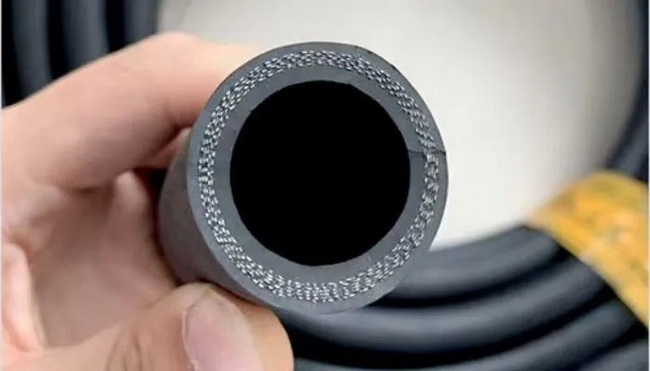
Most industrial silicone and rubber hoses share a three-layer structure: inner tube, reinforcement, outer cover. Reinforcement can be high-strength fabric (such as polyester or aramid) or steel wire in demanding pressure or vacuum applications.
- Silicone hoses often use multiple fabric layers to maintain shape under vacuum and high temperature while staying flexible.
- Rubber hoses leverage steel wire or robust fabric reinforcement to handle high static and dynamic pressures in hydraulic and fuel applications.
Understanding these layers helps engineers specify the right combination of material and reinforcement for conditions such as suction, pulsation, or external abrasion.
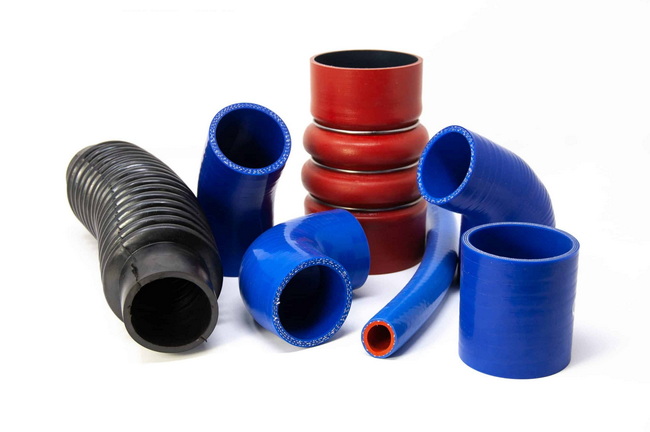
Silicone hoses are available in many bright colors (blue, red, green, and more), supporting visual line identification and branding. Rubber hoses are most commonly black, though custom colors are possible when working closely with a hose manufacturer.
Color-coding lines for coolant, air, fuel, and chemicals not only helps technicians during maintenance but also reduces operational errors in complex systems.
Silicone's non-toxic, odorless nature and high purity make it a leading option for food-grade and medical-grade hoses. When produced under appropriate standards, food-grade silicone hoses can safely transfer beverages, liquid foods, and sensitive pharmaceutical media without imparting taste or odor.
Rubber hoses can also be made to food-grade specifications, but they are more often used in industrial environments where trace odor or extractables are less critical. In cleanrooms, laboratories, and medical devices, silicone hoses are frequently selected because of their smooth, easily sanitized inner surfaces and stable performance under autoclave or sterilization cycles.
Silicone and rubber hoses both play critical roles in modern automotive systems, from the engine and chassis to various auxiliary circuits. Silicone hoses are widely used in engine bays for coolant, turbocharger connections, and vacuum lines because they can withstand high under-hood temperatures and repeated thermal cycling.
Rubber hoses (often rubber-plastic composites) remain dominant in fuel systems, brake systems, and many air-conditioning lines thanks to their pressure resistance and compatibility with oils and refrigerants. For example:
- Silicone hoses: engine coolant lines, turbocharger intercooler connections, vacuum hoses, and performance upgrades where long life and aesthetics matter.
- Rubber hoses: fuel lines, hydraulic brake hoses, standard heater hoses, and many OEM air-conditioning lines.
In performance and motorsport applications, upgrading to silicone coolant and boost hoses can reduce the risk of hose failures and improve long-term reliability.
Correctly identifying hose materials is essential for specifying replacements and planning upgrades. Several simple checks can distinguish silicone from rubber in the field.
- Smell: Silicone hose is typically odorless, while rubber hose often has a noticeable rubber or chemical smell.
- Flexibility: Silicone tends to feel more elastic and remains flexible over a wider temperature range, whereas some rubber hoses stiffen or harden with age.
- Burn test (controlled, small sample only): Silicone tends to produce white smoke and leaves a white ash, while rubber emits black smoke and leaves black residue.
These simple indicators provide a first pass, but for critical applications, material verification should include supplier documentation and, where needed, laboratory testing.
Choosing between silicone and rubber hoses should follow a structured evaluation of your operating conditions. The following step-by-step framework helps engineers and maintenance teams make more informed decisions.
- Temperature range: Identify minimum and maximum media and ambient temperatures.
- Pressure profile: Consider working pressure, peaks, and any pulsations.
- Media type: Water, oil, fuel, chemicals, food, or gases.
- Exposure conditions: UV, ozone, outdoor weather, mechanical abrasion.
Silicone is usually better for wide temperature ranges and UV exposure, while rubber is more often used with oils and fuels under high pressure.
- For oils, fuels, or many hydraulic fluids, properly formulated rubber compounds are usually recommended.
- For water, coolants, air, and many non-oily chemicals, silicone offers stable, long-term performance.
- For food, beverages, and pharmaceuticals, high-purity silicone is frequently the preferred option.
In mixed-media systems (for example coolant with additives or cleaning chemicals), consulting application data and supplier guidance is essential.
Although silicone hoses typically have a higher upfront cost than rubber hoses, their long service life can reduce total cost of ownership. Silicone's resistance to aging, UV, and heat means fewer replacements over the life of the asset, especially in harsh environments.
Rubber hoses may be more economical for shorter-life equipment or applications where periodic replacement is already part of standard maintenance. Deciding between them involves balancing budget, downtime tolerance, and safety margins.
Aspect | Silicone Hose | Rubber Hose |
Core material | Cross-linked silicone elastomer. | Natural or synthetic rubber compounds (for example EPDM, NBR). |
Typical temperature range | About -60 ℃ to +230 ℃ for common formulations. | About -40 ℃ to +120 ℃ for many standard grades. |
Pressure capability | Good, depends on reinforcement; less commonly used for very high-pressure oil. | Excellent in many hydraulic and fuel applications with proper reinforcement. |
Oil and fuel resistance | Limited with standard silicone; special blends needed for oils and fuels. | Strong with appropriate compounds; widely used for fuel and hydraulic lines. |
Flexibility over time | Maintains flexibility and resists hardening and cracking. | May stiffen, crack, or dry-rot with age, heat, and ozone. |
UV and ozone resistance | Excellent, ideal for outdoor exposure. | Variable; some rubbers degrade under UV and ozone. |
Food-grade and medical use | Non-toxic, odorless, widely used for food and medical hoses. | Available but less common than silicone in high-purity applications. |
Automotive applications | Coolant, turbo, intercooler, vacuum lines, performance upgrades. | Fuel lines, brake hoses, many OEM heater and A/C hoses. |
Color and aesthetics | Wide color range for branding and line coding. | Predominantly black, with limited custom colors. |
Upfront cost | Higher initial price, lower replacement frequency. | Lower upfront cost, potentially more frequent replacement. |
Beyond silicone and rubber, TPU lay-flat hose has become a strong alternative for demanding fluid transfer applications. Thermoplastic polyurethane (TPU) lay-flat hoses offer high abrasion resistance, excellent wear properties, and a lightweight structure thanks to thin TPU linings and strong circular-woven reinforcement.
Compared to traditional rubber lay-flat designs, TPU lay-flat hoses can reach higher burst pressures while weighing significantly less, which reduces handling effort and transport costs in the field. They are widely used in applications such as fracking water transfer, mine dewatering, agricultural irrigation, manure handling, and emergency water deployment, where long-distance, high-flow, and rapid deployment capabilities are crucial.
Selecting between silicone hose, rubber hose, and TPU lay-flat hose can be challenging when you are balancing temperature, pressure, media compatibility, and budget. To avoid costly trial and error, share your detailed operating conditions, including temperature range, working pressure, fluid type, and installation environment. A dedicated engineering team can then recommend a hose material, structure, and diameter tailored to your project, help you compare lifecycle costs, and provide custom solutions for demanding applications.
Contact us to get more information!
No. Silicone is better for extreme temperatures, long-term flexibility, and clean applications, while rubber is often better for high-pressure, oil-rich, and cost-sensitive environments. The “better” choice depends on your media, operating conditions, and lifecycle goals.
Standard silicone hose is not ideal for continuous fuel or oil exposure. Specialized fluorosilicone liners or alternative constructions are required for such media, and for many fuel systems, properly specified rubber hoses remain the safer and more economical choice.
Colored silicone hoses offer high temperature resistance, long service life, and a clean, customized look, while also simplifying visual identification of different circuits under the hood. This makes them popular in performance, motorsport, and show-car builds.
TPU lay-flat hoses are highly suitable for long-distance, high-flow transfer of water, slurry, or chemicals in applications like fracking, mine dewatering, and irrigation. They are especially valuable when lightweight handling, rapid deployment, and high abrasion resistance are critical.
Inspection intervals depend on pressure, temperature, and media, but hoses should be checked regularly for hardening, cracking, bulging, leakage, or damage at fittings. Proactive replacement before visible failure is essential to maintain system safety and minimize unplanned downtime.


