

Views: 227 Author: Sunmoon Publish Time: 2026-06-27 Origin: Site


Content Menu
● Understanding The Two Hose Types
● Material Science: TPU vs. Steel-Braided Rubber
● Static Control and Safety in Oil Transfer
● Layflat vs. Conventional Round Hose Deployment
● Mechanical Performance: Pressure, Flexibility, and Abrasion
● Lifetime Cost, Maintenance, and Downtime
● Real-World Use Cases: When Each Hose Wins
● Expert Insight: Selecting the Right Hose for Global Projects
● Sunmoon's Customized TPU Anti-Static Oil Hose Solutions
● Comparison Table: TPU Anti-Static Oil Hose vs. Steel-Braided Rubber Hose
● Practical Selection Checklist for Buyers
● CTA: Partner with Sunmoon for Engineered TPU Layflat Hose Systems
● FAQs
As a hose OEM content strategist working closely with oil & gas, mining, and industrial projects, I've seen both TPU anti-static oil hoses and steel-braided rubber hoses perform extremely well—but in very different scenarios. In this guide, I'll compare them from a practical field and engineering perspective, and show where Sunmoon's customized TPU layflat solutions can give you a measurable edge in safety, lifetime cost, and deployment efficiency. [china-layflat-hose]

TPU anti-static oil hose is a thermoplastic polyurethane layflat hose engineered for the transfer of oils, fuels, and chemicals, often with built‑in anti-static properties and high abrasion resistance. It is typically lightweight, flexible, and designed for long-distance, high‑volume surface transfer. [sunmoonhose]
Steel-braided rubber hose is a traditional cylindrical hose using synthetic rubber as the inner tube and steel wire braiding as reinforcement, especially common in high‑pressure hydraulic and short‑run oil transfer applications. It offers excellent burst resistance and point-load strength but comes with higher weight and more complex deployment on long runs. [china-layflat-hose]
From an engineering standpoint, the core difference starts at the material level. [sunmoonhose]
- TPU Anti-Static Oil Hose
- Made from high-performance TPU with strong adhesion to woven reinforcement. [china-layflat-hose]
- Offers excellent abrasion resistance, low elongation, and good resistance to oils and many chemicals. [sunmoonhose]
- Anti-static formulations help dissipate electrostatic charge in fuel and hydrocarbon transfer. [alibaba]
- Steel-Braided Rubber Hose
- Uses synthetic rubber (e.g., NBR or other elastomers) with steel wire braiding as reinforcement. [china-layflat-hose]
- Outstanding tensile and burst strength at short lengths, but higher weight and stiffness. [china-layflat-hose]
- Rubber compounds can be tailored for oil resistance but are more prone to aging, cracking, and ozone/weathering effects over long outdoor service. [china-layflat-hose]
For long, exposed surface runs and frequent reel‑in/reel‑out, TPU's abrasion resistance and dimensional stability become a game changer, while steel-braided rubber still excels in compact, high‑pressure hydraulic circuits. [sunmoonhose]
In oil and fuel transfer, static electricity is not a theoretical concern—it is a real ignition risk. [alibaba]
- TPU Anti-Static Oil Hose
- Integrates anti-static additives or conductive layers to reduce surface resistivity. [alibaba]
- Designed for continuous fuel and oil transfer where flow velocity, dry conditions, and hose length can increase static build‑up. [alibaba]
- When combined with proper grounding and system design, it helps lower ignition risk in flammable environments. [alibaba]
- Steel-Braided Rubber Hose
- Steel braiding can provide partial conductive paths, yet many standard designs are not optimized specifically for static dissipation in long oil transfer lines. [china-layflat-hose]
- In short hydraulic circuits with lower flammable vapor exposure, static risk is usually controlled by system design rather than hose material. [china-layflat-hose]
For extended oil delivery lines, fuel depots, and shale frac water/oil transfer, choosing a purpose‑built anti-static TPU hose significantly enhances safety margins compared with generic rubber constructions. [sunmoonhose]
From a field-operations viewpoint, the biggest difference is how these hoses behave when you need to run hundreds or thousands of meters. [sunmoonhose]
- TPU Anti-Static Layflat Hose
- Layflat design packs tightly on reels, enabling long continuous runs with fewer joints. [sunmoonhose]
- Lightweight profile supports fast deployment and recovery even in challenging terrains like mining pits or shale well pads. [sunmoonhose]
- Ideal for temporary but demanding projects: emergency dewatering, frac water and oil transfer, flood relief, and mobile fluid logistics. [sunmoonhose]
- Steel-Braided Rubber Hose
- Cylindrical form and higher weight make long-distance deployment slower, often requiring more connectors and manifolds. [china-layflat-hose]
- Better suited to fixed or semi‑fixed installations, short distances, and equipment‑level connections (pumps, compressors, hydraulic systems). [china-layflat-hose]
In practice, project managers and maintenance teams report double‑digit reductions in deployment time when switching from modular steel‑braid and rigid piping systems to high‑pressure TPU layflat hoses on large sites. [sunmoonhose]
Both hoses can be designed for high pressure, but their performance profiles differ. [sunmoonhose]
TPU Anti-Static Oil Hose
- Engineered for high working pressure with through‑the‑weave reinforcement and tight dimensional control. [sunmoonhose]
- Superior abrasion resistance over rough ground, suitable for long drag runs and frequent reel‑in/reel‑out cycles. [sunmoonhose]
- Maintains flexibility across a wide temperature range, aiding handling and storage. [sunmoonhose]
Steel-Braided Rubber Hose
- Offers excellent burst strength and stability in short lengths under pulsating pressure. [china-layflat-hose]
- Good flexibility on small assemblies, but weight and stiffness increase significantly with diameter and length, complicating large‑scale deployment. [china-layflat-hose]
- Outer cover may be more susceptible to cutting and abrasion when dragged repeatedly over sharp surfaces. [china-layflat-hose]
On long high-pressure runs, modern TPU layflat designs can match or exceed required pressure ratings while drastically reducing handling fatigue and mechanical damage risk. [sunmoonhose]
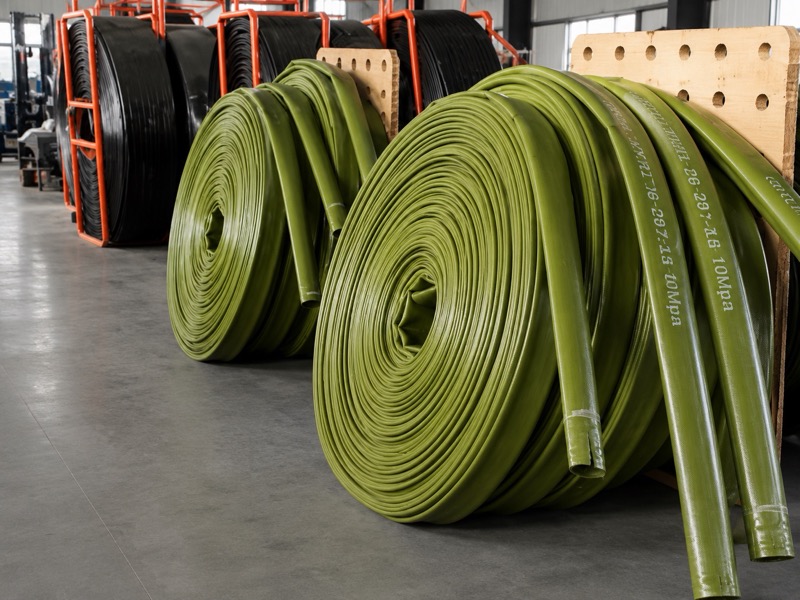
From a buyer's perspective, the true cost of a hose system includes more than unit price—it spans maintenance, downtime, logistics, and replacement cycles. [sunmoonhose]
- TPU Anti-Static Oil Hose
- Lower joint count on long runs reduces leak points and maintenance events. [sunmoonhose]
- High abrasion and weather resistance extend service life in outdoor and mobile operations. [sunmoonhose]
- Lightweight, reel‑based handling cuts labor hours and equipment needs for deployment and retrieval. [sunmoonhose]
- Steel-Braided Rubber Hose
- More joints, fittings, and manifolds on large systems mean more potential failure points. [china-layflat-hose]
- Rubber aging, cover damage, and corrosion around fittings can lead to more frequent inspection and replacement. [china-layflat-hose]
- Heavier hoses require more handling equipment, which adds indirect cost and complexity. [china-layflat-hose]
Across multi‑year projects, field reports and case studies show that optimized TPU systems can significantly reduce lifecycle cost compared with traditional steel‑braided rubber layouts, particularly in mining and shale operations. [sunmoonhose]
Based on industry practice, each hose type clearly dominates in different applications. [sunmoonhose]
Where TPU Anti-Static Oil Hose Excels
- Shale oil & gas frac operations: Long‑distance frac water and oil transfer, rapid redeployment between pads. [sunmoonhose]
- Mining dewatering and fluid logistics: High‑pressure dewatering, fuel transfer in large open‑pit mines. [sunmoonhose]
- Emergency and temporary systems: Flood relief, firefighting support lines, mobile depots and construction sites. [sunmoonhose]
Where Steel-Braided Rubber Hose Excels
- High‑pressure hydraulic circuits: Compact connections on drilling rigs, heavy machinery, hydraulic presses. [china-layflat-hose]
- Short oil and fuel lines: Equipment‑level connections where flexibility and burst strength at short length are critical. [china-layflat-hose]
- Environments with strict dimensional constraints around machinery where layflat geometry is not practical. [china-layflat-hose]
The practical takeaway: use TPU anti-static oil hoses for long, mobile, surface transfer systems, and steel-braided rubber hoses for compact, localized high‑pressure circuits. [sunmoonhose]
From a global sourcing and project design perspective, technical specs alone are not enough; you need alignment between hose choice and operating strategy. [china-layflat-hose]
When advising international buyers, we typically apply a three‑step decision logic:
1. Define flow profile and distance. Long continuous runs with high flow rate almost always favor TPU layflat for deployment efficiency and reduced leak points. [sunmoonhose]
2. Clarify pressure and duty cycle. Short, high‑frequency pressure cycles near equipment often point to steel-braided rubber for compact hydraulic control. [china-layflat-hose]
3. Assess environmental and logistics factors. Harsh terrain, frequent relocation, and limited on‑site storage favor lightweight TPU systems and reelable configurations. [sunmoonhose]
By systematically matching these parameters, project owners can avoid over‑engineering with heavy steel‑braid where layflat is optimal, or under‑engineering hydraulic circuits by choosing hoses designed for surface transfer rather than point‑load pressure. [sunmoonhose]
Sunmoon specializes in engineering-driven TPU layflat hose systems, including oil and gas hoses and high-pressure dewatering solutions for demanding global projects. [china-layflat-hose]
Key strengths that matter for buyers:
- Through‑the‑weave reinforcement and proprietary TPU extrusion deliver stable pressure performance and strong adhesion. [sunmoonhose]
- Customization in diameter, wall thickness, color, and coupling configuration for oil, fuel, and multi‑fluid transfer. [china-layflat-hose]
- Proven track record in large mining projects in Chile and mine rescue dewatering, where high‑pressure TPU layflat reduced emergency response time versus rigid pipelines. [sunmoonhose]
For operations weighing TPU anti-static oil hoses against steel‑braided rubber, Sunmoon's engineering team can provide application‑specific design, sample testing, and OEM/ODM support to ensure each line is correctly specified for its environment and duty cycle. [china-layflat-hose]
| Aspect | TPU Anti-Static Oil Hose | Steel-Braided Rubber Hose |
|---|---|---|
| Core material | TPU layflat with woven reinforcement (sunmoonhose) | Synthetic rubber with steel wire braid (china-layflat-hose) |
| Static control | Designed with anti-static properties for oil transfer (alibaba) | Steel braid offers partial conductivity, not always optimized for static (china-layflat-hose) |
| Deployment style | Layflat, reelable, ideal for long surface runs (sunmoonhose) | Cylindrical, heavier, better for short equipment connections (china-layflat-hose) |
| Typical use cases | Frac water/oil transfer, mining dewatering, emergency fluid logistics (sunmoonhose) | Hydraulic systems, short high-pressure oil lines near machinery (china-layflat-hose) |
| Abrasion & weathering | High abrasion, UV, and ozone resistance for outdoor runs (sunmoonhose) | Good initial performance but more prone to aging and cover damage (china-layflat-hose) |
| Lifecycle cost | Lower leaks and maintenance on long runs, efficient deployment (sunmoonhose) | Higher indirect costs on large systems due to weight and joint count (china-layflat-hose) |
To help engineers and purchasing managers make a fast, rational choice, here is a concise checklist you can apply before specifying hoses:
1. Hose length per run
- Over 200–300 m: strongly consider TPU layflat. [sunmoonhose]
- Under 30 m with complex routing: steel-braided rubber is often appropriate. [china-layflat-hose]
2. Primary function
- Bulk transfer (oil, fuel, water, chemicals) over ground: TPU anti-static layflat. [sunmoonhose]
- Equipment‑level hydraulic power: steel‑braided rubber. [china-layflat-hose]
3. Environment
- Harsh outdoor, frequent redeployment: TPU for abrasion and logistics. [sunmoonhose]
- Stable indoor industrial setting: either, depending on circuit design. [china-layflat-hose]
4. Safety focus
- High flammable risk with long runs: choose anti-static TPU, ensure grounding and monitoring. [alibaba]
- Localized systems: follow hydraulic and machinery safety standards; hose type depends on circuit. [china-layflat-hose]
Using such a checklist not only improves technical fit, it also supports internal EHS and procurement documentation, reinforcing your project's compliance trail. [china-layflat-hose]
If your operation involves long-distance oil, fuel, or multiphase fluid transfer, relying solely on conventional steel‑braided rubber hoses can lock you into higher handling costs and unnecessary leak risk. [sunmoonhose]
By partnering with Sunmoon, you can deploy customized TPU anti-static oil hose systems engineered for your pressure, distance, and safety requirements—backed by real‑world mining, shale, and emergency application experience. [china-layflat-hose]
Contact Sunmoon's engineering team to review your current hose layout and explore a tailored TPU layflat solution that reduces lifecycle cost while improving safety and deployment efficiency in your next project. [china-layflat-hose]
1. Is TPU anti-static oil hose suitable for high-pressure applications?
Yes. Modern TPU layflat hoses are designed with through‑the‑weave reinforcement and controlled wall thickness to handle high working pressures in oil and gas, mining, and dewatering operations, provided they are correctly specified for the system. [sunmoonhose]
2. Can TPU layflat hoses replace steel-braided rubber hoses in hydraulic circuits?
Not usually. TPU anti-static oil hoses are optimized for surface transfer and long runs, while steel‑braided rubber remains the preferred choice in compact hydraulic circuits where pulsating pressure and short, complex routing dominate. [sunmoonhose]
3. How do anti-static properties in TPU hoses improve safety?
Anti-static TPU formulations help dissipate electrostatic charge generated by fast‑moving hydrocarbons and fuels over long hose lengths, reducing the risk of ignition in flammable atmospheres when combined with proper grounding and procedures. [alibaba]
4. What deployment advantages do TPU layflat hoses offer over steel-braided rubber hoses?
TPU layflat hoses can be coiled on reels, run in long continuous lengths, and dragged across rough terrain with fewer joints, enabling rapid deployment and recovery and lowering leak risks in large-scale projects. [sunmoonhose]
5. How does Sunmoon support global buyers in hose selection and customization?
Sunmoon provides engineering consultation, customization of TPU layflat hose dimensions and formulations, sample testing, and OEM/ODM services, drawing on experience from international mining and shale projects to ensure each hose system is correctly designed for its field conditions. [china-layflat-hose]
1. Sunmoon Hose Manufacturing – Official Website. Available at: <https://www.sunmoonhose.com> [sunmoonhose]
2. Jiangsu Sunmoon Shale Gas High Pressure Hose Co., Ltd – Company Profile. Available at: <https://china-layflat-hose.com/about/company-profile/> [china-layflat-hose]
3. TPU Layflat Hose – Product Overview. Available at: <https://china-layflat-hose.com/products/tpu-layflat-hose.html> [china-layflat-hose]
4. Anti-Oil Anti-Static TPU Layflat Hose – Product Listing. Available at: <https://www.alibaba.com/product-detail/ANTI-OIL-ANTI-STATIC-oil-delivery_62010142283.html> [alibaba]
5. How Sunmoon's High‑Pressure TPU Layflat Hose Transforms Shale Gas Water Supply Operations. Available at: <https://www.sunmoonhose.com/how-sunmoon-s-high-pressure-tpu-layflat-hose-transforms-shale-gas-water-supply-operations.html> [sunmoonhose]


