

Views: 222 Author: Loretta Publish Time: 2026-01-22 Origin: Site


Content Menu
● Why Camlock Fittings Matter in Modern Fluid Systems
● Core Types of Camlock Fittings (A–F, DC, DP)
>> Main Pressure-Carrying Types
● Camlock Materials and Their Ideal Uses
● Key Technical Specifications: Pressure, Size, and Temperature
>> Pressure Ratings by Material and Size
>> Understanding Nominal Size and Measurement
● Gasket Materials and Sealing Performance
● Real-World Applications of Camlock Fittings
● Camlock Fittings and TPU Layflat Hose Systems
● How Camlock Fittings Work: Step-by-Step Connection
● How to Choose the Right Camlock Fitting
>> 2. Confirm Size and Connection Style
>> 3. Check Pressure and Temperature
>> 4. Consider Environment and Regulations
● How to Install Camlock Fittings on Hose (Including Layflat)
>> Step-by-Step Installation on Hose
● Maintenance and Safety Best Practices
● Where Camlocks Fit into an Engineering-Driven Hose Solution
● Ready to Engineer Your Next Hose System?
>> 1. Are camlock fittings safe for high-pressure applications?
>> 2. Can I use the same camlock for water and chemicals?
>> 3. What is the difference between a camlock and a hose clamp?
>> 4. Which camlock material is best for food and beverage applications?
>> 5. How often should camlock gaskets be replaced?
Camlock fittings, also called cam and groove couplings, are quick-connect hose fittings that allow you to connect and disconnect hoses and pipes in seconds without tools while maintaining a reliable, leak-tight seal. They are widely used in fluid transfer, powders and granules handling, and are the standard choice for many TPU layflat hose systems in demanding industrial environments.

A camlock fitting is a quick-connect coupling that joins hoses or pipes using a cam lever mechanism instead of tools such as wrenches or clamps. It consists of two matching halves that lock together to create a secure, leak-resistant connection for liquids, gases, powders, or slurries.
- The male adaptor (also called the plug) has circumferential grooves or lugs on its outer surface.
- The female coupler has corresponding cam arms and internal recesses that engage these lugs when the arms are closed.
- When the cam arms are rotated down, they pull the male adaptor into the coupler, compressing the gasket and creating a tight seal.
- To disconnect, the operator simply lifts the arms, releases the pressure, and pulls the fittings apart.
This simple mechanical principle is what makes camlock fittings so fast, repeatable, and user-friendly in the field.
Camlock fittings are used wherever frequent hose changes or rapid connection and disconnection are required without sacrificing safety. In many industries they have replaced threaded, flanged, or clamped joints because they reduce labor, downtime, and leak risk.
Key advantages include:
- Tool-free operation: Operators can connect and disconnect lines without wrenches.
- Time savings: Ideal for frequent product changeovers, mobile equipment, or emergency response.
- Leak reduction: Properly matched sizes and gaskets provide a reliable seal under pressure.
- Versatility: Available in a wide range of sizes, materials, and configurations for hoses, pipes, and equipment ports.
- Compatibility with layflat hoses: Camlocks pair extremely well with PVC and TPU layflat discharge hose for high-volume transfer and rapid deployment.
Camlock couplings are standardized into several types that describe how they connect to hoses or threaded ports. Understanding these types helps engineers and buyers specify exactly what they need.
- Type A – Male adaptor x female thread
Connects a male camlock to a female threaded port, such as a tank, manifold, or valve.
- Type B – Female coupler x male thread
Used where you need a camlock hose connection on a male threaded outlet.
- Type C – Female coupler x hose shank (barb)
Ideal for attaching flexible hose to a camlock system using hose clamps.
- Type D – Female coupler x female thread
Common at equipment inlets and outlets that need quick hose connection via a threaded port.
- Type E – Male adaptor x hose shank (barb)
Provides a male cam adaptor directly on the hose side.
- Type F – Male adaptor x male thread
Often mounted permanently on pumps, tanks, or pipework as a male cam connection point.
- Type DC – Dust cap (for male adaptors)
Covers the male camlock when not in service, preventing dirt and damage to the sealing surface.
- Type DP – Dust plug (for female couplers)
Plugs into the coupler to keep contaminants out and protect the cam and groove interface.
Suggested visual: Insert a labeled chart showing each type (A–F, DC, DP) with a small line drawing and a one-line description.
Selecting the right camlock material is critical for safety, service life, and regulatory compliance. The main options are stainless steel, aluminum, brass, polypropylene (PP), and nylon.
Camlock material | Key advantages | Main limitations | Typical applications |
Stainless steel | High strength; excellent corrosion resistance; handles high temperatures | Higher cost; heavier than aluminum | Corrosive chemicals, acids, alkalis, food and beverage, pharmaceutical, steam, offshore |
Aluminum | Lightweight; cost-effective; good general corrosion resistance | Not suitable for highly acidic or highly alkaline media; oxidizes over time | General industry, construction, water transfer, agriculture, fuel transfer (non-corrosive) |
Brass | Good corrosion resistance in water; easy to machine; antimicrobial properties | Not recommended with ammonia or certain acids; relatively expensive | Marine, salty water, fuel and oil transfer, some utility water lines |
Polypropylene (PP) | Lightweight; low cost; good chemical resistance to many acids and alkalis | Lower mechanical strength; limited high-temperature capability | Agriculture, mild chemicals, low-pressure transfer, temporary systems |
Nylon | Stronger and more impact-resistant than PP; good chemical and heat resistance | Absorbs moisture, which can affect dimensions and performance | Industrial chemicals, oils, fuels under moderate conditions |
This table can be adapted into structured data to help search engines understand which material suits which use case.
Choosing camlocks requires matching pressure rating, nominal size, and temperature resistance to the actual operating conditions. Ignoring any of these factors can lead to premature failure or safety incidents.
Typical maximum working pressures for common camlock materials are:
- Stainless steel: Up to around 250 psi in small sizes (for example 0.5–2 inches), decreasing in larger diameters.
- Aluminum: Similar to stainless in small sizes but with lower ratings in the 2.5–6 inch range.
- Brass: Generally comparable to aluminum in most industrial sizes.
- Polypropylene: Often around 100–125 psi in small sizes, falling to about 50 psi in larger diameters.
Always verify exact ratings from the manufacturer for the specific series and gasket.
Camlock size is defined by the hose or pipe size, not by the overall body dimensions.
- The male adaptor size is determined by the outside diameter of the shank or threaded portion.
- The female coupler size is determined by the inside diameter of the hose end or threaded inlet.
Using mismatched sizes, such as a 2 inch hose with a 1.5 inch camlock, will create restriction, turbulence, and leak risks.
- Stainless steel camlocks can handle high temperatures and are suitable for steam and hot chemical transfer within gasket limits.
- Aluminum has moderate temperature capability and is adequate for most water, fuel, and oil services.
- Brass performs well across a wide temperature range in water and fuels.
- Polypropylene and nylon are limited at high temperatures, so always check the maximum service temperature before specifying them in hot processes.
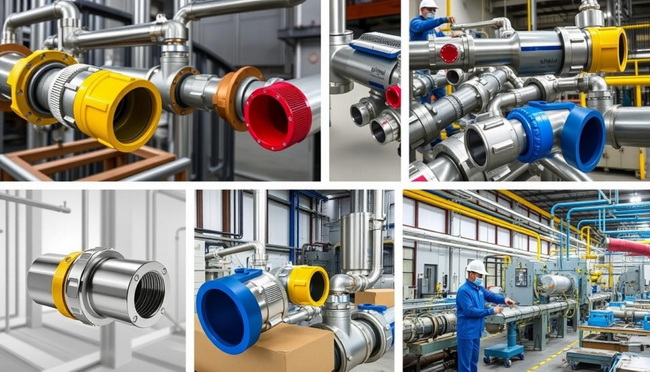
The gasket is the primary sealing element inside the camlock coupler and must match the media, temperature, and hygiene requirements to work reliably.
Common options include:
- NBR / Nitrile: Good oil and fuel resistance, widely used for petroleum products.
- EPDM: Excellent for hot water, steam, and many chemicals; often standard on plastic camlocks.
- Viton (FKM): High-temperature and aggressive chemical resistance for demanding services.
- PTFE or PTFE-enveloped: Maximum chemical resistance for strong acids and alkalis.
- Silicone: Preferred in food and beverage or pharmaceutical applications where hygienic performance and temperature stability are critical.
Selecting a compatible combination of gasket and body material dramatically improves service life and reduces leak-related downtime.
Camlock couplings appear across a wide range of industries because they make hose operations faster, safer, and more modular. They are especially valuable in systems where equipment and process connections change frequently.
Typical application areas include:
- Fuel and oil transfer: Loading and unloading tank trucks, connecting hoses to storage tanks, pumps, and filtration units.
- Chemical processing: Handling acids, alkalis, solvents, and process water where fast changeover is important.
- Food and beverage: Sanitary stainless camlocks used on CIP circuits, syrup transfer, brewery hoses, and dairy lines.
- Agriculture and irrigation: Rapidly connecting layflat hoses, portable pumps, and field distribution lines.
- Construction and dewatering: Connecting discharge hoses for pumps on sites, tunnels, and mines.
- Marine and offshore: Fuel, ballast water, and bilge systems requiring robust and corrosion-resistant couplings.
For TPU layflat hose manufacturers such as Sunmoon, camlock couplings are a natural partner because both are designed for fast deployment and high performance in demanding environments. Together, they form an integrated flexible pipeline solution.
- TPU layflat hose is built with a high-tensile woven reinforcement fully embedded in a tough polyurethane cover, creating a single homogeneous structure without adhesives.
- This construction offers excellent abrasion resistance, high working pressure capacity, and long service life in fluid transfer operations.
- When paired with properly sized camlocks, TPU layflat hoses become a modular pipeline that can be deployed, extended, or reconfigured rapidly in the field.
Typical scenarios where TPU layflat hose plus camlocks excel include:
- Long-distance water transfer for agriculture or mining.
- Temporary firefighting lines or emergency flood control.
- High-volume transfer in industrial cleaning, construction dewatering, or municipal bypass projects.
This integration is especially valuable for global customers who need engineering-driven, field-ready hose systems rather than standalone components.
The operating principle is simple, yet a clear procedure helps ensure safe, leak-free connections. A consistent method also improves training and reduces operator error.
1. Inspect both halves
- Check the male adaptor grooves and female coupler cams for damage, debris, or excessive wear.
- Confirm the gasket is seated correctly and free from cracks or cuts.
2. Align the fittings
- Open the cam arms fully on the female coupler.
- Insert the male adaptor straight into the coupler until the grooves engage the coupler's internal recess.
3. Lock the cam arms
- Rotate both cam arms downward simultaneously until they are fully closed.
- This motion pulls the male adaptor inwards, compressing the gasket and sealing the connection.
4. Pressurize and check
- Slowly introduce fluid or air pressure.
- Inspect the joint for drips, misting, or movement; if leaks appear, depressurize and re-seat the connection.
5. Disconnect safely
- Depressurize the line.
- Lift both cam arms upward to release the adaptor, then withdraw the male half from the coupler.
Choosing the correct camlock is a multi-factor decision that should be structured to minimize risk and lifetime cost. A simple checklist helps designers and buyers avoid common mistakes.
- Identify whether you are transferring water, fuel, oil, chemicals, food product, slurry, or air.
- Check for corrosive components such as acids, alkalis, solvents, salt, or disinfectants.
This step drives the selection of body material and gasket type.
- Match the camlock size to the nominal hose or pipe diameter to avoid bottlenecks and leaks.
- Choose the appropriate type:
- Hose shank types (C, E) for flexible hoses.
- Threaded types (A, B, D, F) for pumps, valves, and manifolds.
- Compare your maximum working pressure and surge pressure to the rated working pressure of the fitting in that size and material.
- Verify that the material and gasket can handle your operating temperature range with a safety margin.
- For food and pharmaceutical applications, prefer stainless steel and compliant gasket materials such as EPDM or silicone.
- For marine or offshore use, corrosion resistance and mechanical strength are critical.
- For temporary or low-risk lines, cost-effective PP or nylon may be acceptable if conditions allow.
- Higher-end materials and precision-cast couplings offer longer life and less downtime in demanding duty.
- In high-volume operations, fewer failures and faster changeover usually outweigh the initial price difference.
Proper installation greatly influences safety, leak rate, and service life. Following a controlled sequence ensures a repeatable, high-quality hose assembly.
1. Gather components
- Male and female camlock fittings (correct type and size).
- Hose or TPU layflat hose.
- Suitable hose clamps or ferrules.
- Wrench or screwdriver for clamps, plus thread sealant or PTFE tape if threaded connections are used.
2. Prepare the hose end
- Cut the hose square and remove burrs or loose reinforcement.
- Ensure the bore is clean, dry, and free from contamination.
3. Install the hose shank camlock
- Slide the clamp or clamps onto the hose first.
- Push the hose fully over the shank of the camlock fitting; slight twisting helps on layflat hose.
- Position the clamp so it covers all barb ridges, then tighten to the manufacturer's torque recommendation.
4. Threaded connections (if applicable)
- Apply suitable thread sealant or PTFE tape to tapered threads if specified.
- Tighten into the mating port without over-torquing, to avoid thread damage or distortion.
5. Functional check
- Connect the camlock pair and gently pressurize the system.
- Re-tighten clamps or fittings if any weeping or movement is observed.
A proactive maintenance routine is crucial for long-term reliability and compliance. Small, regular checks can prevent major failures and unplanned shutdowns.
1- Inspect regularly
- Check cam arms for bending, cracks, or excessive play.
- Examine gaskets for hardening, cuts, or chemical attack.
2- Clean critical surfaces
- Remove product build-up and particulate from grooves, sealing faces, and arms to maintain proper seating.
3- Replace worn components
- If a fitting no longer locks smoothly or the arms do not fully engage, replace it promptly.
- Swap out gaskets at the first sign of deformation or swelling.
4- Use dust caps and plugs
- Fit DC and DP components whenever lines are disconnected to prevent dirt, moisture, and mechanical damage.
5- Train operators
- Ensure personnel understand the correct locking sequence, pressure safety, and basic inspection points.
These practices significantly reduce unplanned downtime and leak-related safety incidents.
For an engineering-driven TPU layflat hose manufacturer, camlocks are not just accessories; they are part of a system-level design focused on reliability and ease of use. Treating hoses and couplings as a single engineered package brings measurable benefits.
- Matching hose construction, camlock material, and gasket to the application allows the entire assembly to be optimized for pressure, abrasion, and chemical resistance.
- Designing hose lengths, camlock types, and accessory layout together reduces on-site assembly time and simplifies logistics.
- For global projects, standardized camlock configurations help customers scale from pilot lines to full networks without redesign.
Positioning camlocks as an integral part of a turnkey layflat hose solution differentiates a technology-focused manufacturer from commodity suppliers.
If your project requires reliable, fast-deploying hose systems, partnering with an engineering-driven TPU layflat hose manufacturer that understands camlock technology can dramatically reduce risk and commissioning time. From material selection and sizing to complete camlock-equipped assemblies, an expert team can help you specify the optimal solution for your pressure, temperature, and chemical requirements.
Take the next step now: share your operating conditions, request a tailored TPU layflat hose and camlock configuration, and design an industrial hose system that delivers safe, efficient performance from day one.
Contact us to get more information!
Camlock fittings are commonly rated up to around 250 psi in smaller stainless steel and aluminum sizes, but the safe pressure always depends on the exact size, material, and product series. You should check the manufacturer's data sheet and apply a suitable safety factor for surge and temperature effects.
A single camlock body can sometimes serve both, but the chemical compatibility of the metal and the gasket must be confirmed for each fluid. Many plants use dedicated hose assemblies for specific media to avoid cross contamination and material attack.
A camlock is a quick-connect coupling that joins two ends of a pipeline, while a hose clamp simply secures a hose onto a barb or nipple. Many hose assemblies use both: a hose clamp to attach the camlock shank to the hose, and the camlock to connect to equipment or another hose.
Stainless steel camlocks with food-grade gaskets such as EPDM or silicone are generally preferred in hygienic applications. They offer excellent corrosion resistance, cleanability, and regulatory acceptance for contact with food and cleaning chemicals.
There is no fixed interval, because gasket life depends on pressure, temperature, media, and cycle frequency. Any gasket that shows hardening, swelling, cracking, or persistent weeping under proper assembly should be replaced immediately.
[1] https://www.strongflex.com/project/camlock/
[2] https://www.proflow-dynamics.com/guide-to-camlock-fittings
[3] https://4starhose.com/complete-guide-to-camlock-fittings-types-applications-and-maintenance
[4] https://www.pvcfittingsonline.com/blogs/resource-center/understanding-camlock-fittings
[5] https://www.sealfast.com/camlock/
[6] https://camlockdirect.com/blogs/camlock-fittings-product-resources/what-are-camlock-fittings
[7] https://camlockdirect.com/blogs/camlock-fittings-product-resources/cam-lock-fitting-guide
[8] https://www.camlock-fittings.com/blog/post/a-comprehensive-guide-to-different-types-of-cam-couplings
[9] https://www.strongflex.com/project/plastic-camlock-fittings/
[10] https://tameson.com/pages/camlock
[11] https://www.commercial-industrial-supply.com/blogs/resource-center/what-is-a-camlock-fitting
[12] https://www.sunmoonpipe.com/tpu-layflat-hose/
[13] https://www.sunmoonpipe.com/tpu-layflat-hose/tpu-lay-flat-hose.html
[14] https://www.strongflex.com/what-is-a-camlock-fitting/


