

Views: 222 Author: Loretta Publish Time: 2025-12-29 Origin: Site


Content Menu
● Understanding Silicone Hose and Its Oil Resistance
● Short-Term vs. Long-Term Oil Exposure
● The Role of Fluorosilicone and FKM-Lined Silicone Hose
● Why Standard Rubber Hoses Still Dominate Oil Applications
● TPU Layflat Hose: The New Generation Oil Hose
>> Key Features of TPU Layflat Oil Hose
● Comparison: Silicone, Rubber, and TPU in Oil Hose Applications
● Industrial and Automotive Use Cases
● How to Select the Right Oil Hose
● Maintenance and Safety Tips for Oil Hose Systems
● Environmental Benefits of TPU Oil Hose
● FAQ
>> 1. Can a standard silicone hose carry oil continuously?
>> 2. What material offers the best oil resistance?
>> 3. Are lined silicone hoses worth the investment?
>> 4. What maintenance practices extend the life of an oil hose?
>> 5. Why is TPU layflat hose gaining popularity in oil transfer?
When people ask whether a silicone hose can be used for oil, the answer is more complex than a simple yes or no. Silicone hose is famous for its flexibility, temperature resistance, and long lifespan, but when it comes to continuous oil contact, not every type of silicone hose performs equally well. To understand what works, you must compare the behavior of silicone against alternatives such as rubber oil hose and TPU layflat oil hose, particularly in demanding industrial and automotive environments.
Silicone is an elastomer with outstanding thermal stability. It thrives in extreme temperatures ranging from -60°C to 200°C, making it ideal for coolant systems, turbochargers, and air ducts in both automotive and industrial setups. However, once exposed to oil for extended periods, standard silicone hose reveals a significant limitation—it absorbs hydrocarbons.
Over time, oil seeps into the silicone matrix, causing it to soften, swell, or blister. This compromises the strength and the sealing ability of the hose, leading engineers to avoid unlined silicone in continuous oil service. Manufacturers explicitly state that standard silicone should not be used where constant oil exposure occurs. In short, although silicone hose can handle high heat and air pressure, it was never formulated as a primary oil hose for direct fluid transfer.
To make the correct choice, you must distinguish between short-term exposure and long-term immersion:
- Short-term or intermittent contact: When silicone hoses are merely exposed to oil vapor, splashes, or mist—such as in engine bays or breather lines—they usually perform adequately. The surface contact is temporary, meaning the likelihood of structural degradation remains low if the temperature stays within limits.
- Long-term exposure: In oil return lines, lubrication systems, or hydraulic circuits, constant oil contact rapidly deteriorates unprotected silicone. The oil penetrates the hose wall, altering its physical properties and often leading to leaking or rupture under pressure.
Therefore, in any application where oil is an active, continuous medium, it's best to look at oil-optimized alternatives.
Technology has evolved to enhance silicone's oil resistance. Modern manufacturers produce specially lined silicone hoses, using either fluorosilicone or FKM (Fluoroelastomer/Viton) layers as inner linings. These linings act as impermeable barriers, blocking oil molecules from migrating into the silicone structure.
A fluorosilicone-lined oil hose maintains flexibility, withstands high temperatures, and remains stable in contact with mineral and synthetic oils. Similarly, an FKM-lined silicone hose offers exceptional performance in high-temperature oil and fuel environments common in motorsports or aerospace engineering.
While these composite hoses significantly improve performance, they do cost more than standard silicone options and must be selected carefully. The internal liner thickness, bonding quality, and compatibility with your specific oil type all influence durability and safety.
Classic rubber oil hose—often made from nitrile (NBR), EPDM blends, or synthetic elastomers—remains the industry standard for oil transfer. Rubber's dense molecular structure resists swelling when exposed to hydrocarbons, making it excellent for continuous oil use. Its flexibility, combined with good pressure and temperature ratings, ensures consistent reliability in engines, hydraulics, and fuel systems.
Another key advantage is the cost-effectiveness of rubber oil hose. It is easier to manufacture, replace, and customize for diameter or wall thickness. Automotive, marine, and industrial oil hose assemblies almost universally depend on rubber-based solutions.
However, rubber has its downsides—it is heavier than silicone and may crack after years of UV exposure, especially if deployed outdoors or in harsh climates.
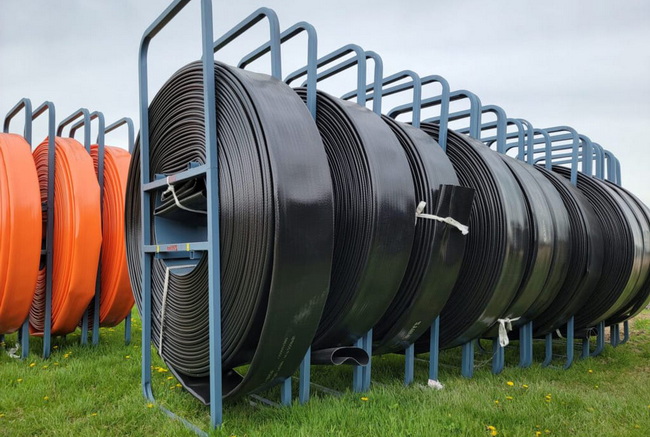
Modern oil-transfer infrastructure requires durability, mobility, and lightweight handling, which traditional rubber hoses cannot fully deliver. That's where TPU (Thermoplastic Polyurethane) layflat hose enters the picture.
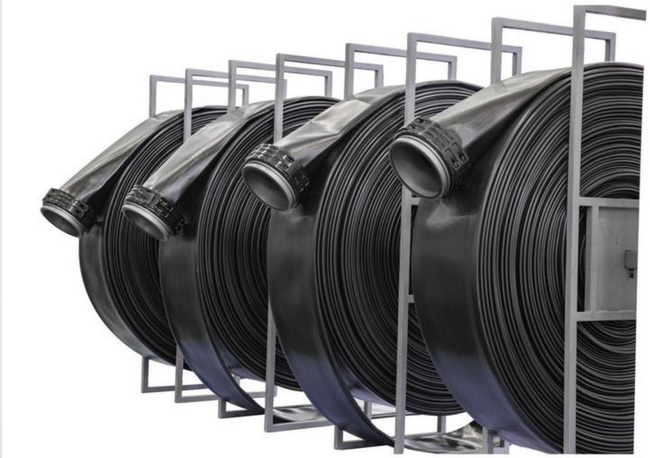
Sunmoon, an engineering-driven manufacturer specializing in TPU layflat hose, has developed solutions for the transport, storage, and distribution of oil across industrial and energy sectors. TPU oil hose exhibits a unique combination of strength and flexibility that makes it ideal for large-scale, high-flow oil movement.
- Superior oil resistance: TPU resists hydrocarbons, fuels, lubricants, and synthetic oils without swelling or softening.
- Lightweight structure: Unlike rubber, TPU layflat oil hose can be easily rolled, transported, and deployed over long distances.
- High tensile and abrasion resistance: The woven polyester reinforcement and extrusion-through-the-weave technique used at Sunmoon ensure that TPU oil hose maintains structural stability under heavy pressure and harsh outdoor conditions.
- Ease of storage: Because TPU hose flattens completely when not in use, it requires minimal storage space and can be rapidly deployed for oil transfers.
Today, TPU layflat oil hoses are widely used in refueling systems, offshore platforms, oil exploration sites, and temporary mobile transfer setups such as emergency fuel supply chains.
When designing or upgrading an oil hose system, engineers must weigh performance, cost, and handling requirements. Each material—silicone, rubber, or TPU—offers distinct trade-offs.
| Property | Silicone (Unlined) | Fluorosilicone/FKM-Lined Silicone | Rubber (NBR/EPDM) | TPU Layflat Hose |
|---|---|---|---|---|
| Oil resistance | Low | High | Very high | Very high |
| Temperature tolerance | Excellent | Excellent | Moderate to high | High |
| Flexibility | Very high | High | Medium | High |
| Pressure capacity | Moderate | Moderate | High | Very high |
| Ideal use case | Air/coolant systems | Specialized oil vapor circuits | Engine oil/fuel lines | Large-scale oil transfer |
| Longevity in oil | Poor without liner | Excellent with liner | Excellent | Excellent |
From this comparison, it's clear that while lined silicone hoses can function effectively in limited oil-contact applications, rubber oil hose and TPU layflat oil hose dominate where reliability and pressure performance are critical.
In the automotive world, different fluids require carefully selected hoses. Silicone hoses are exceptional for coolant and intake systems where temperature control is key. But for oil circulation—such as engine lubrication lines, turbo oil feed, or return hoses—builders almost always rely on rubber or fluorosilicone-lined hoses.
High-performance race cars sometimes employ FKM-lined silicone oil hoses for specialized uses like oil vapor recovery systems, but such implementations are rare and meticulously engineered.
In industrial plants, refineries, and offshore oil rigs, bulk oil transfer demands materials that can withstand both environmental wear and chemical stress. TPU layflat oil hose provides a practical alternative, combining oil resistance, mechanical durability, and fast deployment—qualities needed in temporary or emergency installations. These hoses can be connected end-to-end to create long runs for moving large oil volumes, vital for operations that change locations frequently.
Selecting an appropriate oil hose involves balancing physical, chemical, and operational factors:
1. Fluid type: Identify whether the oil is mineral, synthetic, hydraulic, or bio-based, as their chemical structures differ and interact differently with hose materials.
2. Temperature and pressure range: Check both ambient and working temperatures. Oil at 180°C stresses materials differently than oil at 60°C. Similarly, higher-pressure applications call for reinforced or multi-layer oil hose designs.
3. Environment: Outdoor environments introduce UV exposure, abrasion, and ozone—all of which affect hose life. TPU performs particularly well outdoors.
4. Duty cycle: Continuous use requires more durable materials than hoses used occasionally. TPU and rubber oil hoses have long service lives under constant flow.
5. Flexibility and mobility needs: For portable or temporary installations, the lightweight nature of TPU is a distinct advantage.
By considering these elements carefully, engineers can design a robust, efficient, and long-lasting oil hose system for virtually any environment.
Even the best oil hose will fail prematurely if neglected. Proper care ensures safety and optimal performance:
- Inspect for wear: Regularly check hoses for cracks, swelling, or surface softening—signs of chemical degradation.
- Monitor temperature: Overheating thickens oil and can accelerate polymer breakdown within the hose.
- Avoid twisting or kinking: Static stress points lead to cracks and uneven wear.
- Clean after use: Especially for TPU layflat hoses, proper cleaning and drying extend lifespan by preventing residue buildup.
- Use correct fittings: Poorly sized couplings can cause leaks and reduce pressure tolerance.
Including a preventive maintenance routine in your operation plan can extend the life of each oil hose by 30–50%.
Sustainability plays a growing role in equipment selection. TPU (thermoplastic polyurethane) is a recyclable, energy-efficient material that ensures less waste during production and longer equipment life. Because it combines oil compatibility with mechanical toughness, each TPU oil hose can serve for years with minimal replacement. This durability translates into reduced material consumption, fewer spills, and a lower carbon footprint, making TPU layflat hose the greener alternative for oil transfer systems.
While silicone hose is a high-performance material with excellent thermal stability, it is not inherently oil resistant. Standard silicone should not be used as a continuous-service oil hose due to its permeability to hydrocarbons. When oil exposure cannot be avoided, engineers should select a fluorosilicone- or FKM-lined silicone hose specifically designed for oil and fuel compatibility.
However, for continuous oil flow and high-pressure transfer systems, rubber oil hoses and TPU layflat oil hoses outperform silicone in durability and reliability. TPU layflat hoses, in particular, present a cutting-edge solution—lightweight, flexible, and highly resistant to oil and environmental stress.
By partnering with an engineering-focused manufacturer like Sunmoon, industries ranging from automotive to energy gain tailor-made TPU oil hose solutions that maximize efficiency, safety, and sustainability. Selecting the right oil hose not only protects equipment but also enhances long-term operational stability.
No, standard silicone hoses are not suitable for continuous oil transport. Over time, oil penetrates their porous structure, causing swelling and weakness. For oil flow, always choose a lined silicone hose or a specialized rubber or TPU oil hose.
Rubber oil hoses made from nitrile (NBR) or TPU layflat hoses provide the highest oil resistance and reliability. TPU also offers the advantage of being lightweight and easy to handle, making it ideal for mobile or large-scale oil transfer systems.
Yes—fluorosilicone- or FKM-lined silicone hoses perform exceptionally well in applications requiring both high temperature and oil resistance. They are ideal for engine vapors, fuel system breather lines, and aerospace environments where chemical stability is essential.
Regular inspection for cracks or soft spots, avoiding excessive heat or twisting, and cleaning the hose after each use can significantly prolong service life. Proper couplings and storage conditions also ensure consistent performance.
Its combination of oil resistance, flexibility, light weight, and rapid deployment makes TPU layflat hose the top choice for large-scale or temporary oil transfer operations. Industries appreciate its mobility and low maintenance compared to traditional rubber hoses.


