

Views: 222 Author: Sunmoon Publish Time: 2026-04-11 Origin: Site


In deep mines, dewatering is not just another line item on the capex sheet—it is the thin line between continuous production and an unplanned shutdown that can cost hundreds of thousands of dollars per shift. As someone who has spent years working with mine engineers, pump specialists, and procurement teams on high‑pressure layflat systems, I have watched thermoplastic polyurethane (TPU) well riser hoses quietly replace galvanized steel strings in some of the harshest underground environments worldwide. [zyfire]
From an operational and life‑cycle‑cost perspective, deep mine dewatering is one of the areas where TPU layflat riser hoses now clearly outperform traditional galvanized pipe—on safety, speed, logistics, and total cost of ownership. [midwesthose]
Deep mines are pushing beyond 1 000 m in depth in many regions, with high groundwater inflow, aggressive chemistry, and limited access. Dewatering systems must move large volumes of water—often with solids—around the clock, under high pressure, and through tight vertical and horizontal spaces. [zyfire]
Key challenges mine operators face include:
- High static head and pressure: Pumps and riser lines routinely operate at several hundred psi.
- Abrasive and chemically aggressive water: Suspended solids, low pH, and dissolved salts attack metallic systems.
- Limited access and clearance: Narrow shafts, bends, and low backs make rigid pipe handling slow and risky. [midwesthose]
- High cost of downtime: Every hour a pump is offline can stop production in the affected level.
In this context, any technology that reduces installation time, improves reliability, and cuts unplanned maintenance quickly pays for itself. [midwesthose]
For decades, galvanized steel riser pipe has been the default option for deep wells and mine dewatering because it is familiar, strong, and widely available. However, as depths, flows, and safety requirements increase, its limitations are more obvious underground. [edwin-pump]
Hot‑dip galvanized steel relies on a zinc coating for corrosion protection, which performs reasonably well in many water environments but is not immune to aggressive mine water. Over time, corrosion, pitting, and scale buildup reduce internal diameter, increase head loss, and raise energy consumption. [galvanizeit]
Typical issues with galvanized steel risers in deep mines include:
- Internal corrosion and rust tubercles that reduce flow and can contaminate pumped water. [galvanizeit]
- External corrosion where coating is damaged during handling or at threaded joints.
- Fatigue at couplings and threads due to pump start‑stop cycles and vibration.
In high‑solids or low‑pH mine water, these mechanisms can significantly shorten the effective service life of galvanized strings compared with non‑metallic alternatives. [scwellservice]
Steel riser pipe is heavy, rigid, and jointed—three characteristics that work against fast, safe operations in deep shafts. Each section must be manually aligned, threaded or coupled, torqued, and lowered with hoisting equipment. [waterwelljournal]
This has several consequences:
- More man‑hours per meter of riser installed, especially at depth.
- Higher risk of dropped objects and pinch injuries during make‑up and break‑out.
- Need for larger cranes, derricks, and staging areas.
Even with specialized handling equipment, installing hundreds of meters of steel riser in a confined shaft can take days—time that modern mines no longer tolerate easily. [waterwelljournal]
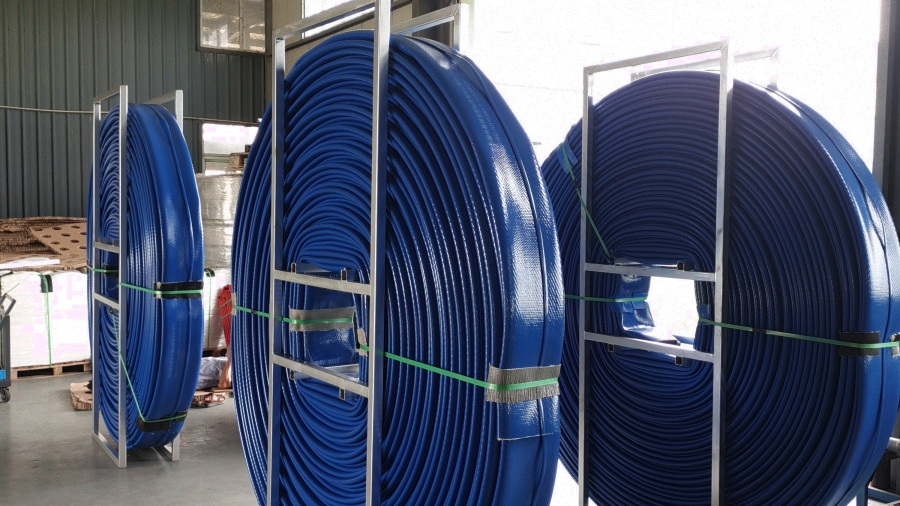
A TPU well riser hose is a high‑pressure layflat hose extruded from thermoplastic polyurethane through a tightly woven polyester or polyamide reinforcement jacket. The "extrusion‑through‑the‑weave" process creates a homogeneous structure where liner, reinforcement, and cover act as a single integrated unit. [zyfire]
Typical mining dewatering TPU layflat features include:
- TPU cover and liner, with high resistance to abrasion, chemicals, hydrolysis, and fungus. [zyfire]
- Circular woven, high‑tenacity polyester reinforcement.
- Working pressures up to 610 psi with burst pressures up to 1 830 psi for selected sizes. [zyfire]
- Operating temperature range from about −50 °C to +80 °C, suitable for most mine climates. [zyfire]
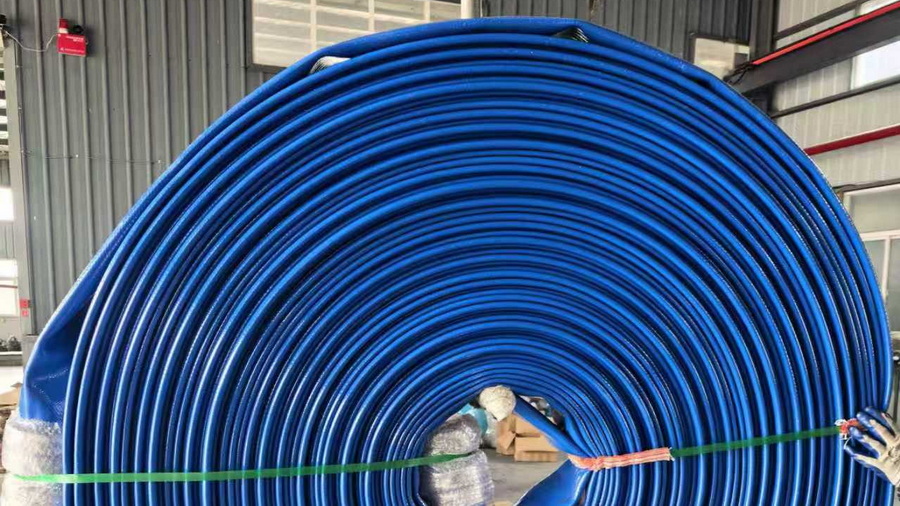
As a layflat, TPU riser hose is supplied in long continuous lengths—typically from 100 m up to 400 m per reel depending on diameter—dramatically reducing the number of joints. [midwesthose]

Below is a practical comparison of TPU layflat riser hose versus galvanized steel for deep mine dewatering.
| Dimension | TPU well riser hose | Galvanized steel riser pipe |
|---|---|---|
| Weight per meter | Low; easy manual handling, less hoisting load (zyfire) | High; requires heavy lifting equipment (waterwelljournal) |
| Corrosion resistance | Excellent chemical and hydrolysis resistance (zyfire) | Dependent on zinc layer; can corrode in mine water (galvanizeit) |
| Abrasion resistance | Very high, outer cover optimized for wear (zyfire) | Moderate; coating damage exposes bare steel (galvanizeit) |
| Installation speed | Up to miles deployed in hours by small crews (midwesthose) | Often days to install jointed pipe (midwesthose) |
| Flexibility in tight spaces | Highly flexible; makes bends, passes obstacles (midwesthose) | Rigid; needs straight runs and large radius bends |
| Joint count and leak risk | Very few joints per string (midwesthose) | Many threaded/coupled joints, higher leak potential |
| Storage and transport | Compact on reels, long lengths per trailer (midwesthose) | Bulky, multiple truckloads for long runs |
| Lifecycle and maintenance | Long service life with low maintenance (zyfire) | Shorter in aggressive water; more maintenance (galvanizeit) |
From a specialist's standpoint, there are five decisive performance areas where TPU well riser hoses clearly outperform galvanized steel in deep mine dewatering.
Field data from TPU hose suppliers in mining applications show that up to 1 mile of 12" TPU hose can be deployed in 1–2 hours by a three‑person crew. On the surface, a crew might install only about 1 000 ft of 12" rigid pipe in a full day—an order‑of‑magnitude difference in productivity. [midwesthose]
For deep mine dewatering:
1. The hose reel is positioned near the shaft or incline.
2. The TPU riser is lowered continuously with the pump attached, with only a few clamps and fittings.
3. Alignment and torqueing of dozens of steel joints are eliminated.
This rapid mobilization reduces the time between flooding and full‑capacity pumping, which directly protects production and equipment. [midwesthose]
Because TPU hose is lighter and flexible, crews work with reels and clamps instead of heavy, rigid sections. This significantly reduces: [zyfire]
- Suspended load durations in the shaft.
- Risk of hand injuries at threads and flanges.
- Working at height around pipe racks and staging.
From a safety manager's perspective, this is one of the most compelling benefits of switching from galvanized risers to TPU layflat systems in deep shafts and declines. [waterwelljournal]
TPU compounds used for mining dewatering hoses exhibit excellent resistance to hydrolysis, many chemicals, and microbial attack. This makes them ideal for handling aggressive mine water that tends to undermine zinc coatings and bare steel over time. [galvanizeit]
In practice, this means:
- Stable internal surface roughness for predictable head loss over the hose's life.
- No rust scale dislodging into pumps or discharge lines.
- Longer service intervals and fewer unscheduled riser replacements.
Where galvanized strings may need partial replacement after years of exposure, quality TPU riser systems often continue in service with minimal degradation in performance. [scwellservice]
TPU layflat riser hose is supplied in long continuous lengths on compact reels. A single flatbed trailer can carry multiple miles of hose, while a 10' × 40' storage area can accommodate similar distances. By contrast, the same length of galvanized steel riser requires multiple truckloads, large yards, and significant stacking infrastructure. [waterwelljournal]
In deep mines with scarce surface laydown area and congested shaft schedules, this logistical advantage simplifies planning and reduces mobilization costs. [midwesthose]
On a per‑meter basis, TPU riser hose is often comparable to high‑quality pipe systems. The real savings come from: [zyfire]
- Fewer man‑hours in installation and retrieval.
- Shorter downtime during pump changes or level extensions.
- Longer service life in aggressive water and abrasive conditions.
When dewatering is mission‑critical, the value of getting pumps online quickly and keeping them running reliably typically outweighs any small initial price advantage of galvanized steel pipe. [galvanizeit]
Across coal, hard‑rock, and base‑metal mines, TPU layflat riser hoses have already proven themselves as a smarter alternative to rigid steel and HDPE lines. [instagram]
Typical applications include:
- Deep shaft dewatering with submersible pumps.
- Ramp and decline dewatering where lines must follow tight curves.
- Emergency flooding response and temporary bypass pumping.
- Permanent high‑pressure discharge lines along the main haulage drift.
One documented case reports large‑bore TPU hose deployed in underground coal mines to move high volumes of water, with the ability to install 2.5 miles of hose in just a few hours, enabling rapid resumption of production after water ingress. [midwesthose]
Sunmoon specializes in high‑pressure TPU layflat hose technology designed for long‑distance water transfer, mine rescue, and emergency drainage. Drawing on 20+ years of hose manufacturing experience and thousands of meters installed across mining, dredging, and large‑scale irrigation, Sunmoon focuses on matching hose construction to real‑world mine conditions. [sunmoonpipe]
Key design features used for deep mine dewatering and well riser applications include:
- Custom ID and pressure rating: Diameters from small well riser sizes up to large‑bore mine drainage, with working pressures tailored to your static head and pump curve. [sunmoonpipe]
- Extra‑thick outer cover: Optimized for abrasion resistance on rugged rock walls and sharp edges in the shaft. [zyfire]
- High‑tenacity reinforcement: Circular woven filament polyester to handle dynamic loads from pump starts and water hammer. [sunmoonpipe]
- Chemical and UV stability: Ensures performance in both underground and surface routing segments. [sunmoonlayflathose]
With in‑house extrusion and weaving capabilities, Sunmoon can customize length, color, coupling interfaces, and branding to align with your mine's standards and safety coding. [sunmoonlayflathose]

From an engineering standpoint, selecting the right TPU well riser hose for deep mine dewatering is a structured process. Below is a practical step‑by‑step approach used in many successful projects.
1. Determine maximum static head (from pump setting depth to discharge point).
2. Estimate friction losses based on target flow rate and line length.
3. Confirm pump performance curve and maximum working pressure.
This defines the required hose working pressure and safety factor.
Using flow and head data, select an internal diameter that keeps velocity within acceptable limits to minimize friction loss and wear. Then choose the pressure class (for example, 250 psi, 300 psi, or 410 psi working pressure) that provides at least a 3:1 burst safety margin. [zyfire]
Where possible, choose continuous lengths that minimize joints—common ranges are 100–400 m depending on shaft configuration. Couplings should be grooved or otherwise compatible with the pump discharge and surface pipework. [midwesthose]
- Confirm hoist capacity and rigging for reel handling.
- Define lowering sequence for pump and hose, including clamping intervals in the shaft.
- Train crews on hose‑specific best practices (bending radius, clamp spacing, and inspection).
By following these steps, mines typically achieve fast installation with predictable performance and low leak risk.
From a specialist's view, the switch from galvanized steel to TPU well riser hose becomes especially compelling in the following situations:
- Deep shafts over 300 m, where installation time and weight penalties of steel are significant.
- Highly corrosive or abrasive mine water environments that have already shortened steel riser life.
- Operations where rapid re‑deployment is required as the mine deepens or extends.
- Sites with tight shaft schedules and limited surface laydown space.
In these scenarios, TPU layflat riser systems usually deliver better safety, lower total cost, and higher operational resilience than galvanized steel strings.
If you are planning a new deep shaft, expanding an existing level, or dealing with recurring corrosion and downtime on galvanized risers, now is the right time to evaluate TPU well riser hoses. Sunmoon can support you with application engineering, hose sizing, and custom‑built TPU layflat riser systems tailored to your mine's depth, water chemistry, and pumping strategy. [sunmoonlayflathose]
Share your current dewatering layout, pump data, and shaft profile, and our team will recommend a TPU riser configuration that can reduce installation time, improve safety, and stabilize long‑term dewatering costs. [sunmoonpipe]
Q1: Are TPU well riser hoses strong enough for very deep wells?
Yes. High‑quality TPU layflat hoses are available with working pressures up to around 610 psi and burst pressures up to about 1 830 psi, suitable for many deep mine and deep well applications when correctly sized. [zyfire]
Q2: How do TPU hoses handle abrasive mine water with solids?
TPU has excellent abrasion resistance, and many mining‑grade hoses use extra‑thick outer covers and robust reinforcement, making them well suited for abrasive conditions in open pit and underground mines. [zyfire]
Q3: Can TPU riser hoses be used as permanent installations, or are they only temporary?
TPU layflat hoses are widely used both as emergency and as long‑term dewatering lines, thanks to their resistance to chemicals, UV, hydrolysis, and fungus, plus good mechanical durability. [midwesthose]
Q4: How does the cost of TPU riser hose compare to galvanized steel pipe?
On a per‑meter basis, TPU hose is often comparable to quality pipe systems, but overall project costs are usually lower because of faster installation, reduced labor, and longer service life in aggressive conditions. [galvanizeit]
Q5: Can Sunmoon customize TPU hoses for specific mine requirements?
Yes. Sunmoon offers custom diameters, pressure ratings, lengths, colors, and end connections, optimized for mining, dewatering, dredging, and emergency drainage applications worldwide. [instagram]
1. Midwest Hose. "TPU Hose in Mining: A Smarter Alternative to Pipe."
https://www.midwesthose.com/tpu-hose-in-mining-a-smarter-alternative-to-pipe/ [midwesthose]
2. ZYfire. "Mining Dewatering TPU Layflat Hose – Technical Data and Features."
https://www.zyfire.com/product/mining-dewatering-tpu-layflat-hose [zyfire]
3. American Galvanizers Association. "The Performance of Hot‑Dip Galvanized Steel in Water Environments."
https://galvanizeit.org/knowledgebase/article/the-performance-of-hot-dip-galvanized-steel-in-water-environments [galvanizeit]
4. SC Well Service. "Well Drop Pipe: PVC vs. Poly vs. Steel Selection Guide."
https://scwellservice.com/blog/drop-pipe-selection-guide.html [scwellservice]
5. Water Well Journal. "Saving Time, Energy, and Money One Pumping System at a Time."
https://waterwelljournal.com/saving-time-energy-and-money-one-pumping-system-at-a-time/ [waterwelljournal]
6. Sunmoon. "Layflat Hose Manufacturer – TPU Layflat Hoses for Mining and Water Transfer."
https://sunmoonlayflathose.com and product pages such as
https://www.sunmoonpipe.com/tpu-layflat-hose/sunmoon-12-inch-250psi-tpu-layflat-mine-rescue-emergency-drainage-hose.html [sunmoonlayflathose]


