

Views: 222 Author: Sunmoon Publish Time: 2026-05-06 Origin: Site


Operating water transfer systems in desert environments presents unique challenges that can quickly destroy standard industrial hoses. UV resistant layflat hoses, particularly those manufactured with NBR (Nitrile Butadiene Rubber), offer proven solutions for extreme sun exposure conditions where temperatures regularly exceed 100°F and UV radiation accelerates material degradation. As a specialized manufacturer of NBR layflat hoses, Sunmoon has developed customized solutions that address the specific demands of desert pumping operations, from agricultural irrigation in the American Southwest to mining dewatering in Australia's outback. [jafirehose]

Prolonged exposure to ultraviolet radiation fundamentally alters the molecular structure of hose materials, causing brittleness, surface cracking, and catastrophic failure. In desert climates, this degradation accelerates dramatically due to several compounding factors that create what industry experts call "extreme UV stress conditions." [sunhose]
When sunlight strikes hose surfaces, UV wavelengths (280-400 nm) break down polymer chains through photo-oxidation, weakening the material's tensile strength and flexibility. Standard PVC layflat hoses exposed to continuous desert sunlight can show visible deterioration within 6-8 months, developing surface crazing that eventually penetrates through to the reinforcement layer. This process creates micro-cracks that expand under pressure, leading to sudden burst failures during critical pumping operations. [linkedin]
Research from industrial hose manufacturers indicates that UV degradation in desert environments occurs 3-4 times faster than in temperate climates due to higher UV index readings, extended daylight hours, and reflective heat from sand and rock surfaces. The combination of intense direct sunlight and radiant ground heat creates a dual assault on hose materials, with surface temperatures frequently reaching 140-160°F even when ambient air temperature measures 105°F. [agriculturedive]
NBR (Nitrile Butadiene Rubber) demonstrates inherent resistance to ozone cracking and UV degradation that significantly outperforms both PVC and standard rubber compounds. The molecular structure of nitrile rubber includes carbon-carbon double bonds that are naturally more stable under UV exposure, reducing photo-oxidation rates by approximately 60% compared to conventional PVC formulations. [papagenogroup]
TPU (Thermoplastic Polyurethane) layflat hoses offer superior UV resistance but come with higher cost considerations that may not suit all desert applications. While TPU provides excellent weather resistance and maintains flexibility across broader temperature ranges (-40°F to 180°F), the material cost runs 40-50% higher than quality NBR alternatives. For operations requiring thousands of feet of discharge hose, this cost differential becomes substantial. [sunhose]
| Material Type | UV Resistance Rating | Temperature Range | Expected Lifespan (Desert) | Cost Index |
|---|---|---|---|---|
| Standard PVC | Poor | -5°F to 149°F | 6-18 months | 1.0x |
| NBR Rubber | Excellent | -20°F to 176°F | 3-5 years | 1.3x |
| TPU | Superior | -40°F to 180°F | 5-7 years | 1.8x |
| Reinforced PVC | Moderate | 14°F to 158°F | 12-24 months | 1.1x |
Advanced UV stabilizers incorporated during the manufacturing process create a protective barrier at the molecular level that absorbs harmful radiation before it can degrade base polymers. Sunmoon's NBR layflat hoses utilize proprietary UV inhibitor compounds that are chemically bonded within the rubber matrix, providing consistent protection throughout the hose's service life rather than relying on surface coatings that can wear away. [zyfire]
High-performance desert hoses employ three-layer construction with UV-stabilized NBR outer layers, high-tenacity polyester reinforcement, and chemical-resistant inner tubes. This engineering approach distributes stress loads across multiple material zones while isolating each layer to perform its specialized function—the outer layer shields against UV and abrasion, the reinforcement handles pressure loads, and the inner tube maintains fluid compatibility. [kebinghose]
The polyester fiber reinforcement in quality layflat hoses provides a 3:1 working-to-burst pressure ratio, essential for desert applications where pressure surges from pump cycling and thermal expansion create dynamic stress patterns. Standard agricultural hoses typically operate at 6 bar (87 PSI) working pressure, while heavy-duty construction models handle 10-12 bar (145-174 PSI) for mining and industrial dewatering. [jonestownag]
Carbon black serves as the most cost-effective UV stabilizer, absorbing UV radiation and converting it to harmless heat energy. Premium NBR formulations incorporate 2-3% carbon black by weight, creating the characteristic dark appearance associated with UV-resistant industrial hoses. This additive works synergistically with hindered amine light stabilizers (HALS) that interrupt free radical chain reactions initiated by UV exposure. [bybenson]
Proprietary UV stabilizer packages can extend outdoor service life by 200-300% compared to untreated materials, with independently verified testing showing minimal degradation after 2,000 hours of accelerated UV exposure equivalent to 3-4 years of desert conditions. These formulations maintain critical physical properties including tensile strength (>1,500 PSI), elongation at break (>400%), and tear resistance even after prolonged sun exposure. [jafirehose]
Matching hose specifications to specific application requirements prevents both over-engineering (unnecessary cost) and under-specification (premature failure). Desert pumping operations span diverse contexts from temporary construction dewatering to permanent agricultural irrigation systems, each with distinct performance criteria. [robertsiegers]
Agricultural irrigation in desert regions requires hoses balancing UV resistance, pressure capacity, and cost-effectiveness for seasonal deployment spanning 4-8 months annually. Growers in California's Imperial Valley and Arizona's farm belt typically specify 4-6 inch diameter NBR layflat hoses rated for 6-8 bar working pressure, prioritizing portability and storage efficiency over maximum burst strength. [ehn]
Mining and construction dewatering operations demand maximum durability with enhanced abrasion resistance for dragging across rock and concrete surfaces. Heavy-duty NBR hoses for these applications feature thicker wall construction (2.5-3.5mm versus 1.8-2.2mm for agricultural models) and reinforced outer layers that resist scuffing and puncture. The investment in premium construction pays dividends when hoses must survive being repeatedly run over by equipment or dragged through debris fields. [zyfire]
Emergency water transfer and firefighting applications require rapid deployment capability that leverages layflat hose's primary advantage—compact storage and quick unrolling. Desert wildfire response teams specify lightweight NBR hoses with aluminum camlock fittings that two personnel can deploy at 200 feet per minute, critical when response time directly impacts containment success. [sunhose]
Extreme desert environments (Arizona, Saudi Arabia, Australian Outback) require the highest UV stabilizer content with carbon black concentrations of 2.5-3% plus supplemental HALS additives. These regions experience annual UV dosage exceeding 8,000 MJ/m², nearly double the exposure in temperate agricultural zones. [truthout]
Semi-arid regions (Central Valley California, Mediterranean zones) can utilize standard UV-stabilized formulations that balance protection with cost optimization. Annual UV exposure in these areas ranges from 4,000-6,000 MJ/m², allowing quality NBR hoses to deliver 4-5 year service life without premium stabilizer packages. [linkedin]
Proper deployment techniques significantly extend hose lifespan beyond material specifications alone by minimizing UV exposure during non-operational periods and preventing stress concentrations that accelerate photo-oxidation. Industry data shows that hoses maintained according to manufacturer guidelines consistently achieve 150-200% of baseline service life expectations. [asjhose]
Whenever operationally feasible, route layflat hoses through shaded corridors utilizing natural terrain features, temporary shade structures, or existing infrastructure. Desert mining operations that implemented strategic hose routing reduced UV-related failures by 68% according to equipment maintenance records. Even partial shading during peak UV hours (10 AM to 4 PM) provides measurable protection. [asjhose]
Avoid placement on highly reflective surfaces such as white sand, concrete, or metal surfaces that amplify UV exposure through ground reflection. Dark soil and vegetation absorb rather than reflect UV radiation, reducing total hose exposure by approximately 15-20%. [linkedin]
Maintain operating pressure within 70-80% of rated working pressure to reduce mechanical stress that compounds UV degradation. Over-pressurization creates micro-stress points in the hose wall that become preferential sites for UV-initiated cracking. Quality pressure regulation with relief valves prevents surge pressures that can spike to 150-200% of normal operating levels during pump startup. [orient-hose]
Allow hoses to cool before storage following extended pumping operations in extreme heat. Thermal cycling between operational temperatures (140-160°F surface) and rapid cooldown creates internal stresses that accelerate material fatigue when combined with UV exposure. A 30-minute cooling period before rolling reduces this stress accumulation significantly. [asjhose]
Implementing structured inspection and maintenance schedules prevents catastrophic failures by identifying UV damage before it compromises hose integrity. Professional operators report that systematic maintenance reduces unplanned downtime by 70-80% compared to run-to-failure approaches. [sunhose]
Check for surface crazing, discoloration, and texture changes monthly during active deployment periods. Early-stage UV degradation appears as subtle color fading and loss of surface gloss before progressing to visible micro-cracking. Experienced maintenance personnel can identify compromised sections through tactile inspection—UV-damaged areas feel noticeably stiffer and less pliable than protected sections. [orient-hose]
Examine coupling connections for stress whitening which indicates excessive movement and UV exposure concentration. Reinforced collar sections at coupling interfaces should maintain flexibility and show no separation between layers. [orient-hose]
Store layflat hoses in completely dark, climate-controlled environments when not actively deployed. UV exposure during storage contributes zero operational value while accumulating degradation that shortens service life. Agricultural operations that implemented covered storage facilities extended average hose lifespan from 2.5 to 4.8 years. [sinohose]
Roll or fold hoses loosely to prevent stress concentration at creases which become preferential sites for UV cracking. Tight rolling creates permanent deformation that weakens material structure even in UV-resistant formulations. Specialized hose reels with large-diameter drums (24-36 inches) minimize this concern for operations with frequent deployment cycles. [kebinghose]
Clean hoses thoroughly before storage to remove mineral deposits, chemical residues, and organic matter that can interact with UV stabilizers and accelerate degradation. A simple freshwater flush followed by complete drainage prevents biological growth and chemical reactions during storage periods. [sunhose]
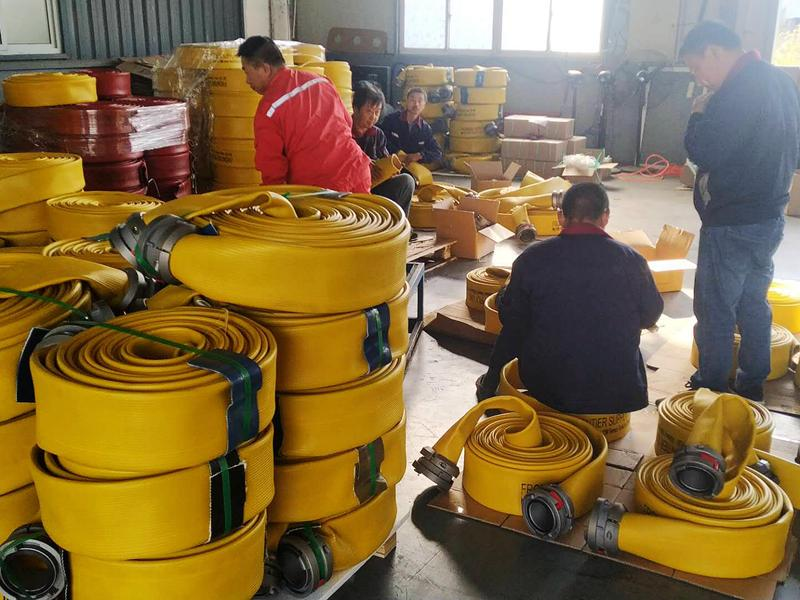
Total cost of ownership (TCO) calculations consistently favor premium UV-resistant NBR hoses over budget alternatives requiring frequent replacement. While initial purchase price runs 30-40% higher, the extended service life and reduced downtime costs deliver superior value across typical 5-year operational horizons. [bigmarketing]
A 500-foot, 4-inch diameter standard PVC layflat hose costs approximately $0.85-1.10 per foot, delivering 12-18 months of desert service before UV degradation necessitates replacement. Over five years, operators purchase replacement hoses 3-4 times, accumulating material costs of $1,275-2,200 plus labor for changeouts. [papagenogroup]
Premium UV-stabilized NBR layflat hose runs $1.25-1.45 per foot but delivers 4-5 years of reliable service in identical conditions. The one-time investment of $625-725 (500 feet) eliminates multiple replacements, change-out labor (estimated at $200-300 per event), and downtime costs that can exceed $500-1,000 per incident for time-sensitive operations. [jafirehose]
| Cost Factor | Standard PVC (5 Years) | UV-Resistant NBR (5 Years) | Savings |
|---|---|---|---|
| Initial Purchase | $425-550 | $625-725 | - |
| Replacements | $850-1,650 (3-4x) | $0 | $850-1,650 |
| Installation Labor | $600-1,200 (3-4x) | $200-300 (1x) | $400-900 |
| Downtime Costs | $1,500-4,000 | $0-500 | $1,500-3,500 |
| Total 5-Year TCO | $3,375-7,400 | $825-1,525 | $2,550-5,875 |
Unplanned hose failures during critical pumping operations create cascading costs far exceeding material replacement expenses. Agricultural irrigation failures during peak growing season can result in crop stress costing thousands per acre, while mining dewatering interruptions may idle entire operations at hourly costs exceeding $10,000. [agriculturedive]
UV-resistant NBR hoses from established manufacturers like Sunmoon deliver predictable performance that supports planning and budgeting. Operations managers can schedule preventive maintenance during planned downtime rather than responding to emergency failures that disrupt production schedules. [jafirehose]
As a specialized NBR layflat hose manufacturer, Sunmoon engineers custom solutions addressing unique requirements that standard catalog products cannot meet. Our technical team collaborates with clients to optimize hose specifications for their specific desert operating conditions, pressure requirements, and deployment methods. [robertsiegers]
Sunmoon manufactures NBR layflat hoses from 1.5 inches to 12 inches in diameter to match pump output and flow requirements across agricultural, mining, construction, and industrial applications. Custom length fabrication eliminates the need for field splicing, reducing leak points and maintaining maximum pressure capacity throughout the hose run. [kebinghose]
Large-diameter hoses (8-12 inches) for high-volume pumping applications receive reinforced construction with additional polyester layers to handle the increased pressure loads while maintaining the flexibility required for compact storage. These specifications commonly serve mining dewatering operations moving 1,000-5,000 GPM across distances exceeding 2,000 feet. [jonestownag]
Sunmoon factory-installs couplings using proprietary bonding techniques that create connections stronger than the hose body itself, eliminating the primary failure point in field-assembled systems. Our aluminum camlock fittings feature UV-resistant gaskets engineered to match the hose's desert service life without requiring replacement. [sunhose]
Custom coupling spacing accommodates specific pump configurations and deployment equipment, optimizing operational efficiency while reducing the total number of connections (and potential leak points) required for complete installations. This engineering approach proves particularly valuable for permanent or semi-permanent irrigation systems where minimizing maintenance requirements drives system design. [ehn]
Desert environments combine UV exposure with severe abrasion challenges from rock, gravel, and sand that standard hoses cannot withstand. Sunmoon's reinforced outer layer construction incorporates abrasion-resistant compounds tested to exceed 10,000 cycles in Taber abrasion testing, compared to 3,000-5,000 cycles for standard NBR formulations. [zyfire]
Strategic reinforcement at high-wear zones such as coupling interfaces and common drag points extends service life in applications where hoses are frequently repositioned across abrasive surfaces. This targeted engineering approach optimizes material usage and cost-effectiveness while delivering protection precisely where operational demands require it. [bigmarketing]
Emerging nanotechnology additives promise UV protection levels 40-50% beyond current carbon black formulations while reducing material weight and improving flexibility. Research prototypes incorporating nano-titanium dioxide and nano-zinc oxide particles demonstrate exceptional UV absorption across broader wavelength ranges, potentially extending desert service life to 7-10 years for premium products. [bybenson]
Smart hose technology integrating embedded sensors will enable real-time monitoring of UV exposure, internal pressure, and temperature, allowing predictive maintenance strategies that optimize replacement timing. Early commercial applications in high-value mining operations show 35% reduction in total hose costs through data-driven lifecycle management. [linkedin]
Sustainable bio-based rubber compounds under development offer equivalent UV resistance to petroleum-based NBR while reducing environmental impact. While currently cost-prohibitive for most industrial applications, ongoing research suggests bio-NBR could reach price parity within 3-5 years as production scaling advances. [dignitas]
Q: How long do UV-resistant NBR layflat hoses last in desert conditions?
A: Quality UV-resistant NBR layflat hoses typically deliver 3-5 years of reliable service in extreme desert environments with proper maintenance and storage practices. Service life depends on UV exposure intensity, operating pressure, storage protocols, and abrasion factors, with some well-maintained hoses exceeding 6 years in semi-arid regions. [sunhose]
Q: Can I repair UV-damaged sections of layflat hose, or must I replace the entire length?
A: While minor surface crazing may not require immediate action, any visible cracking or loss of flexibility indicates structural compromise that cannot be reliably repaired. UV degradation affects material properties throughout the damaged section, making patch repairs unsafe for pressurized applications. Replace compromised sections or the entire hose to prevent catastrophic failure during operation. [sunhose]
Q: What's the difference between UV resistance in NBR versus PVC layflat hoses?
A: NBR (Nitrile Butadiene Rubber) offers inherent molecular resistance to UV degradation and ozone cracking that significantly outperforms PVC materials. NBR hoses maintain flexibility and tensile strength under prolonged sun exposure, typically lasting 3-4 times longer than comparable PVC hoses in desert conditions. PVC hoses become brittle and crack-prone after 6-18 months of continuous UV exposure, while quality NBR formulations resist this degradation for 3-5 years. [papagenogroup]
Q: Do I need UV-resistant hoses if my pumping operations only run during nighttime hours?
A: Yes, because hoses remain exposed to UV radiation during non-operational daylight hours unless stored in completely dark environments. Even hoses used exclusively at night accumulate substantial UV exposure during storage and standby periods, making UV resistance essential for desert applications. The only exception is hoses stored in covered facilities and deployed only at night, but this operational model rarely proves practical. [sinohose]
Q: How can I tell if my current layflat hose has adequate UV protection?
A: Contact your hose supplier for material specifications and UV stabilizer information, as visual inspection cannot reliably determine UV protection levels in new hoses. For hoses already in service, monitor for early degradation signs including color fading, loss of surface gloss, increased stiffness, and surface crazing appearing within the first 6-12 months of desert exposure. Quality UV-resistant hoses should show minimal visible change during this period. [jafirehose]
1. Robert Siegers - SEO for Manufacturers: Strategies to Dominate Search in 2025
https://robertsiegers.com/en/seo-for-manufacturers
2. Wellows - E-E-A-T Checklist for SEO: Strengthen Content with LLM Insights
https://wellows.com/blog/e-e-a-t-checklist/
3. Scube Marketing - Industrial Content Marketing: Creating Content That Generates Leads
https://www.scubemarketing.com/blog/industrial-content-marketing
4. BigMarketing - Manufacturing SEO: 10 Proven Strategies for Top Rankings
https://bigmarketing.com/manufacturing-seo/
5. Innovation Visual - Google's EEAT Guidelines - How To Remain Compliant
6. Kebing Hose - Layflat Hoses: Durable, Flexible, UV-Resistant - Why Us?
https://www.kebinghose.com/news/layflat-hosesdurable-flexible-uv-resistant-why-us.html
7. Jafire Hose - Rubber Layflat Hose vs PVC: Durability for High-Pressure Irrigation
https://www.jafirehose.com/news/industry-news/rubber-layflat-hose-vs-pvc-irrigation-durability.html
8. Sunhose - What are common problems with layflat hose?
https://www.sunhose.com/what-are-common-problems-with-layflat-hose/
9. ZYfire - What Makes a Lay Flat Discharge Hose Truly Durable?
https://www.zyfire.com/news/what-makes-a-lay-flat-discharge-hose-truly-durable
10. Orient Hose - What are some common problems that can occur with a layflat hose
https://www.orient-hose.com/what-are-some-common-problems-that-can-occur-with-a-layflat-hose/
11. Sunhose - Heavy Duty Layflat Hose
https://www.sunhose.com/heavy-duty-layflat-hose/
12. Alibaba - The Science Behind Nbr Pvc Layflat Hose
https://www.alibaba.com/product-insights/nbr-pvc-layflat-hose.html
13. Sinohose - Precautions When Using a TPU Layflat Hose
https://www.sinohose.com/precautions-when-using-a-tpu-layflat-hose.html
14. Jonestown Ag - Flat Lay Discharge Hose – UV Protected, Heavy Duty, Flexible
15. Agriculture Dive - Drying up: Can desert farms survive a changing climate?
https://www.agriculturedive.com/news/desert-farming-climate-change-southwest-arizona-water/712536/
16. Papageno Group - Differences between PVC Layflat Hose and TPU Layflat Hose
17. LinkedIn - How to Prevent Hose Failures in Extreme Environments?
https://www.linkedin.com/pulse/how-prevent-hose-failures-extreme-environments-andrew-cao-fbwmc
18. EHN - Desert farming in the Southwest stretches water resources amid climate stress
https://www.ehn.org/southwest-desert-farming-water-stress
19. Sunhose - PVC vs. Rubber vs. TPU Layflat Hoses Key Differences
https://www.sunhose.com/layflat-hoses-decoded-why-pvc-rubber-and-tpu-cater-to-different-needs/
20. ASJ Hose - Protecting Your Hoses from the Heat: Essential Tips for Longevity and Safety
https://www.asjhose.com/protecting-your-hoses-from-the-heat-essential-tips-for-longevity-and-safety/
21. Truthout - Climate-Fueled Heat Waves Are Creating a Water Crisis in the Southwest
22. Bybenson - UV-Resistant Garden Hose: Shield Against Harmful Sun Rays
https://www.bybenson.com/en-us/blogs/news/uv-resistant-garden-hose-shield-against-harmful-sun-rays


