

Views: 232 Author: Sunmoon Publish Time: 2026-07-02 Origin: Site


Content Menu
● Understanding the Connection Mechanism of PU Layflat Hoses
>> Structural Design of Hose-to-Fitting Connections
● Common Failure Modes in Frac Water Transfer Hoses
>> 2. Localized Bulging Near Fittings
>> 3. Outer Wall Damage Near Couplings
● Root Cause Analysis: Why Does Bulging Occur?
>> Internal Damage from Sharp Edges and Burrs
>> Pressure-Induced Water Migration
>> Comparison: Damaged vs. Undamaged Inner Wall
● Field-Tested Solutions to Prevent Hose Bulging
>> 1. Pre-Installation Inspection (Critical Step)
>> 2. Precision Alignment During Installation
>> 3. Controlled Tightening and Torque Management
>> 4. Emergency Response to Bulging
● Why PU Layflat Hoses Still Dominate the Market
● The Shift Toward Pre-Assembled Hose Systems
>> Factory-Assembled Hose Systems
● Case Study: Field Feedback from a Shale Gas Project
● How Sunmoon Enhances Hose Reliability
● Practical Checklist for Operators
● FAQs
>> 1. What causes bulging in frac water transfer hoses?
>> 2. Can a bulging hose be repaired?
>> 3. Why is alignment important during installation?
>> 4. Are PU layflat hoses better than rubber hoses?
>> 5. How can I reduce installation errors?
Frac water transfer hoses are the backbone of modern shale gas operations, yet persistent issues like joint slippage, bulging, and inner wall damage continue to undermine performance and safety. Drawing on field experience, engineering principles, and real-world user feedback, this article explores why these failures occur and how to prevent them, with a focus on high-performance TPU layflat hoses from manufacturers like Sunmoon.
In large-scale hydraulic fra cturing operations, Frac Water Transfer Hoses play a critical role in transporting massive volumes of water over long distances. However, many operators report recurring issues such as joint slippage, localized bulging, and outer wall damage near fittings, especially when using polyurethane (PU) layflat hoses under high pressure.
From both a field engineer's perspective and a manufacturer's viewpoint, these problems are not random—they stem from identifiable mechanical and installation factors. This guide combines practical troubleshooting, design insights, and preventive measures to help operators maximize hose lifespan and system reliability.
To diagnose failures, it is essential to first understand how the hose and coupling system works.
A typical Frac water transfer hose assembly involves:
- A rigid metal coupling inserted into the inner wall of the hose
- A trapezoidal groove system on the coupling
- A metal clamp (collar) aligned with the groove
- High-strength bolts and nuts to secure the clamp
When tightened, the system creates:
- Mechanical grip via the clamp
- Elastic sealing due to the flexibility of polyurethane
- A closed pressure channel for water transfer
This design relies heavily on precision alignment and surface quality. Even small imperfections can lead to significant failures under high pressure.
Based on industry observations and user feedback, three major issues frequently occur:
- Caused by insufficient clamping force or misalignment
- Leads to partial or complete disconnection
- High safety risk in high-pressure systems
- The most critical and commonly reported issue
- Results in reduced flow efficiency
- Can escalate into rupture if ignored
- Typically caused during installation
- Weakens structural integrity over time
Among these, bulging is the most complex and impactful, requiring deeper analysis.
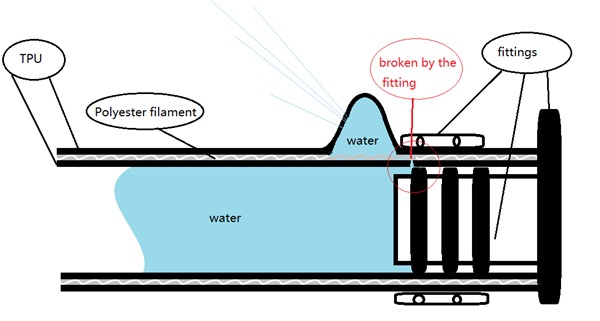
The primary cause of bulging is internal liner damage during installation.
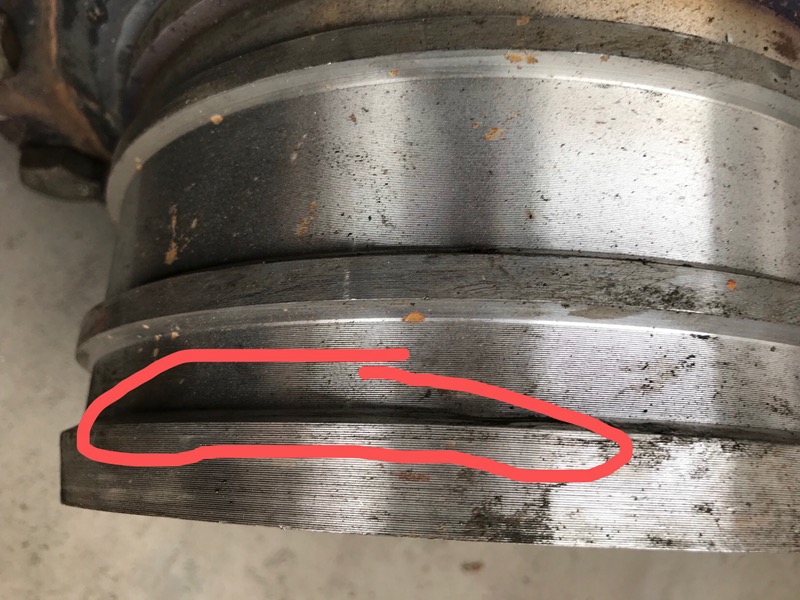
When the trapezoidal grooves on the coupling or clamp contain burrs or sharp edges:
- Tightening the clamp cuts into the inner PU layer
- This creates micro-channels within the hose wall
Once the hose is pressurized:
- Water penetrates through the damaged inner layer
- It reaches the polyester reinforcement layer
- Eventually migrates outward to the outer layer
This leads to:
- Localized swelling or bubbling
- Progressive structural weakening
- Undamaged hose: Maintains full sealing integrity
- Damaged hose: Allows internal leakage and expansion
Even minor internal scratches can evolve into visible bulging after prolonged use.
Drawing from both manufacturing standards and field repair practices, the following steps are essential.
Before installation, thoroughly check:
- Coupling grooves for sharp edges or burrs
- Clamp surfaces for welding residues or splatter
- Groove edges for proper chamfering or rounding
If defects are found:
- Perform grinding and polishing
- Ensure all contact surfaces are smooth and uniform
This step alone can eliminate a large percentage of failures.
Improper alignment is a hidden but major risk.
Best practices:
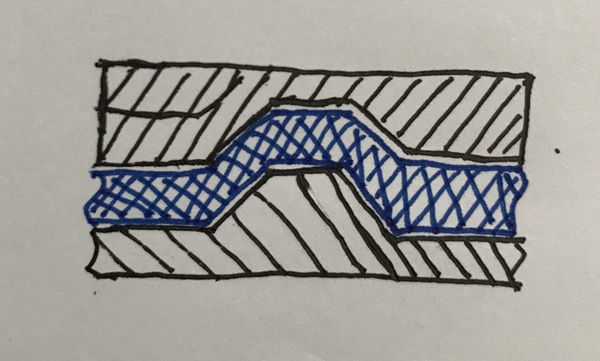
1. Align clamp grooves precisely with coupling grooves
2. Avoid offset or skewed positioning
3. Use a measuring tape to verify alignment before tightening
Even slight misalignment can:
- Concentrate stress on one side
- Increase risk of internal damage
Over-tightening is just as dangerous as under-tightening.
- Use calibrated tools where possible
- Apply even torque distribution
- Avoid sudden or uneven tightening
This ensures:
- Uniform distribution
- Reduced risk of liner damage
If bulging occurs:
- Immediately release system pressure
- Remove the affected coupling
- Assess hose length
Repair options:
- If sufficient length remains: reinstall coupling
- If not:
- Cut damaged section
- Use two couplings to reconnect
Quick action prevents escalation into catastrophic failure.
Despite these issues, polyurethane layflat hoses remain the preferred choice in frac operations.
- High abrasion resistance
- Excellent flexibility under pressure
- Lightweight and easy to deploy
- Excellent chemical resistance
However, their elastic nature also makes them more sensitive to:
- Surface imperfections
- Installation quality
This reinforces the importance of precision handling and quality control.
A growing trend in global markets is the adoption of:
Benefits include:
- Reduced on-site installation errors
- Consistent quality control
- Faster deployment
Manufacturers like Sunmoon are increasingly offering:
- Custom pre-fitted hose assemblies
- Tailored coupling designs
- Application-specific configurations
This shift significantly reduces human error, which is the root cause of many failures.
A North American operator reported:
- Frequent bulging issues within 2 weeks of deployment
- Root cause traced to unpolished coupling grooves
After implementing:
- Pre-installation polishing
- Alignment verification
Results:
- Failure rate reduced by over 70%
- Improved flow consistency
- Lower maintenance costs
This highlights how small procedural changes deliver significant ROI.
As a specialized Chinese manufacturer, Sunmoon focuses on both product quality and application support.
- Custom OEM/ODM solutions
- Precision-engineered coupling systems
- Strict surface finishing standards
- Technical guidance for installation
Sunmoon also emphasizes:
- Global adaptability
- Compliance with industry standards
- Continuous product improvement based on user feedback
Before deploying your frac water transfer system, ensure:
- All fittings are free of burrs and sharp edges
- Clamp and groove alignment is precisely matched
- Installation tools are properly calibrated
- Operators are trained in correct assembly procedures
This checklist can dramatically improve system reliability and lifespan.
If you are experiencing recurring hose failures or want to optimize your frac water transfer system, consider working with a manufacturer that understands both engineering design and field realities.
Contact Sunmoon today to explore customized Frac Water Transfer Hose solutions tailored to your operational needs. Reduce downtime, improve safety, and maximize performance with expert-backed products.
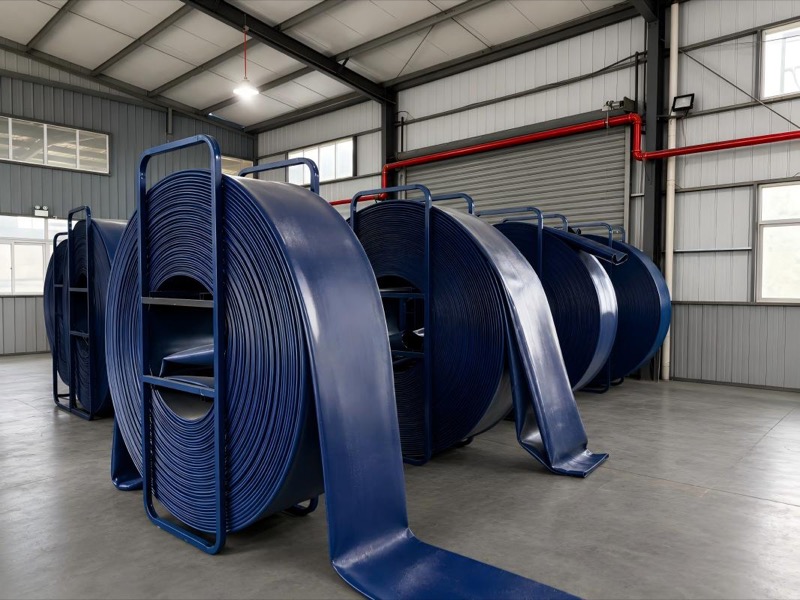
Bulging is primarily caused by internal liner damage, often due to sharp edges or burrs on couplings, allowing water to seep into the hose structure.
Yes, if detected early. The damaged section can be removed and reconnected using couplings, provided sufficient hose length remains.
Misalignment causes uneven stress distribution, increasing the risk of internal damage and eventual failure.
PU hoses offer better flexibility, abrasion resistance, and weight advantages, but require more careful handling during installation.
Use pre-assembled hose systems, follow strict inspection protocols, and ensure proper training of installation personnel.
1. Sunmoon Hose – Frac Water Hose Product Page https://www.sunmoonhose.com/frac-water-hose.html
2. U.S. Department of Energy https://www.energy.gov
3. Society of Petroleum Engineers https://www.spe.org
4. Oil & Gas IQ https://www.oilandgasiq.com


