

Views: 222 Author: Loretta Publish Time: 2026-01-08 Origin: Site


Content Menu
● Why Industrial Hose Storage Matters
>> Temperature, Humidity, and Air Quality
>> Protection From Light, Ozone, and Chemicals
● Main Industrial Hose Storage Solutions
● Wall‑Mounted Hooks, Hangers, Tracks, and Balancers
● Hose Trolleys and Mobile Carts
● TPU Layflat Hose Storage Best Practices
● Step‑by‑Step Storage Procedure
>> Step 1: Cleaning and Initial Inspection
>> Step 2: Drying and Contamination Control
>> Step 3: Depressurizing and Relaxing
>> Step 4: Coiling and Placement
● Labeling, Organization, and Shelf‑Life Control
● Ongoing Inspection During Storage
● Storage Recommendations by Hose Type
● Building a Hose Management Program Around TPU Layflat Hoses
● Clear, Targeted Call to Action
● FAQs About Industrial Hose and TPU Layflat Hose Storage
>> 1. How often should stored industrial hoses be inspected?
>> 2. Can TPU layflat hoses be stored outdoors?
>> 3. Is it safe to hang heavy hoses on a single hook?
>> 4. Do thermoplastic and TPU hoses have a defined shelf life?
>> 5. What is the most common mistake in hose storage?
Properly storing industrial hoses, especially modern TPU layflat hoses, is one of the most effective ways to extend service life, reduce failures, and improve workplace safety. With a well‑designed storage strategy, facilities can protect hoses from environmental and mechanical damage while improving operational efficiency.
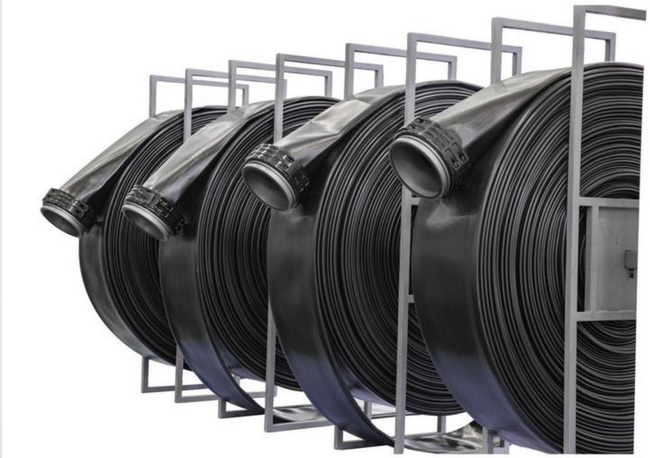
A well‑managed storage system shields hoses from UV, ozone, chemicals, mechanical stress, and moisture, all of which can drastically shorten service life and increase failure risk. It also improves productivity by reducing search time, mis‑picks, and unplanned downtime in day‑to‑day operations.
Key business benefits include:
- Longer hose service life and fewer urgent replacements.
- Reduced leaks, bursts, and contamination incidents that can halt production.
- Better inventory control and clearer maintenance planning for critical assemblies.
The storage environment is just as important as the hardware used to hold hoses. Most recommendations favor a cool, stable indoor space with controlled conditions.
- Keep temperature in a moderate range to minimize hardening, cracking, or loss of flexibility.
- Maintain a dry, clean, and well‑ventilated area to prevent mold, corrosion, and jacket degradation on both hose and fittings.
- Avoid large temperature swings that can accelerate aging of elastomers and thermoplastics.
Certain environmental factors significantly speed up hose degradation, especially over long storage periods.
- Store hoses indoors or under cover, away from direct sunlight and rain.
- Keep hoses away from ozone‑generating equipment such as welding machines, high‑voltage systems, and large electric motors.
- Prevent long‑term exposure to aggressive chemicals, solvents, oils, or fuels unless hoses are sealed and fully compatible.
Different facilities require different storage systems depending on hose length, diameter, material, and usage frequency. Selecting the right combination of systems improves both protection and access.
Hose reels are cylindrical devices that allow hoses to be wound and unwound quickly, making them ideal for high‑use or long‑length hoses.
- Manual reels are suited to light‑ and medium‑duty applications that prioritize low cost and simplicity.
- Motorized reels (electric or hydraulic) support heavier hoses, frequent cycling, and longer storage distances.
Advantages
- Fast deployment and retraction to reduce operator fatigue and tripping hazards.
- Helps maintain roundness and reduces the risk of flat spots and kinks when correctly sized.
- Can be mounted on walls, skids, or equipment to save floor space.
Limitations
- Standard designs may not fit very large‑diameter or extremely long hoses without custom sizing.
- Open reels provide limited shielding from dust, UV, and chemicals unless combined with covers or enclosures.
Hose racks support multiple hoses in an organized array, keeping assemblies off the floor and easy to inspect.
- Wall‑mounted racks work well in permanent maintenance bays with solid structures.
- Freestanding racks can be moved or reconfigured as hose inventories change.
Advantages
- Structured hanging that minimizes twisting, stacking, and compression damage.
- Quick visual checks for wear, labeling, and leaks at ends and fittings.
- Easy segmentation by size, pressure rating, or application area.
Limitations
- Limited capacity per bay; large inventories require modular expansion.
- Requires careful anchoring and sufficient aisle clearance to prevent impacts from vehicles or carts.
Wall‑mounted systems are compact solutions for keeping hoses on vertical surfaces, often near the point of use.
- Hooks and hangers support coiled hoses and keep them off the floor.
- Track systems allow hoses to slide laterally for easier selection and retrieval.
- Spring balancers support hose weight during operation and retract hoses automatically when not in use.
Advantages
- Excellent space saving and improved tidiness in work areas.
- Reduced trip hazards and impact damage in tight workshops or service bays.
Limitations
- Limited storage capacity, typically suited to operational rather than bulk storage.
- Requires robust walls or frames for safe mounting and long‑term reliability.
Hose cabinets provide fully enclosed storage for hoses that require stronger protection against the environment or unauthorized use.
- Wall‑mounted cabinets fit smaller hose sizes and shorter lengths.
- Floor‑mounted cabinets support larger volumes and bulkier assemblies.
- Lockable cabinets help control access to safety‑critical or certified hoses.
- Ventilated cabinets allow airflow to reduce condensation and moisture buildup.
Advantages
- Strong shielding from UV, dust, chemicals, and physical impacts.
- Clear internal organization and labeling support fast emergency response and scheduled maintenance.
- Suitable for hoses governed by strict shelf‑life or certification requirements.
Limitations
- Higher initial cost and need for adequate wall or floor space.
- Requires more planning for layout, installation, and future expansion.
Wooden boxes are a portable, customizable choice, often used for temporary yards, mobile projects, or export shipments.
- Standard boxes offer simple physical protection for coiled hoses.
- Custom boxes are built to specific hose diameters and lengths.
- Lined boxes include foam or rubber padding to cushion hoses and fittings during transport.
Advantages
- Good impact resistance during handling, logistics, or cross‑site transport.
- Easy to label externally by project, medium, or pressure class.
Limitations
- Wood can warp, absorb moisture, or harbor pests if not properly treated and maintained.
- Lower long‑term durability in high‑humidity, coastal, or outdoor storage scenarios.
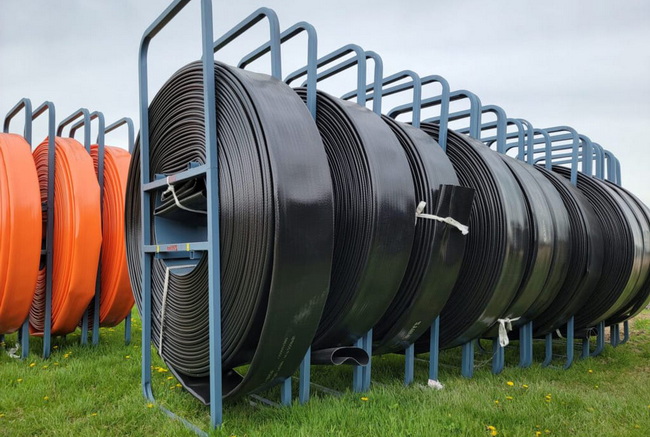
Hose trolleys are designed for frequent hose movement between job sites or distant parts of a facility.
Advantages
- High mobility, allowing a single operator to handle long or heavy assemblies safely.
- Often integrate hooks or reels for controlled coiling and uncoiling.
- Minimizes dragging hoses across rough ground, which is especially important for TPU layflat hoses.
Limitations
- Requires clear aisles, ramps, and parking space to operate effectively.
- Needs periodic checks and maintenance of wheels, casters, and frames.
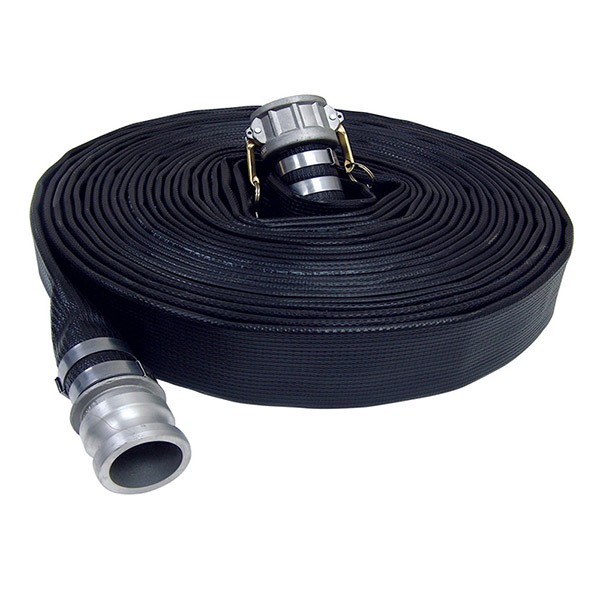
TPU layflat hoses lie flat when depressurized, offering major storage and transportation advantages over traditional rubber or PVC hoses. They typically feature a TPU cover, reinforcement, and excellent resistance to abrasion, puncture, and many chemicals.
Key characteristics relevant to storage:
- Lightweight and compact when flat, yet able to handle long‑distance water or fluid transfer when pressurized.
- Commonly used in agriculture, mining, industrial water transfer, emergency supply, and similar demanding applications.
Recommended storage practices:
- After use, fully drain and clean the interior to remove water, slurry, or chemicals and avoid internal degradation or microbial growth.
- Store hoses in a dry, cool, shaded area; avoid prolonged direct sunlight, even though TPU has good UV resistance.
- Prevent sharp bends, tight knots, or heavy loads on the flat hose to avoid localized deformation and potential weak spots.
- In cold climates, use temperature‑controlled areas above freezing and avoid flexing or coiling hoses when extremely cold.
A dedicated TPU layflat zone with wide‑radius racks or reels, clear labeling, and good ventilation is an effective way to protect this high‑value hose category.
A standardized, documented procedure ensures hoses are stored safely and consistently across teams and shifts.
- Clean the hose internally and externally according to the medium carried and the manufacturer's recommendations.
- Inspect for cuts, bulges, abrasions, exposed reinforcement, rusted fittings, or leaks.
- Remove or tag any hose that fails inspection and route it to repair, testing, or disposal.
- Allow hoses to drain and air‑dry completely using drying racks, stands, or suitable airflow.
- Avoid storing damp hoses in dark, warm areas to reduce mold growth and corrosion.
- Use protective end caps or plugs to keep dust, moisture, and debris out of the hose bore.
- Ensure hoses are fully depressurized and disconnected from power sources before handling or storage.
- Store hoses in a relaxed state, without permanent tension, compression, or twisting.
- Avoid stacking heavy items on top of stored hose coils to prevent flattening and cover damage.
Apply a coiling method suited to hose length, stiffness, and material.
- Single coil: convenient for short, flexible hoses that can be coiled by hand while following natural curvature.
- Figure‑eight coil: suitable for longer hoses to reduce twist and kinking where hose memory is a concern.
- Reel winding: ideal for frequent use or long lines when coils are formed directly on a properly sized reel.
For TPU layflat hoses, store them in their natural flat, coiled form with gentle strapping and no sharp edges where the hose contacts racks, boxes, or pallets.
Modern hose management depends on effective identification and tracking.
- Label each hose with size, pressure rating, temperature range, medium, and manufacturing or first‑use date.
- Use color coding or clearly marked zones to separate applications such as water, chemicals, compressed air, or fire‑fighting.
- Apply a First‑In, First‑Out principle so older hoses are used or inspected first to avoid unnecessary scrapping.
Many facilities also maintain a simple register or digital record with hose IDs, storage locations, inspection dates, and any maintenance actions taken.
Hoses continue to age while in storage, so periodic checks remain important.
- Define inspection intervals based on criticality: more frequent checks for high‑pressure or safety‑critical hoses, less frequent for general service.
- During inspection, look for cracking, discoloration, surface blistering, hard spots, absorbed chemicals, rust at fittings, and deformation in coils.
- Rotate coiled hoses and adjust positions occasionally to reduce long‑term flat spots and compression marks.
For seasonal TPU layflat hose applications, include a pre‑season inspection and storage‑to‑service checklist before deployment.
Using a simple matrix helps teams choose appropriate storage for each hose family.
Hose Type / Typical Use | Recommended Storage System | Environment Notes |
High-pressure hydraulic hose | Enclosed racks or cabinets with end caps | Cool, dry, away from light and ozone sources |
General industrial rubber hose | Wall or floor racks, hooks, or reels | Clean, dry, moderate temperature |
TPU layflat transfer hose | Wide-radius racks, reels, or flat coils in boxes | Shaded, dry, avoid freezing and direct sunlight |
PVC layflat hose | Shelves or boxes with broad support surfaces | Cool, dry, ventilated, away from heat sources |
Fire-fighting and emergency hoses | Labeled cabinets or dedicated reels | Highly accessible and protected from contamination |
This type of structure turns storage selection into a quick, repeatable decision rather than a guess at each location.
For sites that use long or multiple TPU layflat lines, treating hoses as managed assets rather than simple consumables brings measurable benefits.
Recommended practices include:
1. Creating a master list of all TPU hose lengths, diameters, and pressure ratings, including batch or serial information.
2. Assigning dedicated storage locations for each size and pressure class with clear signage.
3. Implementing a usage and inspection log that records operating hours, campaigns, media, and any observed issues.
4. Aligning storage and inspection routines with applicable standards and manufacturer guidance.
This structured approach helps reduce unexpected failures on long layflat runs and lowers the overall cost of ownership.
If your operations rely on demanding fluid transfer tasks and you want hoses that store compactly, deploy quickly, and deliver long service life, this is the time to review your hose strategy. Upgrade your hose fleet with engineering‑driven TPU layflat solutions and match them with professional storage systems, clear labeling, and standardized procedures. Reach out to a specialized TPU layflat hose manufacturer and request guidance on customized hose selection, storage layout design, and maintenance planning so your team can confidently achieve safer, more efficient, and more cost‑effective operations.
Most facilities inspect critical hoses at least every three to six months and general service hoses at least annually. Very harsh operating conditions, long storage periods, or safety‑critical applications often require shorter inspection intervals.
Short‑term outdoor storage is sometimes acceptable if hoses are clean, dry, shaded, and protected from mechanical damage. For long‑term storage, indoor areas are strongly preferred to avoid UV exposure, temperature extremes, and accidental impacts.
Heavy or large‑diameter hoses should not be hung from a single narrow hook. They should be supported on wide, smooth racks or multiple supports to avoid sharp bends, kinks, and concentrated stress points that can reduce service life.
Thermoplastic and TPU hoses often show very long or practically unlimited storage life when kept in proper conditions. However, each manufacturer provides its own recommendations regarding maximum shelf life and inspection intervals, and those guidelines should always be followed.
A common critical mistake is leaving hoses on the floor in busy areas where they are exposed to constant foot or vehicle traffic, oil, and sunlight. Other frequent issues include storing hoses under tension, coiling them too tightly, and failing to dry or cap them before long‑term storage.


