

Views: 222 Author: Loretta Publish Time: 2026-01-23 Origin: Site


Content Menu
● Why ISO 18752 Matters for Hydraulic Systems
● ISO 18752 Classes and Constant Pressure Levels
● Nominal Sizes and Applicability by Class
● Grades A, B, C, D and Hose Types
● Impulse Performance and Expected Service Life
>> Typical Impulse Requirements
● Type and Maximum Working Pressure Mapping
● Core Performance Requirements in ISO 18752
● ISO 18752 vs. Traditional DIN and SAE Standards
● Practical Hose Selection Using ISO 18752
>> Step 1: Define System Pressure
>> Step 2: Evaluate Duty Cycle and Environment
>> Step 3: Check Space Constraints
>> Step 4: Confirm Size Availability
>> Step 5: Verify Compatibility
● Example Manufacturer Implementation
● Compact Hydraulic Hoses: Space-Saving Design
● Super Flexible Hydraulic Hoses and Sustainability
● Quality, Certification, and Reliability
● Action-Oriented Conclusion: Upgrade Your Hydraulic System Strategy
● FAQ: ISO 18752 Hydraulic Hoses
>> Q1. What is the main advantage of ISO 18752 over older hose standards?
>> Q2. How do I choose between grades A, B, C, and D?
>> Q3. When should I use compact hose types (AC, BC, CC, DC)?
>> Q4. Are ISO 18752 hoses compatible with existing SAE or DIN hose references?
>> Q5. What certifications should I look for in an ISO 18752 hose supplier?
ISO 18752 is a global standard that classifies and tests hydraulic hoses based on constant working pressure and impulse performance, making hose selection faster, safer, and more consistent across applications. This guide explains the standard in depth and shows how to use ISO 18752 in real projects to improve reliability, uptime, and maintenance efficiency.

ISO 18752 is an international standard for steel wire or textile reinforced hydraulic hoses and hose assemblies used with petroleum-based hydraulic fluids. It defines technical requirements, test methods, dimensional specifications, and performance indicators so manufacturers and users worldwide can work with unified criteria.
Unlike older standards that focus mainly on hose construction, ISO 18752 centers on constant pressure ratings across all hose sizes in a family. This makes it easier for engineers to match hoses to system pressure and duty cycles without recalculating for each diameter.
Using ISO 18752 hoses helps engineers and maintenance teams:
- Reduce selection errors by choosing hoses based on pressure class and impulse grade rather than complex construction rules.
- Improve safety and reliability because hoses are tested to strict pressure, temperature, oil resistance, and aging requirements.
- Standardize global sourcing, since ISO 18752 is widely accepted and recognized in international markets.
For OEMs and system integrators, ISO 18752 also simplifies documentation and after-sales support, because performance expectations are clearly defined and validated.
ISO 18752 defines ten maximum working pressure (MWP) classes, from 3.5 MPa to 56 MPa (35–560 bar). Each pressure class applies to the entire size range of that hose family, which is a key difference from many DIN and SAE standards where pressure changes with size.
ISO 18752 Class | MWP (MPa) | MWP (bar) |
35 | 3.5 | 35 |
70 | 7 | 70 |
140 | 14 | 140 |
210 | 21 | 210 |
250 | 25 | 250 |
280 | 28 | 280 |
350 | 35 | 350 |
420 | 42 | 420 |
490 | 49 | 490 |
560 | 56 | 560 |
This constant-pressure concept is especially useful in:
- Mobile equipment with mixed hose sizes, such as excavators, cranes, and mining trucks.
- Industrial systems with long hose runs and multiple branches operating at a defined system pressure.
ISO 18752 covers hose nominal sizes from 5 mm to 102 mm, but not every size is available at every pressure class. In the standard tables, “X” indicates that a given size can meet the specified class, while “N/A” means that series cannot safely reach that pressure.
In practical terms:
- Smaller sizes, such as 5–12.5 mm, are typically available for most classes from 35 to 420 bar.
- Larger sizes, especially above 63 mm, are usually limited to lower classes because of structural limits and burst safety margins.
Designers should always match both size and class, ensuring the selected hose is applicable for the required pressure level according to the standard table.
ISO 18752 divides hoses by impulse resistance grade and construction type. This provides a clear way to match hoses to duty cycles ranging from general industrial use to extreme high-cycle applications.
- Grade A: Standard impulse performance, suitable for moderate duty applications.
- Grade B: Higher impulse life compared to grade A, often used for more demanding industrial and mobile hydraulics.
- Grade C: High-temperature and high-impulse performance, typically used for spiral hoses in heavy-duty environments.
- Grade D: Very high impulse life, designed for severe duty and long service life in extreme pressure conditions.
Each grade is further split into standard and compact variants:
- AS, BS, CS = standard types.
- AC, BC, CC, DC = compact types.
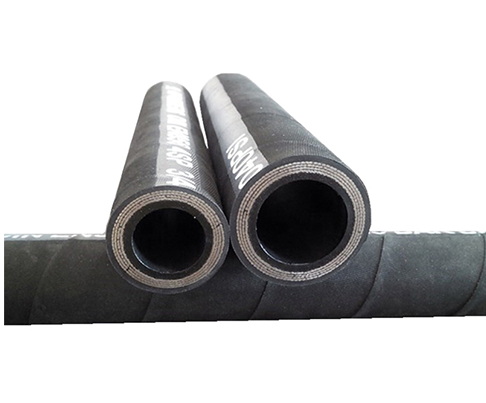
Standard hoses generally have a larger outer diameter and bending radius, while compact hoses achieve smaller outer diameter and tighter bend radius for space-limited installations.
ISO 18752 defines minimum impulse cycles at specific temperatures and percentages of maximum working pressure. These values help engineers estimate relative hose life under demanding load cycles.
For braided hoses:
- Grade A: 200,000 cycles at 133% of MWP at 100 °C.
- Grade B: 500,000 cycles at 133% of MWP at 100 °C.
For spiral hoses:
- Grade C: 500,000 cycles at 120–133% of MWP at up to 120 °C, depending on class.
- Grade D: 1,000,000 cycles at 133% of MWP at 120 °C.
In higher pressure classes (350, 420, 490, 560), Grade C hoses often use 120% of MWP instead of 133% in impulse tests. This balance reflects the extreme stress at very high pressures but still guarantees robust performance.
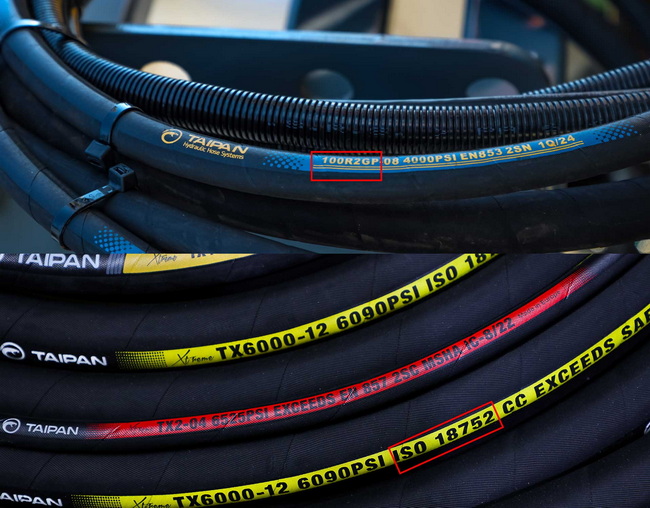
Each pressure class is associated with one or more type combinations (such as AS, AC, CS, CC, DC), and the standard clearly shows where a given type is allowed or not applicable.
In general:
- Grades A and B (AS, AC, BS, BC) cover lower to mid-range classes up to around 420 bar.
- Grade C (CS, CC) starts from 210 bar and extends into higher classes, with compact CC types available up to the highest classes.
- Grade D (DC) serves high-pressure, high-impulse ranges from 210 to about 420 bar.
This structure helps users quickly filter suitable hose families based on both pressure and duty level.
ISO 18752 defines several critical performance criteria that every compliant hose must satisfy.
Key requirements include:
- Pressure resistance: Hoses must safely withstand rated working pressure and pass burst tests without rupture.
- Temperature resistance: Performance must be maintained within specified temperature ranges, with no failure under high or low temperature exposure.
- Oil resistance: Tube and cover must resist swelling, softening, or cracking when exposed to hydraulic oils.
- Aging resistance: Compounds must withstand environmental factors such as UV, ozone, and weathering over time.
- Dimensional accuracy: Inner and outer diameter, concentricity, and minimum bending radius are strictly controlled for each class and grade.
These requirements ensure that ISO 18752 hoses are suitable for demanding hydraulic environments where safety and uptime are critical.
While DIN and SAE standards classify hoses mainly by construction (for example, number of wire braids or spirals) and size-dependent working pressure, ISO 18752 uses a performance-based constant pressure approach.
Key differences:
- ISO 18752 provides the same pressure rating for a hose family across all sizes.
- Many DIN and SAE standards specify working pressure that decreases as hose size increases.
- ISO 18752 places explicit focus on impulse performance, temperature, and duty grades A–D.
- DIN and SAE documents often center more on construction description and basic pressure testing.
For modern machine design, ISO 18752 can reduce complexity, especially in global platforms that must share common hose specifications across multiple regions and suppliers.
To choose an ISO 18752 hose efficiently and safely, follow a clear step-by-step process.
- Identify the maximum working pressure of your hydraulic system.
- Select the ISO class (for example, 210, 280, 350 bar) that is equal to or above this maximum working pressure.
- Use grades A or B for general industrial and moderately demanding applications.
- Choose grades C or D for high-cycle, shock-loaded, or high-temperature systems requiring extended impulse life, such as mining or heavy construction machinery.
- Use compact types (AC, BC, CC, DC) where smaller outer diameter and tighter routing are required.
- In open installations with generous space, standard types (AS, BS, CS) may be sufficient and easier to handle.
- Consult the nominal size tables to confirm that the required diameter is available at the selected class and grade.
- Avoid combinations marked as not applicable, even if pressure calculations appear acceptable in theory.
- Ensure that the hose materials are compatible with the fluid type, including any additives.
- Check ambient and fluid temperature ranges, as well as mechanical factors such as vibration, movement, and routing path.
This structured method reduces the risk of underspecifying hoses and helps extend service life in the field.
A typical ISO 18752-focused manufacturer may offer a full series covering grades A, B, C, and D to support different application levels. Product design, manufacturing, and testing are aligned with ISO 18752 requirements, often backed by quality management certifications.
Such a portfolio usually includes:
- Grade A and B braided hoses: Meeting AS, AC, BS, and BC pulse levels and compatible with widely used braided hose standards.
- Grade C and D spiral and high-impulse hoses: Meeting CS, CC, DC levels and cross-referenced to high-pressure spiral hose standards.
This type of product mapping helps users transition from legacy SAE and DIN references to ISO 18752 families while maintaining or improving system performance.
Compact hydraulic hoses are designed with reduced outer diameters and tighter minimum bending radii, making them ideal for modern compact equipment and dense hydraulic power units.
Typical features of compact hoses include:
- Smaller outer diameter, allowing more hoses to be routed in the same space.
- Tighter bending radius, which supports shorter hose runs and cleaner layouts.
- Good flexibility, simplifying installation and reducing mechanical stress at fittings.
Compact hose constructions that correspond to AC-type performance under ISO 18752 are often used where space is a critical constraint yet reliable pressure performance is still required.
Super flexible hydraulic hoses use optimized reinforcement and thinner outer rubber layers to increase flexibility and reduce bend radius. This improves ease of installation and enhances dynamic performance in moving applications.
Key benefits:
- Improved flexibility for applications with frequent motion, such as robotics, lift platforms, and articulated booms.
- Reduced material usage, especially in designs that use less rubber, which can be relatively more environmentally friendly.
- Enhanced routing options, enabling more ergonomic and efficient hose layouts.
In addition, maintaining a typical safety factor, such as 4:1 between burst and working pressure, ensures that these hoses provide both flexibility and high safety margins.
For users and system designers, the value of ISO 18752 is strongly reinforced when combined with robust manufacturing quality systems.
Important signals of reliability include:
- ISO 9001-certified quality management systems, ensuring consistent processes from raw material through final inspection.
- Product certifications such as CE and industry-specific approvals, which demonstrate compliance with safety and performance requirements.
- Documented testing, including pressure, impulse, and aging tests aligned with ISO 18752 requirements.
Some manufacturers also offer favorable pricing for long continuous lengths, such as rolls longer than 500 m, which can reduce joints, simplify installation, and minimize potential leak points.
Adopting ISO 18752-compliant hydraulic hoses is a strategic way to standardize pressure classes, simplify global specification, and increase system reliability. By selecting the correct combination of class, grade, and type, designers can better control risk, optimize hose routing, and extend service life under real operating conditions.
If your projects involve high working pressure, compact routing, or demanding duty cycles, now is the ideal time to review your hose standards and migrate to an ISO 18752-based approach. Work with an experienced hose manufacturer or engineering partner to audit your current installations, identify improvement opportunities, and specify the ideal ISO 18752 hose families for your equipment.
Contact us to get more information!
The main advantage of ISO 18752 is its focus on constant working pressure across all sizes in a hose family, combined with clear impulse grades. This greatly simplifies hose selection compared with many size-dependent standards and helps designers maintain consistent safety margins across the entire system.
Choose grades A or B for general-purpose and moderately demanding applications where impulse cycles and temperatures are within standard limits. Select grades C or D for high-pressure, high-temperature, or high-cycle applications, especially in heavy-duty mobile or industrial machinery, where extended impulse life and long-term durability are critical.
Compact hose types are the best choice when installation space is limited or when you need tighter bend radii, such as in compact mobile machinery, dense hydraulic power packs, or retrofit projects. They help reduce clutter, improve accessibility, and enable more efficient routing without sacrificing performance.
Many ISO 18752 hose families can be cross-referenced to common SAE and DIN hose designs, especially for braided and spiral constructions. This allows a gradual transition where you align new projects and replacement programs with ISO 18752 while still recognizing familiar reference codes during the changeover period.
Look for suppliers that hold ISO 9001 certification, relevant regional approvals, and industry-specific certifications where required, such as mining or industrial safety standards. These credentials indicate that the manufacturer follows documented processes, performs regular testing, and can provide traceability and support throughout the product lifecycle.


