

Views: 232 Author: Sunmoon Publish Time: 2026-07-07 Origin: Site


Content Menu
● Understanding Large Diameter Frac Water Transfer Hose
● 10 vs 12 Frac Water Hose: Why Diameter Matters
● Flow Volume Fundamentals: 10 vs 12 Layflat Hose
● Practical Flow Comparison: 10 vs 12 in Real Projects
>> Typical Operational Characteristics: 10" vs 12" TPU Frac Water Hose
● Material Matters: Why TPU Layflat Hose Dominates Frac Water Transfer
● Sunmoon's Engineering Approach to Large Diameter Frac Water Hose
● Case‑Based Insights: How Diameter Choice Impacts Operations
● Expert Framework: When 10 Is Ideal vs When 12 Wins
>> When 10 TPU Layflat Hose Is Typically the Right Choice
>> When 12 TPU Layflat Hose Provides Clear Advantages
● Designing Around Elevation and Pressure Surges
● Best‑Practice Steps: How to Select Between 10 and 12 for Your Next Project
● Sunmoon's Customization for 10 and 12 Frac Water Transfer Hose
● UX‑Optimized Summary: 10 vs 12 – A Quick Decision Snapshot
● Clear Call to Action: Design Your Next Frac Water System with Sunmoon
● FAQs: Large Diameter Frac Water Hose (10 vs 12)
Both 10" and 12" large diameter frac water transfer hoses can deliver high flow rates over long distances, but a 12" TPU layflat hose typically provides significantly higher flow volume and lower friction loss at the same pump pressure—while the 10" hose offers a more compact, cost‑efficient option for many shale water transfer layouts. [sunmoonhose]
In modern shale gas and tight oil operations, large diameter frac water transfer hose functions as the main artery feeding high‑volume water from impoundments or rivers to multi‑well pads. Unlike rigid steel pipe or HDPE poly line, TPU layflat frac water hoses can be rapidly deployed, retrieved and rerouted as frac spreads move from pad to pad, making them ideal for dynamic campaigns. [made-in-china]
From my own experience supporting shale gas water transfer projects, the choice of hose diameter, material, and routing strategy is often the difference between smooth frac execution and costly non‑productive time (NPT) caused by pressure drops, leaks, or flow bottlenecks. As a China‑based manufacturer of high‑pressure TPU layflat hose, Sunmoon focuses on engineered frac water transfer solutions rather than just selling hose as a commodity. [sunmoonhose]
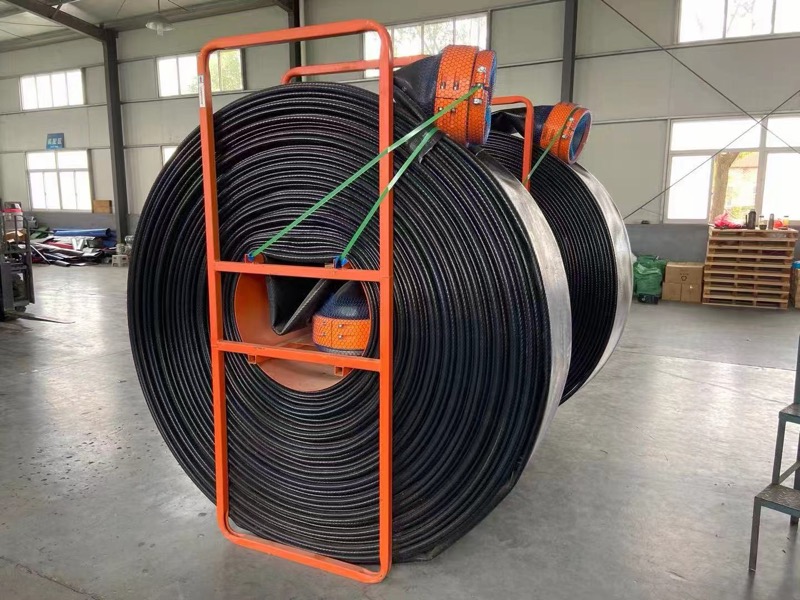
When comparing 10" vs 12" large diameter frac water hose, the core engineering question is simple: *how much water can you move per hour at a given pressure, distance, and terrain?* In hydraulic terms, a larger internal diameter dramatically reduces friction loss per unit length and increases potential flow volume at the same pump power. [made-in-china]
However, diameter is never chosen in isolation. Operators must balance flow targets, pump fleet, terrain, deployment speed, logistics, and budget, which is why both 10" and 12" TPU layflat hoses are widely used as main lines in shale plays. In practice, 10" often becomes the "sweet spot" for many frac water transfer runs, while 12" is selected where ultra‑high flow or longer booster spacing is required. [sunmoonhose]
From a hydraulic perspective, the internal cross‑section area of a 12" hose is noticeably larger than that of a 10" hose, meaning more water can pass through for the same flow velocity. Combined with a smooth TPU inner liner, this helps minimize friction losses, reduce pump energy consumption per barrel, and stabilize pressure profiles over long distances. [made-in-china]
Field reports from high‑capacity layflat systems confirm that large‑diameter TPU hoses (10–12", and even 16") enable higher flow rates with fewer pumps, lowering operating fuel costs and crew requirements. In many real projects, operators see faster fill times, more stable frac schedules, and reduced booster pump count when upsizing to 12" hose where terrain and logistics allow. [sunmoonhose]
Although exact flow numbers depend on pump curves, elevation, and fluid properties, industry practice provides clear patterns for 10" vs 12" TPU layflat frac water hoses. In high‑efficiency water transfer systems: [made-in-china]
- 10" TPU layflat hose is often used as the primary trunk line for multi‑kilometer runs with high but manageable flow targets. [made-in-china]
- 12" TPU layflat hose is chosen where operators need to push significantly higher volume or extend booster spacing without sacrificing rate. [sunmoonhose]
Below is a conceptual comparison reflecting how operators typically use these sizes in the field.
| Aspect | 10" TPU Frac Water Transfer Hose | 12" TPU Frac Water Transfer Hose |
|---|---|---|
| Primary role | Main line for high‑volume runs over several km (made-in-china) | Main line for ultra‑high volume systems and longer booster spacing (sunmoonhose) |
| Flow potential | Very high flow, strong balance of rate and control (made-in-china) | Higher maximum flow at same pressure, better for peak rate campaigns (sunmoonhose) |
| Friction loss | Low, but higher than 12" at same flow and distance (made-in-china) | Lower friction loss per unit length thanks to larger diameter (sunmoonhose) |
| Pump energy | Efficient for most standard frac water layouts (made-in-china) | More energy‑efficient at extreme flow volumes (sunmoonhose) |
| Deployment logistics | Easier handling and storage, smaller footprint than 12" (made-in-china) | Larger coils and weight, requires more robust handling equipment (sunmoonhose) |
| Cost profile | Lower material and logistics cost per meter (made-in-china) | Higher initial hose cost, offset by flow / pump savings in some projects (sunmoonhose) |
| Typical use cases | Multi‑well pads, long‑distance transfer with high but stable demand (made-in-china) | Super‑high rate frac programs, large impoundments, long trunk lines with fewer boosters (sunmoonhose) |
This table reflects how engineers and water transfer supervisors typically position 10" vs 12" hoses when designing frac water systems, rather than rigid, universal "rules." [sunmoonhose]
Whether you choose 10" or 12", the material and construction of the hose is critical. Modern TPU (thermoplastic polyurethane) layflat hoses are purpose‑designed for the harsh conditions of shale gas fields. Their smooth inner bore, high‑tenacity reinforcement, and tough outer cover deliver: [made-in-china]
- High burst and working pressure, compatible with typical 200–300+ psi long‑distance water transfer ranges. [made-in-china]
- Outstanding abrasion resistance, protecting against rough ground, gravel access roads, and steel transitions. [sunmoonhose]
- Excellent chemical and temperature resistance, enabling use with fresh water, brine, and many produced‑water blends from low to high ambient temperatures. [sunmoonhose]
Compared with rubber or PVC, TPU layflat hose offers lower friction loss, longer life, and better deployment speed, which is why operators increasingly standardize on TPU for critical frac water lines. [made-in-china]
As a China‑based manufacturer focused on high‑pressure TPU layflat frac hose, Sunmoon designs its products around the real‑world constraints operators face on the pad: uptime, safety, logistics, and lifecycle cost. Publicly available specifications and project case descriptions show that Sunmoon's frac water transfer hoses are engineered with: [sunmoonhose]
- High‑pressure TPU cover and liner with woven reinforcement for large diameter (including 10" and 12") water transfer. [made-in-china]
- Low elongation and high tensile strength, reducing twisting or "snaking" under pressure and maintaining stable flow. [sunmoonhose]
- Abrasion‑resistant outer covers, enabling direct ground deployment across typical shale terrain. [made-in-china]
From an industry perspective, this design aligns with global best practices for frac water transfer where large diameter layflat hose is used as the main trunk line. [sunmoonhose]
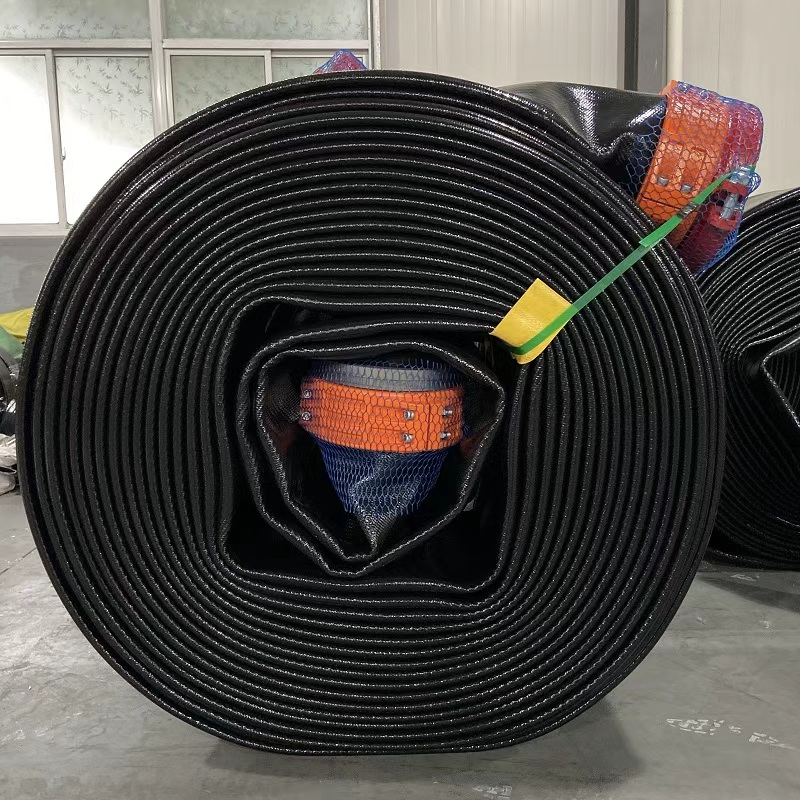
In shale projects where Sunmoon TPU layflat hose has been deployed, engineering teams typically start with the target flow rate, distance, and elevation profile before deciding between 10" and 12". In one representative scenario described by Sunmoon, the operator needed to move water from low‑lying impoundments up to elevated well pads with substantial elevation changes. [made-in-china]
The solution involved designing a high‑pressure layflat hose configuration matched to static head and pump curves, then optimizing routing and slope transitions using sloped steel frames to protect hose–steel connections. In such projects, selecting 10" vs 12" hose directly influences: [sunmoonhose]
- Number of booster pumps required across the route.
- Overall energy consumption per barrel transferred.
- Pressure stability during multi‑stage frac operations. [made-in-china]
These practical results explain why experienced operators treat diameter selection as a core engineering decision, not a purely price‑based choice. [sunmoonhose]
From an engineering and operations standpoint, you can use the following decision framework when selecting between 10" and 12" large diameter frac water hoses.
10" large diameter frac water transfer hose generally fits best when: [made-in-china]
- Your frac program requires high but not extreme flow rates across several kilometers.
- Terrain includes moderate elevation changes where hydraulic conditions are manageable with standard booster spacing.
- Logistics favor smaller, lighter coils and easier deployment in constrained rights‑of‑way.
- Budget targets prioritize lower hose acquisition and transport cost, while still achieving strong performance.
In these conditions, 10" TPU layflat hose becomes a robust, cost‑efficient backbone for the majority of frac water transfer lines. [made-in-china]
12" large diameter frac water transfer hose is typically recommended when: [sunmoonhose]
- You must deliver very high, continuous flow volume to multi‑well pads over long distances.
- You want to extend booster pump spacing without suffering unacceptable pressure drop.
- Energy efficiency is a priority, and you aim to reduce pump load per barrel transported through lower friction loss.
- Your project scale and logistics can support handling larger, heavier hose reels and associated equipment.
In these high‑demand scenarios, the larger bore of 12" hose can materially improve project economics and operational reliability. [sunmoonhose]
A key but sometimes overlooked factor in 10" vs 12" flow volume planning is how hose diameter interacts with elevation changes and transient pressure events such as start‑ups and sudden shutdowns. [sunmoonhose]
From a practical engineering standpoint:
- Larger diameter hoses (12") tend to moderate velocity and help reduce localized surge pressures, assuming pump control is well managed.
- However, greater column weight and volume in 12" lines can increase the energy involved in water hammer if start‑up and shutdown procedures are poorly controlled.
Sunmoon's field practice of using sloped steel frames at height transitions and ramping pumps gradually is therefore critical for both 10" and 12" hoses, but becomes especially important for large‑diameter lines with high fill volume. Treating elevation and transient pressure as integral parts of diameter selection is an advanced design step that helps protect hose integrity and maintain safe operations. [sunmoonhose]
Based on industry guidance and Sunmoon's project experience, a step‑by‑step selection process helps you make the right diameter decision. [made-in-china]
1. Define maximum flow and distance
- Quantify your peak barrels per minute or cubic meters per hour, along with total line length and terrain profile. [made-in-china]
2. Model friction loss for both diameters
- Work with your hose supplier and pump vendor to model friction loss per 100 m / 100 ft for both 10" and 12" TPU hoses. [made-in-china]
3. Map booster pump spacing and pressure envelope
- Use the friction loss results to determine optimal booster spacing and expected pressure at key points for each diameter. [made-in-china]
4. Evaluate logistics and site constraints
- Assess road access, storage space, handling equipment, and crew capacity to see whether 12" logistics are practical or whether 10" is more realistic. [sunmoonhose]
5. Compare lifecycle cost, not just purchase price
- Consider energy savings, reduced booster count, and expected hose life; in some large projects, 12" may deliver better lifecycle economics despite higher initial cost. [sunmoonhose]
This structured process aligns your diameter choice directly with hydraulic performance, safety margins, and operational realities, rather than relying on generic "rules of thumb."
One practical advantage of partnering with Sunmoon is project‑specific customization across diameters, pressure classes, and lengths. Instead of forcing your water transfer system to match off‑the‑shelf hose, Sunmoon can tailor: [made-in-china]
- Diameter: 10", 12" and other sizes for trunk lines and laterals. [made-in-china]
- Working pressure ratings: aligned with your pump fleet and maximum operating envelopes. [sunmoonhose]
- Coil lengths: shorter for tight access roads, longer for rapid deployment with reel trailers. [made-in-china]
- Coupling styles and end fittings: e.g., Victaulic‑type quick couplings or flanged ends, compatible with existing infrastructure. [made-in-china]
This level of customization helps global operators and service companies standardize on a hose platform that matches their frac strategies, rather than compromising system design around limited stock sizes. [made-in-china]
To make diameter selection more intuitive, you can think of 10" vs 12" frac water hose in terms of simple, high‑impact questions:
- If your priority is balanced high flow, easier deployment, and cost control, start with 10" TPU layflat hose as your baseline. [made-in-china]
- If your priority is maximum flow volume, fewer boosters, and energy optimization for large trunk lines, evaluate 12" TPU layflat hose with detailed hydraulic modeling. [sunmoonhose]
In both cases, combining engineered TPU construction with Sunmoon's design support and training provides a strong foundation for safe, efficient frac water transfer operations. [sunmoonhose]
If you are planning a new frac water transfer project or upgrading from rigid pipe or mixed hose systems, now is the ideal time to evaluate 10" vs 12" large diameter TPU layflat hoses with Sunmoon's engineering team. [sunmoonhose]
To move forward:
- Share your target flow rate, total distance, elevation profile, fluid type, and existing pump data with Sunmoon. [sunmoonhose]
- Request a custom 10" vs 12" hydraulic comparison and hose layout proposal tailored to your field conditions.
- Schedule remote or on‑site training so your crews can deploy, operate, and maintain large diameter layflat systems confidently from day one. [sunmoonhose]
By integrating diameter optimization, TPU engineering, and hands‑on support, Sunmoon helps you turn frac water transfer from a bottleneck into a competitive advantage.
1. Does a 12" frac water hose always deliver more flow than a 10" hose?
In hydraulic theory, a 12" hose has a larger cross‑sectional area and can deliver more flow at the same velocity and pressure, but actual results depend on pump curves, elevation, and system design. [made-in-china]
2. When should I choose 10" instead of 12" for frac water transfer?
Choose 10" when you need high flow across several kilometers, but logistics, terrain, or budget make 12" impractical; 10" offers a strong balance of volume, handling, and cost. [made-in-china]
3. Can I mix 10" and 12" hoses in the same water transfer system?
Yes, many operators use 12" for main trunk sections and 10" or smaller sizes for laterals or specific segments, but transitions must be engineered carefully to avoid unexpected pressure changes. [sunmoonhose]
4. How does TPU layflat hose help reduce pump energy use in large diameter systems?
Smooth TPU inner linings reduce friction loss, so pumps can achieve the same flow at lower differential pressure, cutting fuel consumption and emissions over long transfer distances. [sunmoonhose]
5. How can Sunmoon support diameter selection for my next project?
Sunmoon can review your flow targets, distance, elevation, water analysis, and pump data, then recommend optimal 10" vs 12" hose configurations, pressure ratings, lengths, and couplings for your specific field. [made-in-china]
1. Sunmoon Hose Manufacturing – "How Sunmoon's High‑Pressure TPU Layflat Hose Transforms Shale Gas Water Supply Operations." https://www.sunmoonhose.com/how-sunmoon's-high-pressure-tpu-layflat-hose-transforms-shale-gas-water-supply-operations.html
2. Sunmoon Hose Manufacturing – "Frac Water Transfer: Optimizing Flow Rates with 10" TPU Frac Water Hoses." https://www.sunmoonhose.com/sa/frac-water-transfer-optimizing-flow-rates-with-10-tpu-frac-water-hoses.html
3. ASOE Hose – "Frac Water Transfer Solution." https://www.asoehose.com/oil-gas/frac-water-transfer-solution/
4. Hondo Resources – "Top 11 Best Practices for Effective Frac Water Transfer." https://hondotx.com/blog/frac-water-transfer-best-practices/
5. Keystone Clear – "The Benefits of Using 16-inch Layflat Hose for Water Transfer in the Permian Basin." https://keystoneclear.com/resources/blog/the-benefits-of-using-16-inch-layflat-hose-for-water-transfer-in-the-permian-basin/
6. JAFirehose – "TPU Lay Flat Hose for Shale Gas Fracturing Water Transfer." https://www.jafirehose.com/news/industry-news/tpu-lay-flat-hose-shale-gas-fracturing-water-transfer.html
7. Midwest Hose – "TPU Hose in Mining: A Smarter Alternative to Pipe." https://www.midwesthose.com/tpu-hose-in-mining-a-smarter-alternative-to-pipe/
8. China Rubber Hose – "Hoses for Shale Gas & Oil Fracturing." https://www.china-rubberhose.com/hoses-for-shale-gas-oil-fracturing/
9. PureLine – "3 Advantages in Using Lay-Flat Hose for Water Transfer." https://www.pureline.com/3-advantages-in-using-lay-flat-hose-for-water-transfer/
10. Sunmoon Hose – Corporate and product information. https://www.sunmoonhose.com


