

Views: 222 Author: Loretta Publish Time: 2026-01-14 Origin: Site


Content Menu
● What Are NPSM And NPT Threads?
● NPSM vs NPT: Structural And Sealing Differences
● Sealing Methods And Pressure Performance
● Application Scenarios For Each Thread Type
● Compatibility Considerations Between NPSM And NPT
● Comparison Table: NPSM vs NPT Threads
● Threaded Hose And Pipe Systems
● Practical Selection Steps For NPSM And NPT
● Installation Guidance For Reliable Joints
● FAQs About NPSM And NPT Threads
>> 1. What is the key difference between NPSM and NPT threads?
>> 2. Can NPSM and NPT threads be connected directly?
>> 3. Which thread type is more suitable for high‑pressure applications?
>> 4. Why are NPSM threads common in hydraulic swivels and service points?
>> 5. How can existing fittings be identified as NPSM or NPT?
In hydraulic, pneumatic, and industrial fluid systems, choosing the appropriate thread type is critical for leak prevention, operational safety, and long‑term reliability. This guide explains how two widely used standards, NPSM and NPT, differ and how to select the right option for your hose application.[1][2][3]

NPSM (National Pipe Straight Mechanical) and NPT (National Pipe Taper) are North American pipe thread standards that use a similar 60° thread angle but very different geometries. NPSM uses straight threads for mechanical joints, while NPT uses tapered threads that provide a pressure‑tight seal.[2][4][3]
NPSM threads are intended primarily for mechanical retention and alignment and rely on an external sealing element such as an O‑ring or gasket. NPT threads are designed so that tightening causes interference between male and female threads, often augmented with sealant, to achieve sealing directly through the thread form.[5][3][2]
NPSM threads are straight, parallel pipe threads used in mechanical joints where proper alignment, repeatable assembly, and external sealing are required. They are common in fluid power and industrial machinery where fittings are frequently assembled and disassembled.[3][2][5]
Key characteristics of NPSM threads include:[2][5]
- Straight thread design with 60° included angle.
- Constant major and minor diameters along the thread length.
- No inherent thread seal, requiring an O‑ring, gasket, or washer at the seat.
- Often used as female ports combined with NPTF male fittings and a 30° seat to create a reliable mechanical and face seal.
Typical uses for NPSM threads include hydraulic and pneumatic systems, industrial equipment connections, water treatment devices, and other assemblies that require frequent maintenance or precise orientation.[3][2]
NPT threads are tapered pipe threads engineered to create a pressure‑tight joint when properly tightened and sealed. The taper causes the male and female threads to interfere under torque, producing metal‑to‑metal contact that helps prevent leakage.[6][2][3]
Core characteristics of NPT threads are:[1][2]
- Tapered profile (approximately 1:16 taper) with a 60° thread angle.
- Sealing achieved through radial thread interference and, in many cases, PTFE tape or liquid sealant.
- Widely used in liquid and gas piping, including water, gas, oil, and chemical networks.
- Available in variations such as NPTF, which controls crest and root tolerances more tightly to achieve a dry thread seal.[5][2]
NPT threads are popular in high‑pressure hydraulic circuits, compressed air systems, process piping, and general industrial and residential plumbing.[7][3]
Although NPSM and NPT share the same basic thread form and angle, they behave very differently under load and pressure due to their geometry. Understanding these differences helps prevent mismatches that can cause leaks or premature failure.[4][5][3]
Structurally, NPSM is a straight pipe thread with zero taper, while NPT is a tapered pipe thread that narrows at a defined rate along its length. Both use flat crests and roots to balance strength and contact, but NPT's taper forces the flanks together, generating sealing pressure as torque increases.[4][2][3]
In terms of sealing, NPT threads rely on their taper plus interference and sealant, whereas NPSM threads rely on an external sealing component at a 30° or similar seat. This fundamental difference means that NPT connections can often function as self‑sealing pipe joints, while NPSM connections must be designed as mechanical joints with separate sealing elements.[2][5][3]
NPT threads typically offer higher pressure ratings than NPSM when used according to their respective standards and with suitable sealant. This makes NPT a frequent choice in high‑pressure and safety‑critical circuits.[6][1][5][3]
NPTF, a dry‑seal variant of NPT, optimizes crest and root dimensions to minimize spiral leakage without requiring sealant, making it attractive in many hydraulic and fuel systems. NPSM threads, by contrast, depend on correctly selected O‑rings or gaskets and properly machined seats, which can provide excellent sealing at low to medium pressures when installed correctly.[5][3][2]
For applications involving gases or hazardous liquids, the higher inherent sealing capability of tapered threads often provides a safety margin that is difficult to match with straight threads alone. However, when frequent disconnection is expected, replacing O‑rings on NPSM joints can be more predictable than relying on repeatedly disturbed thread seals.[8][6][3][5]
Each thread type is optimized for specific usage patterns and operating conditions. Selecting the correct type reduces the risk of leakage, eases maintenance, and can simplify standardization across equipment.[1][3][2][5]
NPT threads are often used where line pressure is high and the system is not disassembled frequently, such as permanent or semi‑permanent pipe runs. NPSM threads are frequently specified in modular equipment, test stands, and hose assemblies where alignment and serviceability are priorities and where using replaceable seals is desirable.[6][3][2][5]
In fluid power systems, both families appear side by side, with NPT or NPTF used on ports and rigid lines and NPSM used on swivel nuts, adapters, and service connections. This mixed usage allows designers to balance sealing, orientation, and repeatability across different sections of the same system.[9][3][5]
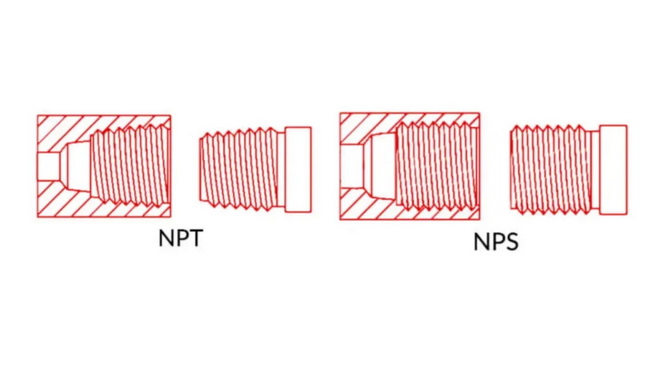
Because NPSM and NPT share a 60° thread angle and similar pitch, they may partially engage, but that does not mean they are fully interchangeable or suitable for sealing without careful design. Relying on accidental compatibility can introduce unsafe stress patterns or inconsistent sealing.[4][3][5]
NPTF male connectors are commonly used with NPSM female swivel fittings that incorporate a 30° inverted seat where the seal occurs on the seat rather than on the threads themselves. This arrangement is widely accepted in hydraulic systems and illustrates how combining tapered and straight threads can work when the interface geometry is properly defined.[10][9][2]
Outside of such recognized combinations, mixing NPT and NPSM threads without appropriate seats or sealing elements is not recommended for pressure‑tight connections. Adapters specifically designed to transition between standards are a safer option than forcing threads to mate.[7][3][5]
Aspect | NPSM Thread | NPT Thread |
Thread geometry | Straight, parallel pipe thread with 60° angle. | Tapered pipe thread with 60° angle, approx. 1:16 taper. |
Sealing mode | External sealing via O-ring, gasket, or washer at a machined seat. | Thread interference, often with PTFE tape or liquid sealant; NPTF can be dry-seal. |
Primary function | Mechanical retention, alignment, and reusability. | Pipe sealing for liquids and gases in pressure lines. |
Typical pressure range | Low to medium pressure with correctly specified seals. | Medium to high pressure piping and hydraulic systems. |
Maintenance behavior | Well suited to frequent assembly and disassembly; seals are easy to replace. | Repeated tightening may cause thread wear or galling if not managed carefully. |
Common variants | Straight mechanical female ports and swivels combined with NPTF male seats. | NPT, NPTF, and related tapered pipe standards for dry or sealed threads. |
Typical applications | Hydraulic swivels, test points, equipment interfaces, modular assemblies. | Water, gas, oil, chemical piping, valves, and high-pressure manifolds. |
Hose assemblies, manifolds, and pipe networks must integrate thread types, sealing materials, and operating conditions in a consistent way to avoid leaks or mechanical stress. Poorly matched thread types can create misalignment, thread damage, and unreliable sealing even if the joint initially appears tight.[11][3][5]
High‑pressure fluid transfer, including applications in oil and gas, mining, municipal water, and agriculture, often uses tapered pipe threads on rigid components combined with straight mechanical threads on swivels and adapters. Engineering‑focused hose and equipment suppliers can support system designers in matching thread standards to hose construction, pressure rating, and chemical compatibility.[12][13]
A structured approach helps ensure that each threaded connection uses the most appropriate standard for its function in the system. The following steps provide a practical way to make that selection.[3][7][1][5]
1. Define pressure level and medium.
Determine system working and peak pressure, plus whether the medium is a gas, flammable, or otherwise hazardous.[6][3]
2. Decide on sealing philosophy.
Choose whether the design will rely on thread sealing, face sealing, or a combination of both, and document that choice.[2][5]
3. Assess maintenance frequency.
Evaluate whether the joint will be disturbed regularly and, if so, how easily seals can be replaced or inspected.[8][5]
4. Verify applicable standards.
Confirm compliance with relevant North American or global standards, along with any corporate or industry‑specific rules that restrict thread types.[14][7]
5. Coordinate with component suppliers.
Align the chosen thread types with available valves, pumps, hoses, and adapters so that the entire system remains consistent and serviceable.[13][10]
Correct installation practices significantly affect the performance and service life of threaded pipe joints. Improper torque, surface damage, or contaminated sealing areas can undermine even well‑designed connections.[9][5][3][6]
For tapered threads, the use of appropriate sealant in the correct quantity helps prevent spiral leakage while avoiding over‑lubrication, which can lead to overtightening. For straight mechanical threads, careful inspection and lubrication of O‑rings or gaskets, plus attention to seat cleanliness, improves sealing and reduces the risk of extrusion or cutting.[9][5][3][6]
Torque recommendations may vary depending on thread size, material, and condition, so consulting manufacturer documentation and adjusting for sealant use is essential. Using calibrated tools and consistent procedures across installation teams further helps standardize quality.[10][9][3]
For projects that involve complex fluid systems, long‑distance transfer, or high operating pressures, reviewing thread selection, sealing strategy, and component compatibility early in the design phase can prevent costly changes later. Technical consultation with a specialized hose and fitting manufacturer allows system designers to verify thread standards, integrate suitable seals, and align pressure capabilities across all components.[12][13][3]
To move from theory to a fully engineered solution, share system drawings, operating pressures, medium characteristics, and maintenance expectations with a qualified engineering team and request a detailed recommendation for thread types, sealing methods, and hose or pipe components tailored to that specific application.[13][10]
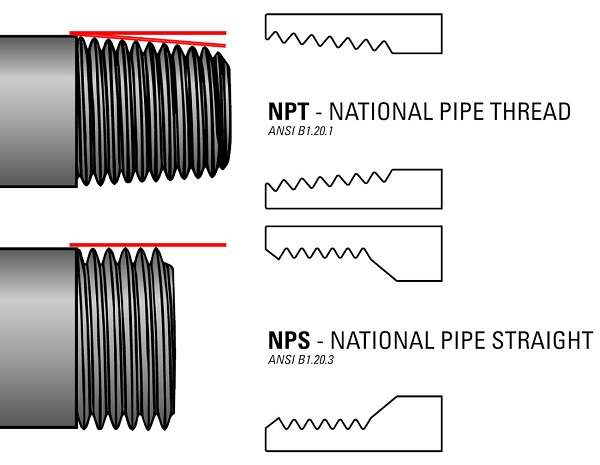
The key difference is that NPSM is a straight mechanical pipe thread that requires an external seal, while NPT is a tapered pipe thread that seals through thread interference and sealant.[2][3]
Although NPSM and NPT threads can engage due to similar pitch and thread angle, they are not considered fully compatible for pressure sealing unless used in a recognized combination with a suitable seat and sealing element.[5][9]
Tapered pipe threads such as NPT and NPTF generally provide higher pressure ratings and are preferred in many high‑pressure systems, especially when transporting gases or hazardous liquids.[6][3]
NPSM threads provide good alignment and reusability and, combined with O‑rings or gaskets, allow for frequent disassembly and maintenance without relying on the threads themselves to seal each time.[2][5]
Identification typically involves checking whether the thread is straight or tapered, measuring thread pitch, and comparing dimensions with reference charts, and when necessary consulting the manufacturer to verify the standard.[15][3]
[1](https://www.qchydraulics.com/npsm-vs-npt.html)
[2](https://www.strongflex.com/npsm-vs-npt-thread-difference/)
[3](https://hydraxio.com/npsm-vs-npt/)
[4](https://www.qchydraulics.com/nps-vs-npsm-thread.html)
[5](https://cntopa.com/npsm-thread-vs-npt-thread-whats-the-difference.html)
[6](https://www.laikehydraulics.com/npt-vs-npsm-what-s-the-difference/)
[7](https://www.cpcworldwide.com/Knowledge-Center/Technical-Toolbox/Understanding-NPT-Pipe-Thread-Types)
[8](https://www.evergoodhose.com/uk/blog/post/npsm-vs-npt-thread-hose-fittings-key-differences-and-best-uses.html)
[9](https://www.kurthydraulics.com/support/north-american-connections/)
[10](https://renapur.fr/itm/1501-NPTF-Pipe-Male-X-NPSM-Pipe-Swivel-Female-90-Elbow/1126493)
[11](https://www.reddit.com/r/Irrigation/comments/10uunjc/so_confused_about_nps_fittings/)
[12](https://www.sunmoonhose.net/tpu-layflat-hose/)
[13](https://www.sunmoonhose.com)
[14](https://fr.cngoodfitting.com/quest-ce-que-les-filetages-npt-nptf-nps-et-npsm/)
[15](https://www.youtube.com/watch?v=vbqWSMRRaxU)
[16](https://www.sunhose.com/tpu-layflat-hose/%3Fsrsltid=AfmBOorzv0erLEPqOzS8VnFMkuZzGrw-ilZDwHMy118C6AUiudO2wo17)
[17](https://answers.discounthydraulichose.com/5670079/What-is-the-difference-between-NPT-and-NPSM)


