

Views: 222 Author: Loretta Publish Time: 2026-01-16 Origin: Site


Content Menu
● What Is a Stainless Steel Braided Hose?
● What Is a Nylon Braided Hose?
● Performance Comparison: Nylon vs Stainless Steel Braided Hose
● Typical Applications of Stainless Steel Braided Hose
● Typical Applications of Nylon Braided Hose
● Engineering Selection Framework
>> Step 1: Define Operating Envelope
>> Step 2: Match Hose Type to Conditions
>> Step 3: Evaluate Total Cost of Ownership
● Integrating Braided Hoses with Advanced Layflat Hose Systems
● Why Work With an Engineering-Driven Hose Partner
● Call to Action: Request a Tailored Hose System Proposal
● FAQs: Nylon vs Stainless Steel Braided Hose
>> 1. Can nylon braided hose be used in place of stainless steel braided hose in demanding systems?
>> 2. Is stainless steel braided hose always the better option?
>> 3. How should media compatibility be evaluated for these hoses?
>> 4. Can different hose types be combined within a single installation?
>> 5. What information is essential before requesting a hose recommendation from a manufacturer?
Nylon braided hose and stainless steel braided hose each have distinct strengths in pressure rating, temperature resistance, flexibility, and cost, and choosing correctly prevents leaks, failures, and unnecessary overspecification. This guide structures those differences into clear, practical sections so engineers, buyers, and technicians can specify the most suitable hose for their applications.[2][3][4]

A stainless steel braided hose is a flexible hose with an inner tube (such as rubber, PTFE, EPDM, or metal) reinforced by an outer stainless steel wire braid. The metal braid improves pressure capacity, protects the tube from impact and abrasion, and helps maintain integrity under high mechanical stress.[5][6][2]
The construction typically includes:[6][7]
- Inner core conveying the medium (water, oil, fuel, gas, chemicals).
- Stainless steel braid as reinforcement and external protection.
- Optional outer cover to improve wear and environmental resistance.
A nylon braided hose is a flexible hose where a rubber, PU, PVC, or PTFE inner tube is covered with a woven nylon fiber braid. The nylon reinforcement significantly increases flexibility, reduces weight, and supports easy routing compared with metal-braided designs.[8][9][6]
Typical structure features:[10][6]
- Inner tube compatible with the conveyed fluid.
- Nylon fiber braid providing pressure and abrasion resistance.
- Lightweight, flexible profile suited to compact and mobile systems.
This section highlights the most important engineering differences that affect safety, service life, and cost.[2][6]
Factor | Stainless steel braided hose | Nylon braided hose |
Typical pressure rating | Very high; widely used in high-pressure hydraulics, steam, and safety-critical lines | Medium; suitable for many automotive, pneumatic, and low-pressure hydraulic returns |
Temperature range | Approx. -60°C to +260°C with PTFE core, depending on design | Approx. -40°C to +120°C in typical constructions |
Corrosion resistance | Excellent against many oils, fuels, and chemicals when correctly specified | Good for many common fluids, but less robust with aggressive chemicals and high heat |
Flexibility | Stiffer, larger minimum bend radius; more installation space required | Very flexible with small bend radius; ideal for tight or complex routing |
Weight | Heavier due to stainless braid; adds structural robustness but increases system mass | Lightweight, supporting weight-sensitive systems and easier manual handling |
Abrasion resistance | Very strong; well suited to harsh, abrasive environments | Fair to good; external protection is needed where severe rubbing is expected |
Cost | Higher upfront cost; often offset by long service life in harsh duty | Lower unit cost; attractive for large-volume and moderate-duty applications |
A clear visual chart comparing pressure, temperature, and bend radius across typical hose sizes can be inserted directly below this table to help readers grasp performance envelopes at a glance.[4][2]
Stainless steel braided hoses are widely chosen where failure would cause significant safety, environmental, or downtime consequences.[6][2]
Common uses include:[2][6]
- Industrial steam lines, chemical transfer, and high-pressure gas or liquid systems.
- Pump, compressor, and pipeline connections where vibration and pulsation must be controlled.
They are also common in:[12][6][2]
- Automotive and transportation systems such as brake, clutch, and performance fuel lines.
- Hot water, gas connections, and heating equipment in building services.
Nylon braided hose is preferred where moderate pressure, compact routing, and weight reduction are central requirements.[8][6]
Key application areas include:[10][8][6]
- Automotive fuel lines, vacuum lines, and coolant return circuits under controlled conditions.
- Pneumatic tools, air compressors, and spray equipment in workshops or light industry.
Nylon-braided constructions also appear in:[13][6]
- High-end garden hoses and home water connection lines.
- Low-pressure hydraulic returns and lubrication circuits.
A structured evaluation process helps ensure that the chosen hose type, size, and construction align with system demands.[3][5]
Before choosing a hose, it is essential to define:[14][5]
- Normal and peak working pressure, including surge events.
- Minimum and maximum operating temperature of both medium and environment.
- Fluid type and compatibility requirements for the inner tube and reinforcement materials.
It is also important to note installation constraints such as available space, bend radius, movement, and exposure to UV, chemicals, or physical impact.[3][4]
A practical approach is to align demands with material strengths.[15][2]
- Stainless steel braided hose is typically selected for high-pressure, high-temperature, or safety-critical circuits where maximum durability and abrasion resistance are required.
- Nylon braided hose is suited to low- and medium-pressure systems where flexibility, weight savings, and cost efficiency are more significant than extreme performance margins.
Respecting manufacturer-rated pressure and temperature limits is crucial for whichever hose type is chosen.[5][14]
Total cost of ownership includes purchase price, installation effort, expected service life, and consequences of downtime.[4][2]
- Stainless steel braided hose often justifies its higher initial cost in harsh environments due to fewer replacements and reduced unplanned shutdowns.[5][2]
- Nylon braided hose can deliver very competitive lifecycle cost in clean, moderate environments when correctly supported and not overloaded.[10][8]
A small table comparing expected replacement intervals across typical use cases can be inserted here to help readers quantify lifecycle differences.[4][2]
Correct installation techniques are essential for realizing the rated performance of either hose type.[3][5]
For stainless steel braided hose, best practices include:[7][5]
- Maintaining bend radius at or above the specified minimum to avoid kinking and fatigue.
- Avoiding torsion during assembly by keeping fittings aligned and preventing twist along the hose.
For nylon braided hose, attention should be given to:[9][8]
- Protecting the outer braid from sharp edges and continuous rubbing, using clamps or sleeves as needed.
- Keeping the hose away from heat sources that could raise temperatures beyond the nylon's limit.
An illustrative diagram showing correct and incorrect bend radius and support spacing is effective when placed in this section.[14][5]
In many modern fluid-transfer projects, braided hoses are only one part of a broader system that can also include long-distance layflat hoses.[16][17]
Typical configurations pair:[18][16]
- Stainless steel braided hoses at pumps, manifolds, and critical connection points where vibration and pressure fluctuations are highest.
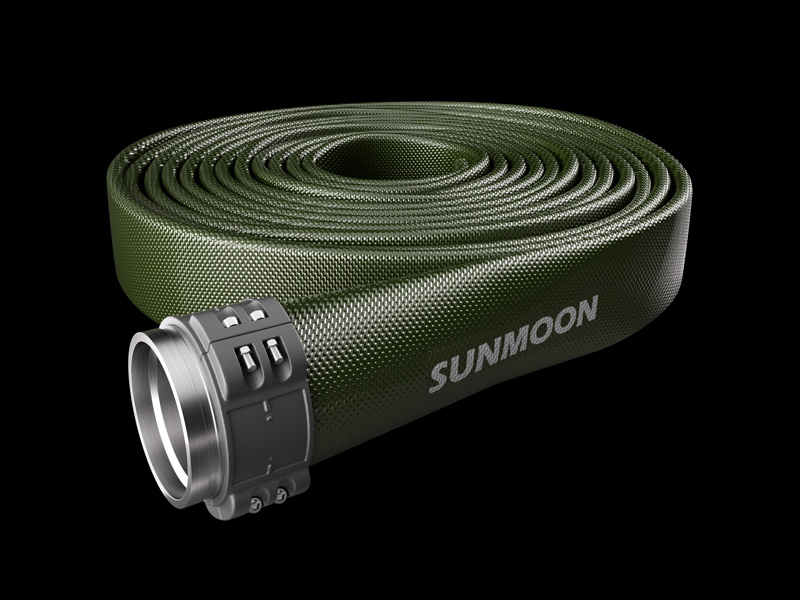
- Lightweight layflat hoses, such as TPU high-pressure layflat products, for long-distance transfer in oil and gas, mining, emergency drainage, and firefighting.
Combining the strengths of braided hoses in connection zones with advanced layflat hoses for trunk lines supports robust, efficient, and rapidly deployable systems in demanding field conditions.[16][18]
Projects with complex hydraulic, water transfer, or chemical systems benefit from support that extends beyond catalog selection.[19][16]
An engineering-driven manufacturer with integrated research, production, and sales offers:[19][16]
- Assistance with defining specifications and matching hose types, diameters, and pressure ratings to real operating conditions.
- Customized solutions covering high-pressure layflat hose, compatible couplings, and appropriate braided hose interfaces.
This type of collaboration reduces the risk of mismatch between hose materials, couplings, and system pressure pulses, which improves reliability over the entire lifecycle.[16][19]
The most reliable fluid-transfer systems are built on accurate pressure–temperature–media analysis, appropriate hose selection, and well-engineered integration of braided and layflat hose technologies.[2][4]
Project owners, engineers, and buyers who are planning new installations or upgrades can prepare key data such as line pressure, temperature range, media type, route length, and deployment method, then share it with a specialized hose manufacturer to obtain a tailored system proposal. By doing so, it becomes possible to select nylon or stainless steel braided hoses with confidence, integrate them with high-performance layflat solutions, and achieve a balanced outcome in safety, performance, and cost for each specific application.[18][19][16][3]
In systems that operate at high pressure, elevated temperature, or carry safety-critical media, nylon braided hose is generally not recommended as a direct substitute for stainless steel braided hose because its performance margins are lower. For these applications, a stainless construction with appropriate inner tube material provides a more robust safety buffer.[6][5][2]
Stainless steel braided hose is not always the best option, because it carries higher cost and weight and can be harder to install in tight spaces. When a system operates within moderate pressure and temperature limits, a correctly specified nylon braided hose can deliver adequate performance with advantages in flexibility and cost.[8][6]
Media compatibility should be checked for both the inner tube material and the reinforcement environment, using chemical compatibility charts and manufacturer data. Properties such as swelling, softening, or embrittlement at the intended temperature range should be evaluated before final selection.[5][3][4][2]
Different hose types can be combined effectively when each section is chosen according to its local operating conditions and correctly rated fittings are used. It is common to see stainless steel braided hose at critical connection points, nylon braided hose on auxiliary lines, and layflat hose used for long-distance transfer segments.[14][18][16]
Essential information includes desired hose diameter, working and peak pressure, operating temperature range, fluid type, expected service life, and installation layout, including bend constraints and movement. Clear data on these parameters enables the manufacturer's engineering team to recommend suitable nylon or stainless steel braided hose constructions and, where appropriate, compatible layflat hose components.[19][16][3][5]
[1](https://www.strongflex.com/nylon-vs-stainless-steel-braided-hose/)
[2](https://cntopa.com/nylon-vs-stainless-steel-braided-hose-a-comprehensive-guide.html)
[3](https://nwus.swagelok.com/en/about-us/insights-blog/how-to-select-the-right-hose-for-your-application)
[4](https://gushanrubber.com/types-of-braided-hose/)
[5](https://www.aeroflexindia.com/factors-to-consider-when-selecting-an-ss-braided-flexible-hose-for-industrial-use/)
[6](https://nl.swagelok.com/hubfs/Brochures/Components/Hoses/Hoses-Quick-Look.pdf)
[7](https://kingdaflex.com/braided-nylon-hose-vs-stainless/)
[8](https://www.waterpipefactory.com/knowledge/understanding-nylon-braided-hose-standards-a-comprehensive-guide/)
[9](https://www.waterpipefactory.com/knowledge/the-ultimate-guide-to-nylon-braided-hoses-strength-versatility-and-application/)
[10](https://www.sinopulse.cn/nylon-braided-hose-vs-stainless-steel-braided-hose/)
[11](https://deriveauto.co.uk/pages/hose-information-guide)
[12](https://www.waterpipefactory.com/knowledge/the-ultimate-guide-to-nylon-braided-hoses-in-industrial-applications/)
[13](https://www.thehosemaster.co.uk/blogs/news/braided-hose-what-is-it-and-how-do-you-use-it)
[14](https://gushanrubber.com/nylon-vs-stainless-braided-hose/)
[15](https://china-layflat-hose.com/about/company-profile/)
[16](https://www.sunmoonhose.com)
[17](https://www.sunmoonhose.net/tpu-layflat-hose/)
[18](https://www.sunmoonhose.net)


