

Views: 222 Author: Sunmoon Publish Time: 2026-05-19 Origin: Site


Puncture resistance is one of the biggest reasons more engineers and fleet operators are switching from traditional canvas hose to TPU layflat hose in demanding projects. [sunhose]
From my experience working with field engineers, irrigation contractors, and mining project managers, hose failure is almost never a "small" issue. A puncture in the wrong place means downtime, environmental risk, overtime labor, and angry clients. In this context, TPU layflat hose has emerged as a preferred choice over canvas hose for operations where abrasion, sharp stones, and repeated dragging are part of daily reality. [solutions.covestro]
Sunmoon, as a specialized Chinese manufacturer of TPU layflat hose, has seen this shift first-hand across oil & gas, mining, agriculture, and municipal projects worldwide. In this article, I will compare puncture resistance and real-world performance of TPU layflat vs. traditional canvas hose from both an engineer's and a manufacturer's perspective. [linkedin]

Puncture resistance is the ability of a hose wall to withstand penetration from sharp or angular objects under load. In practical terms, it determines whether your hose survives: [sunhose]
- Dragging over gravel roads or quarry floors
- Contact with cut rebar, sharp rocks, and metal edges
- Occasional vehicle crossings or track equipment
- Accidental impact from tools on site
From a technical standpoint, puncture resistance is influenced by material hardness, tensile strength, wall construction, and reinforcement layout. TPU compounds are engineered to combine high tensile strength and excellent abrasion resistance, whereas canvas hoses rely more on woven textile strength and a thinner rubber or PVC inner coating. [papagenogroup]
Modern TPU layflat hoses used in mining, oil & gas and emergency drainage are usually built as through-the-weave constructions. A typical design includes: [rubber-pvc-hose]
- Inner layer: Thermoplastic polyurethane (TPU)
- Reinforcement: High-tensile circular woven polyester or polyamide
- Outer layer: TPU cover bonded into a single homogeneous wall
This design encapsulates the textile completely inside TPU, so sharp objects must cut through a tough TPU skin before reaching the reinforcement. [sunmoonpipe]
Traditional canvas hose is typically made from:
- Outer jacket: Woven polyester or cotton canvas
- Inner lining: PVC or rubber compound, often thin for flexibility
- Bonding: Mechanical bonding between lining and textile; not always fully encapsulated [yby-irrigation]
When dragged over rough terrain, the exposed textile jacket is directly in contact with the ground, which makes it more vulnerable to abrasion and localized cutting. [yby-irrigation]
Key takeaway: A properly engineered TPU layflat hose offers a fully encapsulated reinforcement and a tougher, more elastic outer shell compared with the relatively exposed fiber surface of canvas hose. [rubber-pvc-hose]
In aggressive environments (quarries, open-pit mines, rocky riverbeds), TPU layflat hoses are widely used because they can withstand dragging across highly abrasive ground while maintaining integrity. TPU's high tear strength and elasticity help the hose deform under point load rather than crack or split. [china-layflat-hose]
Canvas hose, by contrast, shows faster wear in the outer jacket when repeatedly dragged on sharp gravel or concrete. Over time, frayed fibers and localized cuts give small sharp stones a "path" into the hose wall, significantly increasing puncture risk. [yby-irrigation]
Manufacturers of TPU compounds for hoses highlight their high mechanical strength and puncture resistance, often validated in high-pressure and high-burst applications. In field use, this translates to better survival when: [lubrizol]
- A metal tool or pipe falls on the hose
- Heavy fittings rest on a tight bend
- Tracks from equipment cross over a pressurized line sporadically
Canvas hose can manage moderate impacts, but once the outer fibers are damaged, the inner lining is much more exposed. [yby-irrigation]
From an engineering and procurement perspective, it helps to visualize how TPU layflat and canvas hose compare on puncture-related performance and overall durability. [lubrizol]
| Parameter | TPU Layflat Hose | Traditional Canvas Hose |
|---|---|---|
| Puncture resistance | Very high on both inner and outer TPU layers sunhose | Moderate; textile jacket can fray and expose lining yby-irrigation |
| Abrasion resistance | Excellent, suitable for highly abrasive ground sunhose | Good initially but degrades as fibers wear yby-irrigation |
| Burst / working pressure | Supports high working and burst pressure in demanding applications rubber-pvc-hose | Medium to high, but more sensitive to damage in jacket yby-irrigation |
| Flexibility under load | Flexible yet tough; maintains wall integrity solutions.covestro | Flexible, but outer fibers stiffen or fuzz with wear yby-irrigation |
| Typical applications | Mining, oil & gas, emergency drainage, long-distance water transfer | Irrigation, general water delivery, engineering drainage yby-irrigation |
| Service life in harsh terrain | Long, especially when properly sized and handled sunhose | Shorter when constantly dragged on rough, sharp surfaces yby-irrigation |
From this overview, TPU layflat clearly positions itself as the more puncture-resistant option for high-abrasion, high-risk environments.
As someone who has worked with multiple hose formulations, the superiority of TPU in puncture resistance comes down to material science and processing. [solutions.covestro]
- High tensile strength and tear resistance: Industrial-grade TPU compounds for hoses are designed to withstand high burst pressures and localized stress without cracking. [solutions.covestro]
- Elastic deformation: TPU can deform and rebound when a sharp object presses into the wall, absorbing energy instead of splitting. [solutions.covestro]
- Homogeneous wall construction: Through-the-weave TPU hoses embed the reinforcement and eliminate weak interfaces and delamination points. [sunmoonpipe]
- Resistance to micro-cracks: Good hydrolytic and microbial resistance reduces micro-cracking that might otherwise turn into puncture points over time. [lubrizol]
In contrast, the puncture resistance of canvas hoses depends heavily on the woven fabric and a relatively thin PVC or rubber lining, which is easier to cut under localized pressure. [papagenogroup]
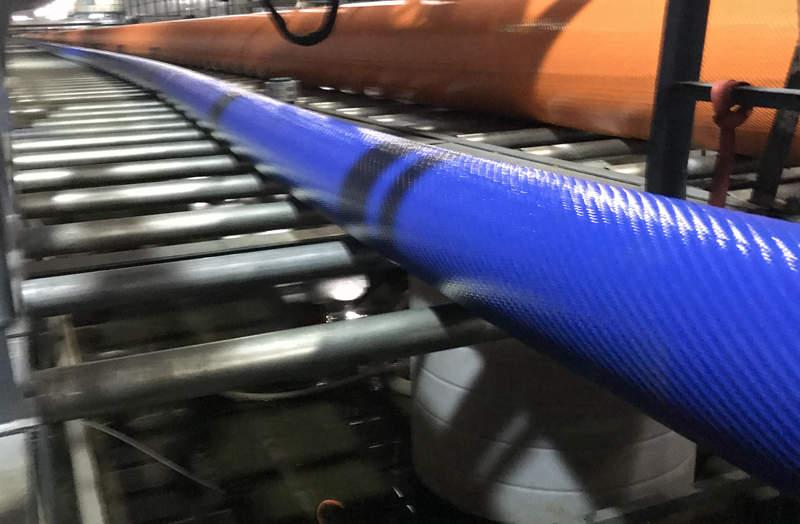
Deep-mine dewatering systems often run hoses over rough rock, steel grates, and underground equipment. TPU layflat hoses designed for 500 psi–class working pressures are common because they maintain integrity even after months of dragging and repositioning. Sunmoon's high-pressure TPU hoses, for example, are fully tested at 1.5 times working pressure before shipment, which gives operators confidence that minor surface damage will not immediately cause failure. [rubber-pvc-hose]
Canvas hoses in these environments typically serve as shorter, more static connections or backup lines rather than primary long-distance transfer hoses because sustained abrasion can quickly compromise the jacket. [yby-irrigation]
In oilfield water transfer or frac operations, hoses cross temporary roads, metal ramps, and mixed terrain. TPU layflat hoses with high abrasion and puncture resistance are increasingly chosen over traditional fabrics because a single failure can halt an entire operation and create costly downtime. [linkedin]
Canvas type hoses can still play a role in lower-pressure applications or where hoses are not frequently moved, but they are no longer the first choice when puncture risk is high and access is difficult. [yby-irrigation]
Regardless of material choice, operators can significantly extend hose life using some simple field practices. From an expert UX and operations standpoint, these are the minimum best practices:
1. Match hose to application
Use TPU layflat for continuous dragging over rough terrain, high-pressure pumping, and critical transfer lines. [linkedin]
2. Use protective ramps and sleeves
Where hoses cross roads or contact steel edges, add ramps, half-pipes, or protective sleeves to distribute load and avoid point impacts. [rubber-pvc-hose]
3. Avoid tight radius bends
Tight bends increase wall stress and make puncture damage more likely when any sharp object presses from outside. [lubrizol]
4. Inspect after each shift
Develop a quick inspection checklist focusing on worn spots, deep cuts, and exposed fibers (for canvas) or local gouging (for TPU). [lubrizol]
5. Specify testing and certification
Work with manufacturers, like Sunmoon, that apply full-length hydrostatic testing and work to ISO-certified quality systems. [linkedin]
From a procurement or project owner's view, the question is not just "Which hose is stronger?" but "Which hose is more economical over the whole project lifecycle?" [sunhose]
- Initial cost: Canvas hoses usually have a lower initial purchase price per meter. [yby-irrigation]
- Service life in harsh use: TPU layflat typically delivers a longer service life when subjected to repeated dragging, sharp aggregate, and high pressures. [linkedin]
- Failure cost: Puncture and burst events carry additional costs: lost product, cleanup, downtime, and emergency repairs. [linkedin]
In many high-risk scenarios, users report that one TPU hose can outlast multiple canvas hoses, making TPU more cost-effective when evaluated on a cost-per-hour or cost-per-kiloliter-pumped basis. [sunhose]
Industry reports on the North American TPU layflat hose market show steady growth driven by agriculture, mining, and industrial water transfer, citing TPU's flexibility, durability, and chemical resistance. Leading TPU suppliers and system integrators emphasize properties like puncture resistance, high-burst pressure, and long-term flexibility as key enablers for modern hose systems. [linkedin]
Sunmoon's own evolution—from a focus on large-size layflat hoses to advanced TPU and high-pressure lines—mirrors this market shift. Export customers increasingly specify TPU layflat hoses as their default for new projects, while canvas hoses stay in more traditional, lower-risk irrigation and general service roles. [sunmoonpipe]
From a buyer's perspective, choosing the right manufacturer is just as important as choosing TPU over canvas. Sunmoon was founded in 2011 and has specialized in big-size and high-pressure layflat hoses from the beginning. The company operates 3 large workshops, 6 professional production lines, and has implemented ISO 9001:2015, ISO 14001:2015, and ISO 45001:2018 management systems. [linkedin]
For TPU layflat hoses, Sunmoon applies:
- Through-the-weave TPU constructions with high-tensile reinforcement for better puncture resistance [sunmoonpipe]
- 100% hydrostatic testing of hoses with couplings at 1.5× working pressure for 3 hours before shipment [sunmoonpipe]
- Custom options for diameter, working pressure, color, and length to match site conditions and reel systems [linkedin]
For project owners, this combination of material, design, and process control means fewer unexpected punctures, more predictable service life, and safer operations.
For teams making a procurement decision today, a simple decision framework helps:
- Choose TPU layflat hose when:
- The hose will be dragged across rough or sharp terrain daily
- Working pressures are medium to high and downtime is costly
- The line is critical (dewatering, emergency drainage, municipal bypass, oilfield water transfer)
- You need longer runs and fewer couplings
- Choose traditional canvas hose when:
- The pressure is moderate, terrain is relatively smooth
- Hoses are seldom moved and mainly used in static irrigation or low-risk transfer
- Initial budget is extremely tight and puncture risk is low
In short, if puncture resistance and reliability are your priorities, TPU layflat from a certified manufacturer like Sunmoon is the safer and more economical choice over the full project lifecycle. [sunhose]
If your current canvas hoses are failing too often, it is likely not just an operations issue—it is a material and design issue. Sunmoon's engineering team can help you map out your terrain, pressure requirements, and deployment method, then recommend a TPU layflat configuration that minimizes puncture risk and total lifecycle cost. [linkedin]
You can contact Sunmoon directly via the official website to discuss custom TPU layflat hoses for mining, construction, agriculture, emergency drainage, or oil & gas transfer projects. Upgrading from canvas to TPU layflat could be one of the fastest ways to gain more uptime, fewer leaks, and a safer worksite. [sunmoonpipe]
1. Is TPU layflat hose always better than canvas hose?
Not always. TPU layflat is superior in puncture resistance, abrasion resistance, and high-pressure applications, but canvas hose can still be appropriate in lower-risk, budget-sensitive irrigation or general water transfer jobs. [rubber-pvc-hose]
2. Can I replace all my canvas hoses with TPU immediately?
You can, but many operators start by upgrading the most critical, high-risk lines first—such as main dewatering or transfer lines—while phasing in TPU on secondary circuits over time. [linkedin]
3. How much longer does TPU layflat last compared with canvas hose?
Service life depends heavily on pressure, terrain, and handling, but data from layflat hose comparisons consistently show TPU delivering significantly longer life in harsh conditions than PVC or canvas-type hoses. [sunhose]
4. Are TPU layflat hoses suitable for potable water and chemicals?
Yes, many TPU compounds are formulated with chemical resistance and options for food or potable water compliance, making TPU suitable for a wide range of fluids. [solutions.covestro]
5. What certifications should I look for in a TPU hose manufacturer?
Look for ISO 9001 quality management, ISO 14001 environmental management, and ISO 45001 occupational health and safety, along with documented pressure and leak testing procedures, such as full-length testing at 1.5× working pressure. [linkedin]
1. Sunhose. "Layflat Hoses Decoded: Why PVC, Rubber and TPU Cater to Different Needs." – <https://www.sunhose.com/layflat-hoses-decoded-why-pvc-rubber-and-tpu-cater-to-different-needs/> [sunhose]
2. Covestro. "Discover Desmopan® TPU for durable, flexible hoses and tubes." – <https://solutions.covestro.com/en/highlights/articles/stories/2024/desmopan-tpu-for-hoses-and-tubes> [solutions.covestro]
3. Sunmoon Hose Manufacturing (LinkedIn Company Profile). – <https://www.linkedin.com/company/sunmoon-layflathose-manufacturing> [linkedin]
4. China Layflat Hose Manufacturer. "TPU layflat hose, polyurethane reinforced lay flat hose." – <https://www.rubber-pvc-hose.com/project/tpu-layflat-hose/> [rubber-pvc-hose]
5. Papageno Group. "Differences between PVC Layflat Hose and TPU Layflat Hose." – <https://www.papagenogroup.com/news/Differences-between-PVC-Layflat-Hose-and-TPU-Layflat-Hose-173.html> [papagenogroup]
6. Smart Research. "North America TPU Layflat Hose Market Size 2026." – <https://www.linkedin.com/pulse/north-america-tpu-layflat-hose-market-size-2026-smart-nioqc> [linkedin]
7. Sunmoon. "SUNMOON TPU layflat mine rescue emergency drainage hose." – <https://www.sunmoonpipe.com/tpu-layflat-hose/sunmoon-12-inch-250psi-tpu-layflat-mine-rescue-emergency-drainage-hose.html> [sunmoonpipe]
8. China Layflat Hose. "TPU Layflat Hose Product Page." – <https://china-layflat-hose.com/products/tpu-layflat-hose.html> [china-layflat-hose]
9. YBY Irrigation. "PVC Lay-flat Hose Vs Canvas Hose, Which Is Better?" – <https://www.yby-irrigation.com/info/lay-flat-hose-vs-canvas-hose-which-is-better-74915174.html> [yby-irrigation]
10. Lubrizol. "Hose and Tube Solutions." – <https://www.lubrizol.com/industries/industrial/hose-and-tube> [lubrizol]


