

Views: 222 Author: Sunmoon Publish Time: 2026-06-18 Origin: Site


Content Menu
● Why Source 3 Lay Flat Hose from China
● Technical Essentials of 3 Lay Flat Hose
● Transparent Selection Criteria
● Top 10 3 Lay Flat Hose Manufacturers in China (2026)
>> 1. Jiangsu Sunmoon Shale Gas High‑Pressure Hose Co., Ltd. (Sunmoon)
>> 2. Hangzhou Haikuo Rubber and Plastic Products Co., Ltd.
>> 3. Shandong Jinyu Rubber Group Co., Ltd.
>> 4. Jiangsu Tongyi Hose Co., Ltd.
>> 5. Hebei Xinlong Plastic Co., Ltd.
>> 6. Zhejiang Xingye Rubber Products Co., Ltd.
>> 7. Guangdong Jiahong Plastic Products Co., Ltd.
>> 8. Shaanxi Hongda Rubber Co., Ltd.
>> 9. Fujian Longxiang Rubber Products Co., Ltd.
>> 10. Tianjin Hongda Plastic Co., Ltd.
● Comparison Table: Key Parameters for 3 Lay Flat Hose Suppliers
● Buyer Guide: How to Vet a 3 Lay Flat Hose Factory in China
>> 1. Verify the Legal Entity and ISO Certificates
>> 2. Assess Technical Fit: Not All Layflat Is Equal
>> 3. Sample, Test, and Document
>> 4. Logistics and Packaging Considerations
● Common Pitfalls When Sourcing Lay Flat Hose (and How to Avoid Them)
>> Pitfall 1: Material Downgrading and Under‑Reinforcement
>> Pitfall 2: Outdated or Mis‑Scoped ISO Certificates
>> Pitfall 3: Over‑Focusing on Unit Price
>> "Internal" Pitfall (Often Known in the Trade, Rarely Written Online)
● Conclusion and Call to Action
● FAQ: Advanced Questions from Professional Buyers
For global procurement managers, the real risk in 3" lay flat hose sourcing is not price, but lifecycle cost: failure in the field, warranty disputes, and delivery delays. This ranking therefore focuses on factories, not traders. [hosemanufacture]
When selecting manufacturers, we prioritized:
- Valid quality systems and export track record (ISO‑type certifications, project references, hydrostatic testing, etc.). [hosemanufacture]
- Engineering capability in NBR/TPU/PVC layflat hose (pressure classes, reinforcement design, large‑diameter experience). [linkedin]
- Transparent QC and traceability (batch testing, hydrostatic lines, inspection reports). [metafuro]
- Stable export operations (English communication, packaging options, logistics familiarity). [china-layflat-hose]
In addition, we cross‑checked business registration and certificates via official Chinese databases and issuer websites, which is a standard due diligence step recommended by professional verification agencies. [linfordco]

China has built large industrial clusters for rubber and plastic hose in provinces such as Jiangsu, Shandong, Zhejiang, and Guangdong, where supply chains for polymers, textile reinforcement, and extrusion equipment are highly integrated. This cluster effect lowers cost per meter while supporting small‑batch customization and fast tooling for OEM projects. [china-layflat-hose]
Market research shows the global lay flat hose and wider industrial hose segment is growing steadily, driven by oil & gas, construction dewatering, agriculture irrigation, and emergency water transfer projects. Between 2026 and 2033, both the lay flat segment and broader industrial hose market are projected to grow at solid mid‑single to double‑digit CAGRs, indicating long‑term demand for reliable Chinese supply partners. [grandviewresearch]
A 3" lay flat hose typically refers to an inside diameter of about 3 inches, used for agriculture irrigation, dewatering, oilfield water transfer, and temporary industrial fluid lines. Structurally, these hoses use a flexible elastomeric or thermoplastic tube, a high‑strength textile reinforcement, and an outer cover optimized for abrasion and weather resistance. [strongflex]
Key technical dimensions buyers should pay attention to include:
- Material system: NBR/PVC blends for oil‑resistant water discharge, TPU for high pressure and abrasion, or PVC for cost‑sensitive water transfer. [strongflex]
- Pressure class and safety factor: Working pressure vs. burst pressure, with safety factors typically 2.5–4.0 depending on the application. [linkedin]
- Compliance and certifications: ISO 9001 for quality management, plus application‑specific approvals and, if exported to Europe, conformity with regulations underpinning CE, RoHS‑relevant material control, and other environmental directives. [metafuro]
For demanding uses such as frac water transfer, mine rescue, or high‑pressure dewatering, TPU and aramid‑reinforced constructions are preferred because they maintain flexibility while handling higher working pressures and abrasion. [strongflex]
To build a practical and defensible "Top 10" for 3" lay flat hose in China, we combined industry data, public information, and typical buyer requirements: [hosemanufacture]
- Focus on factories with clear specialization in lay flat hose (NBR/TPU/PVC) and export orientation. [hosemanufacture]
- Evidence of engineering capability: development of larger diameters, high‑pressure products, or application‑specific lines (e.g., drag hose, firefighting, food‑grade). [hosemanufacture]
- QC transparency: mention of 100% inspection, hydrostatic testing, or batch reports. [china-layflat-hose]
- Service capability: responsiveness, support for OEM/ODM (branding, color, reel systems, coupling packages). [linkedin]
Within this framework, Jiangsu Sunmoon Shale Gas High‑Pressure Hose Co., Ltd. is positioned as a flexible, engineering‑driven partner, especially suitable for mid‑sized brands and project‑based buyers who need deeper customization and technical dialogue rather than pure catalog reselling. [linkedin]
> Note: The sequence reflects positioning by specialization, engineering depth, and suitability for export 3" layflat projects. It is not a universal ranking for all hose types. [hosemanufacture]
Sunmoon, founded in 2011 in Jiangsu Province, is an engineering‑driven manufacturer specializing in TPU and NBR layflat hoses for high‑pressure water transfer, oil & gas, agriculture, and dewatering. The company operates a 35,000 m² plant with eight standardized automated lines and an 80‑member team, deliberately keeping the organization lean to prioritize precision and quality over sheer volume. [linkedin]
Technically, Sunmoon has moved beyond standard 3" agricultural hose by pioneering 14", 16", and even 20" ultra‑large‑diameter layflat hoses, demonstrating strong design capability in reinforcement structure, compounding, and process control. Its 2023 and 2025 R&D milestones, including high‑performance drag hoses and aramid‑reinforced layflat hoses, show a consistent focus on abrasion resistance, pressure stability, and long service life under field conditions. [linkedin]
For buyers of 3" NBR or TPU layflat, a major advantage is Sunmoon's engineering‑level customization: the factory can tailor diameter, working pressure, hose structure, materials, lengths, and even matching coupling systems and hose reel solutions around actual operating conditions. Unlike suppliers that offer only one pressure class per diameter, Sunmoon provides "right pressure, right value" options, allowing procurement teams to avoid over‑specifying (and over‑paying) while still meeting safety requirements. [linkedin]
From a QC standpoint, every hose is hydrostatically tested on a 260‑meter pressure‑test line, with traceable test records per hose, which is a level of transparency that reduces warranty risk for overseas buyers. Export‑oriented communication, multi‑language site support, and a customer‑centric culture make Sunmoon especially suitable for small to mid‑sized brands seeking OEM branding, color customization, and project‑specific technical support rather than generic off‑the‑shelf products. [linkedin]
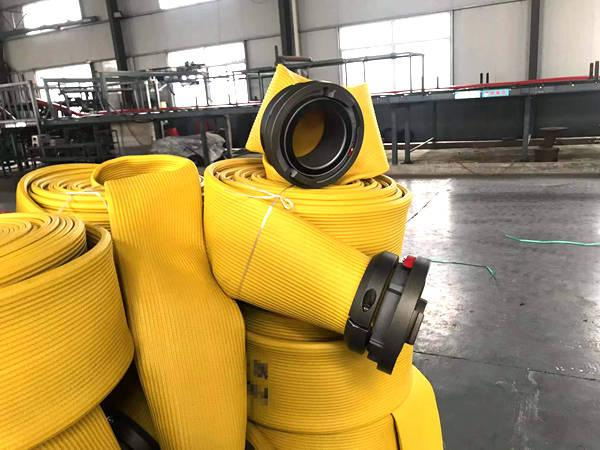
Haikuo is one of the better‑known layflat hose exporters from China, offering a wide range of PVC, rubber, and composite layflat hoses for agriculture, industry, and construction. Its production uses extrusion and weaving technologies to achieve uniform wall thickness and strong textile reinforcement, which is critical for stable pressure performance on 3" lines. [hosemanufacture]
The company emphasizes material selection, using higher‑grade PVC and rubber blends for better flexibility and abrasion resistance. For global buyers, Haikuo's broad catalog and existing certifications make it attractive for standard 3" water discharge and general‑purpose hoses, especially when a mixed portfolio of hose types is needed from one supplier. [hosemanufacture]
Shandong Jinyu is a large‑scale rubber enterprise with major capacity in high‑pressure layflat hoses, often serving mining and construction industries. For 3" applications, its differentiation lies in high‑pressure resistance, anti‑abrasion outer covers, and the ability to operate under wide temperature ranges, which is important for sites with both cold winters and hot summers. [hosemanufacture]
Given its scale, Jinyu is suitable for long‑term framework agreements and large projects that require consistent volumes and tight delivery schedules. However, minimum order quantities and engineering dialogue are typically better aligned with larger buyers and distributors rather than very small brands. [hosemanufacture]
Jiangsu Tongyi focuses on lightweight, flexible layflat hoses, mainly for agricultural and gardening markets. For buyers needing economical 3" layflat hoses for irrigation, Tongyi's strength is in cost‑effective design, ease of handling, and environmental friendliness of materials. [hosemanufacture]
The company uses automated lines and optimized production processes to reduce unit costs, making it appealing for price‑sensitive projects and developing markets. Its reputation for stable quality and reliable delivery makes it a reasonable choice when performance requirements are moderate and cost per meter is the primary KPI. [hosemanufacture]
Hebei Xinlong specializes in PVC layflat hoses, providing a broad spectrum of sizes and colors, including typical 3" water discharge variants. PVC's chemical resistance and smooth inner surface translate into low fluid resistance and high flow rates, which is beneficial for dewatering and temporary water lines. [hosemanufacture]
Xinlong competes on cost leadership, leveraging efficient PVC processing and large product portfolios to provide very competitive pricing. For OEM projects, color‑coded hoses and various wall thickness options can help distributors differentiate product tiers without significant re‑engineering. [hosemanufacture]
Zhejiang Xingye is known for rubber‑based layflat hoses for firefighting and other critical services. Its constructions emphasize fire resistance, high‑speed water delivery, and flexibility under high‑pressure, high‑stress conditions, which translates well to premium 3" hoses used in emergency water supply or municipal backup systems. [hosemanufacture]
The company holds several firefighting‑related certifications and has strong application know‑how in this niche. For buyers, Xingye is most suitable when 3" hose is part of fire protection or emergency packages where compliance and performance trump unit price. [hosemanufacture]
Guangdong Jiahong produces multi‑layer layflat hoses using co‑extrusion technology, combining abrasion‑resistant outer layers with chemically resistant inner liners. This structure allows higher pressure resistance and extended service life, which is valuable in 3" hoses used in more demanding industrial or chemical transfer settings. [hosemanufacture]
Co‑extrusion also offers tighter control over thickness and layer properties, enabling OEM designs that differentiate on performance rather than just branding. Jiahong is a good candidate when the project requires advanced hose constructions and the buyer is prepared to work with the factory on detailed specifications. [hosemanufacture]
Shaanxi Hongda targets heavy‑duty layflat applications, including oil and gas transportation and large‑scale industrial projects. Its hoses feature thick‑wall construction, high‑strength reinforcement, and corrosion‑resistant compounds, making them suitable for 3" lines exposed to hydrocarbons and harsh environments. [hosemanufacture]
The factory's large production capacity and industrial experience are attractive for EPC contractors and major operators looking for a partner capable of supporting mega‑projects. However, buyers must be prepared for higher MOQs and engineering lead times due to the heavy‑duty positioning. [hosemanufacture]
Fujian Longxiang focuses on environmentally friendly and food‑grade layflat hoses, used in food and beverage processing. For 3" hose, this means food‑grade materials, easy‑to‑clean inner surfaces, and compliance with relevant hygiene standards. [hosemanufacture]
If your application involves potable water, food transfer, or low‑contamination processes, Longxiang's capabilities can reduce regulatory risk and simplify audits. The factory also positions itself around sustainable production processes, which can support ESG narratives for downstream brands. [hosemanufacture]
Tianjin Hongda manufactures plastic layflat hoses for urban water supply, sewer drainage, and green‑area irrigation. Its 3" hoses are designed for versatile civil and municipal uses, with UV resistance and easy installation as key design targets. [hosemanufacture]
Being located in Tianjin offers logistical advantages for projects in northern China, while its cost‑effective pricing supports budget‑constrained infrastructure work. For overseas buyers, Hongda can be a backup or secondary source for standard civil‑grade 3" PVC or composite layflat hoses. [hosemanufacture]
> The table below summarizes typical positioning; actual figures should be confirmed with each factory's latest datasheets and certifications. [china-layflat-hose]
| Manufacturer | Core 3" Material Focus | Typical Positioning | Relative MOQ (3") | Certifications / QC Signals |
|---|---|---|---|---|
| Sunmoon (Jiangsu) | TPU / NBR, aramid‑reinforced options (linkedin) | High‑pressure, engineering‑grade, flexible OEM for SMEs (linkedin) | Medium (supports project‑based orders) (linkedin) | Hydrostatic test per hose, engineering QC, quality certificates listed (linkedin) |
| Hangzhou Haikuo | PVC / rubber layflat range (hosemanufacture) | Broad catalog, global export (hosemanufacture) | Medium | Multiple international quality certifications, strict QC systems (hosemanufacture) |
| Shandong Jinyu | Rubber high‑pressure layflat (hosemanufacture) | Large‑scale, mining & construction (hosemanufacture) | High | Strict QC, decades of rubber industry experience (hosemanufacture) |
| Jiangsu Tongyi | Lightweight PVC layflat (hosemanufacture) | Cost‑effective agriculture & garden (hosemanufacture) | Low–Medium | Modern automated lines, emphasis on environmental protection (hosemanufacture) |
| Hebei Xinlong | PVC layflat hoses (hosemanufacture) | Cost leadership, wide size/color range (hosemanufacture) | Low | Strict quality management, smooth bore flow performance (hosemanufacture) |
| Zhejiang Xingye | Rubber firefighting layflat (hosemanufacture) | Fire protection & emergency systems (hosemanufacture) | Medium | Fire‑related certifications, industry‑specific standards (hosemanufacture) |
| Guangdong Jiahong | Multi‑layer co‑extruded layflat (hosemanufacture) | Advanced performance, chemical / pressure demanding uses (hosemanufacture) | Medium–High | Co‑extrusion technology, strong R&D and innovation (hosemanufacture) |
| Shaanxi Hongda | Heavy‑duty rubber layflat (hosemanufacture) | Oil & gas, large industrial projects (hosemanufacture) | High | Strict QC, industrial project references (hosemanufacture) |
| Fujian Longxiang | Food‑grade rubber layflat (hosemanufacture) | Food & beverage, hygiene‑sensitive uses (hosemanufacture) | Medium | Compliance with food safety standards (hosemanufacture) |
| Tianjin Hongda | Plastic layflat for civil uses (hosemanufacture) | Municipal water & drainage (hosemanufacture) | Low–Medium | Continuous product upgrades, UV‑resistant designs (hosemanufacture) |
Experienced sourcing teams never rely solely on PDF certificates attached in emails. They cross‑check the factory's business license via China's National Enterprise Credit Information Publicity System or regional AIC portals using the 18‑digit registration number. This step confirms that the entity actually exists, matches the name on the proforma invoice, and is authorized for the stated business scope. [metafuro]
For ISO 9001 or other certificates, you should verify:
- Certificate number, scope, and validity dates via the issuing certification body or the relevant national accreditation bodies. [linfordco]
- That the certified scope explicitly includes "lay flat hose," "rubber/plastic hose," or related products, not unrelated services. [linfordco]
If anything is unclear, contact the certification body directly using contact information from its official website, not the PDF. [linfordco]
Clarify up front:
- Required working pressure and safety factor.
- Fluid type (water with suspended solids, brine, oil‑contaminated water, fertilizers, etc.).
- Temperature range and expected service life per deployment.
Factories like Sunmoon that offer multiple pressure options per diameter allow you to optimize cost/performance, instead of over‑buying a high‑pressure product for a low‑pressure irrigation job. For oilfield or mining uses, prefer TPU and aramid‑reinforced constructions from factories with proven high‑pressure references; for basic irrigation, a good NBR/PVC or PVC layflat from a cost‑oriented manufacturer may be sufficient. [strongflex]
A robust sampling process should include:
- At least two production samples of 3" hose produced on standard mass‑production lines (not lab samples).
- Third‑party hydrostatic testing to verify working and burst pressure.
- Basic dimensional checks (ID, wall thickness, weight per meter) against the agreed specification.
Factories with in‑house pressure‑test lines and test records per batch, such as Sunmoon, can share test reports as part of the pre‑shipment documentation package. This reduces the risk that mass‑produced goods deviate significantly from approved samples. [linkedin]
3" layflat hose is relatively bulky; packaging and reel solutions affect freight cost and on‑site handling. Chinese factories that offer customized reel systems, palletization, and labeled coils help streamline deployment at project sites. When comparing quotes, ensure you understand: [china-layflat-hose]
- Coil length and reel options.
- Packaging dimensions and weights for container optimization.
- Labeling, barcoding, and branding options for OEM programs.
A frequent issue in low‑price offers is using lower‑grade PVC or NBR, thinner covers, or reduced textile reinforcement, which may still pass short lab tests but fail under real‑world cycling. To mitigate this, specify minimum weight per meter, reinforcement type, and pressure ratings in the contract, then verify during incoming inspection. [eastophose]
Some factories show outdated ISO certificates, or certificates issued for non‑hose products. Always check the expiry date and product scope, and verify the certificate number with the issuer's online database or accreditation portals. [metafuro]
Choosing the lowest unit price often leads to higher lifecycle cost when hoses fail early, cause downtime, or require frequent replacement. Industry buyers often compare "cost per 1,000 hours of operation" for a given application rather than cost per meter. Engineering‑grade suppliers like Sunmoon, or multi‑layer specialists like Jiahong, may reduce total cost of ownership even when their initial quotes are higher. [grandviewresearch]
In the layflat hose trade, one under‑discussed practice is switching the textile yarn specification between sample and bulk. The factory may use higher‑tenacity yarn for the sample roll and downgrade to cheaper yarns in production while keeping the same polymer compound. This is harder to detect visually but significantly affects burst pressure and fatigue life; the hose may only fail after months in the field. [linkedin]
To guard against this:
- Ask the factory to document the yarn specification (denier, material, weave pattern) in the technical agreement.
- During pre‑shipment inspection, cut a random sample from a production roll and perform independent tensile and burst tests through a reliable lab.
- For critical projects, request periodic third‑party witnessing of production or pre‑shipment testing.
China's 3" lay flat hose manufacturing ecosystem offers options ranging from cost‑optimized PVC for basic irrigation to engineering‑grade TPU and aramid‑reinforced hoses for high‑pressure, high‑abrasion environments. The key for procurement managers is to align project requirements with the right factory profile, balancing technical depth, QC transparency, and long‑term cooperation potential instead of pursuing unit price alone. [china-layflat-hose]
If you are evaluating suppliers for 3" lay flat hose—especially for high‑pressure, oilfield, dewatering, or agricultural drag applications—factories like Jiangsu Sunmoon Shale Gas High‑Pressure Hose Co., Ltd. can serve as a representative partner that combines engineering‑grade quality with flexible OEM support for mid‑sized brands and project‑driven buyers. You can use the criteria and checks in this guide as a structured checklist when engaging with any of the listed manufacturers. [linkedin]
1. How can I verify if a Chinese factory's ISO 9001 certificate is still valid and not forged?
Ask for a complete, high‑resolution copy of the ISO certificate and note the certificate number, standard, scope, and accreditation body. Then, use the IAF and national accreditation body tools or the certification body's own online database to verify the certificate number, company name, location, scope, and expiry date. [metafuro]
2. What's the most reliable way to confirm that 3" layflat hoses from mass production match my approved sample?
Specify measurable parameters (ID, wall thickness, weight per meter, reinforcement type, pressure rating) and include them in the purchase contract, then conduct random destructive testing on coils from the bulk shipment to compare with sample data. Factories with hydrostatic test lines and traceable test records can provide batch reports that you can cross‑check against your own lab results. [strongflex]
3. How can I differentiate whether I need TPU, NBR/PVC, or PVC for my 3" hose project?
PVC layflat is typically used for low‑pressure water discharge and cost‑sensitive irrigation; NBR/PVC blends offer better oil resistance and higher temperature capability for industrial water with hydrocarbons; TPU is preferred for high‑pressure, high‑abrasion, or long‑distance transfer, such as frac water or mine dewatering. An experienced supplier can model pressure loss, mechanical stress, and expected cycles to recommend the most economical construction for your duty profile. [strongflex]
4. For multi‑year projects, how should I structure a framework agreement with a Chinese layflat hose supplier?
Define annual volume forecasts, review cycles for pricing based on raw material indices, and a fixed test plan (e.g., quarterly third‑party burst tests on 3" hoses). Include change‑control clauses so any modification to material formulation, reinforcement yarn, or production location triggers re‑qualification of samples. [grandviewresearch]
5. How can I minimize risk when starting with a new factory for critical applications (oil & gas, firefighting)?
Begin with a pilot batch of 3" hoses for non‑critical sections, supported by full documentation (material data sheets, test reports, certificates), and perform third‑party auditing of the factory's QC processes. Only move to large‑scale deployment after validating performance in the field across at least one full operating season. [linfordco]
- Global industrial hose market size and forecast (2025–2033): Grand View‑style market reports. [grandviewresearch]
- Lay flat hose market growth outlook and technology trends (2026–2033): recent industry analyses. [linkedin]
- Verification process for Chinese manufacturers and business licenses: National Enterprise Credit Information Publicity System and related guidance. [metafuro]
- ISO certificate verification practices and international accreditation resources. [linfordco]
- General technical background on lay flat hose types, materials, and applications. [strongflex]


