

Views: 222 Author: Sunmoon Publish Time: 2026-06-19 Origin: Site


Content Menu
● Why China Leads in Dewatering Hose Manufacturing
● Transparent Selection Criteria for This Top 10 List
● Top 10 Dewatering Hose Pipe Manufacturers in China (2026)
>> 1. Jiangsu Sunmoon Shale Gas High-Pressure Hose Co., Ltd.
>> 3. Suzhou Seapeak Co., Ltd.
>> 4. Hebei Dayufeiteng Rubber & Plastic Hose Co., Ltd.
>> 5. Large Integrated Rubber Hose Groups (e.g., Fushida, Hyrubber, Jinflex)
>> 6–10. Other Specialized Layflat and Dewatering Hose Exporters
● Comparison Table: Key Supplier Dimensions
● Technical Essentials of Dewatering Hose Pipes
● Buyer's Guide: Verifying Chinese Dewatering Hose Manufacturers
>> 1. How to verify the factory itself
>> 2. Sample and testing workflow
>> 3. Logistics and Incoterms considerations
● Industry Pain Points and "Internal" Pitfall Guide
>> A rarely discussed internal tip
● Conclusion and Call to Action
● FAQ: Advanced Questions Professional Buyers Ask
For global procurement managers, choosing a dewatering hose pipe partner in China is less about price and more about long‑term risk control and lifecycle cost. You need factories that can keep flow rates, pressure ratings, and delivery schedules stable over multi‑year projects.
When screening dewatering hose suppliers, experienced buyers usually assess four core dimensions:
1- Factory certifications and compliance
- ISO 9001 for quality systems, sometimes ISO 14001 for environmental management.
- Product‑level approvals where relevant (CE, RoHS for certain components or assemblies).
- Ability to pass project‑specific audits from international EPCs or municipal water authorities. [metafuro]
2- R&D and engineering capability
- In‑house formulation or strong know‑how in TPU/NBR rubber compounding, reinforcement design, and layflat hose structure.
- Ability to tune wall thickness, burst pressure, and abrasion resistance around your project's hydraulic conditions.
3- Quality control and process stability
- Incoming raw material checks (TPU pellets, NBR, yarns), online pressure and dimensional checks, plus 100% visual inspection for bonding, cover defects, and coupling integrity.
- Traceability from batch to finished hose reel, which is critical for warranty handling.
4- Delivery reliability and service model
- Proven capacity to keep lead times stable during peak season.
- Dedicated export team that understands Incoterms, customs documentation, and claims handling.
Behind these evaluation points is a fast‑growing industrial hose market: global industrial hose assemblies are projected to grow from about USD 20.17 billion in 2025 to USD 37.42 billion by 2035, reflecting the importance of reliable hose suppliers in mining, construction, and water management. [polarismarketresearch]
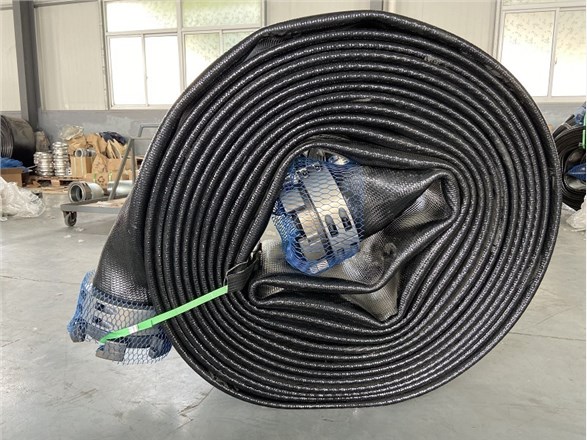
China has built dense industrial clusters for hose and rubber products, similar to how Foshan dominates furniture and Shenzhen electronics. In provinces like Jiangsu, Shandong, Hebei, and Zhejiang, you see complete ecosystems: resin suppliers, textile reinforcement producers, extrusion and weaving machinery, and hose assemblers in the same region. This reduces logistics time for components and supports rapid customization.
In layflat and dewatering hoses specifically, China benefits from:
- Mature supply chains for TPU, NBR, and high‑tenacity polyester yarn.
- A wide base of OEM factories already serving global brands in mining, oil & gas, and agriculture.
- Competitive yet increasingly quality‑focused mid‑sized factories that have upgraded to automated lines and stricter QC to match export expectations.
For procurement managers, this means you can source both high‑volume commodity dewatering hoses and highly customized, project‑specific layflat assemblies from the same country, provided you select the right partner and verify their claims properly. [sunmoonpipe]
To build a practical, buyer‑oriented ranking of dewatering hose pipe manufacturers in China, the following criteria are applied:
- Product scope and specialization
- Focus on layflat and dewatering hoses (TPU, NBR, slurry, mine drainage, large‑bore water transfer), not general rubber goods only. [sunmoonhose]
- Export track record
- Proven shipments to North America, Europe, or major mining/municipal markets.
- Visibility on B2B platforms or trade fairs and stable presence over multiple years.
- Quality and certification posture
- ISO 9001 or similar quality system certification; CE, RoHS, or related approvals where relevant.
- Evidence of routine pressure, tensile, and abrasion testing.
- Capacity and flexibility
- Sufficient annual meter output to support large tenders, plus willingness to handle smaller OEM batches for niche brands.
- Ability to adjust sizes (e.g., 4"–16") and working pressure ranges based on project requirements.
- OEM/ODM and engineering support
- Capability to develop private‑label products, custom colors/markings, and packaging.
- Technical communication in English and responsiveness in sample and drawing iterations.
- Reputation and buyer feedback
- Industry reputation from public sources, case references, and consistency of delivery performance.
These criteria are oriented toward professional buyers who need medium‑to‑long‑term partners rather than one‑off low‑price suppliers.
Jiangsu Sunmoon is a specialized manufacturer focusing on TPU layflat hoses, anti‑oil delivery flat hoses, pipeline repair hoses, slurry hoses, and NBR LDH fire hoses, with an annual capacity around one million meters. Founded in 2011 and located in Taizhou, Jiangsu, the company has grown around shale gas extraction, mine drainage, agricultural irrigation, and remote water supply applications, which naturally overlap with demanding dewatering projects. [sunmoonpipe]
From a buyer's standpoint, Sunmoon represents a high‑value choice for small to mid‑sized brands and distributors that require deep OEM customization without the bureaucracy of very large state‑owned plants. The factory emphasizes R&D‑driven design, allowing customization of hose diameter, wall thickness, working pressure, and compound selection to match specific water transfer or sludge dewatering conditions. [sunmoonpipe]
Key advantages for global buyers:
- Strong focus on TPU layflat and slurry/dewatering‑type hoses, not just general rubber products. [sunmoonhose]
- One‑million‑meter annual capacity suitable for project and distributor orders while remaining flexible on MOQs.
- Experience across shale gas, emergency mine drainage, and agricultural water transfer gives practical feedback loops on abrasion and kink resistance.
- Export‑oriented service mindset, with experience in OEM branding, printing, and packaging support.
For procurement managers managing multiple SKUs and private‑label lines, Sunmoon's combination of technical flexibility and responsive communication can be attractive when you need iterative prototyping and tighter control over hose performance in harsh field conditions. [sunmoonhose]
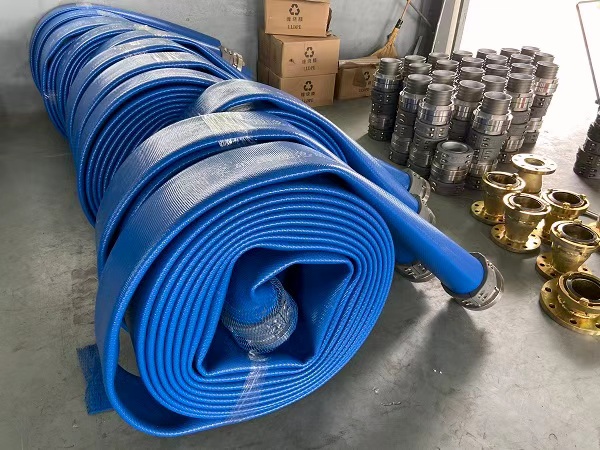
Qingdao‑area hose manufacturers under the "Qingflex" brand are known for hydraulic and industrial hoses, including layflat products used in construction dewatering, tunneling, and temporary water bypass. They usually operate modern extrusion and braiding lines with integrated testing, and serve both domestic and overseas markets. [alienfrac]
Buyers often select Qingflex‑type factories when they need:
- Broad hose portfolios (hydraulic plus industrial) from one vendor.
- Established export procedures and ability to meet various standards across sectors.
Suzhou Seapeak is widely recognized in layflat hose and irrigation‑related products, often supplying PVC and TPU layflat hoses for agriculture, construction, and water transfer. Its location in Jiangsu province benefits from proximity to resin producers and export hubs, enabling consistent lead times. [sunmoonhose]
For dewatering projects, Seapeak is often considered by buyers that:
- Want to integrate dewatering hoses with broader irrigation or fluid transfer product lines.
- Need standard specifications with large‑volume, price‑sensitive procurement.
Hebei Dayufeiteng is representative of the Hebei hose cluster, manufacturing a wide range of industrial hoses including high‑pressure, mine, and water discharge hoses that can be configured for dewatering applications. The Hebei region offers competitive labor costs and a dense rubber processing ecosystem.
Procurement teams typically look at Dayufeiteng‑type suppliers when they:
- Need heavy‑duty layflat and rubber hoses for construction and mining dewatering.
- Want to source complementary products such as suction hoses from the same supplier.
Some large Chinese groups, often listed in hydraulic hose rankings, also run dewatering and layflat product lines. These companies may not brand themselves around dewatering hoses specifically but provide high‑capacity production and mature quality systems. [alienfrac]
They are suitable for:
- Buyers needing multi‑country approvals and large volume framework contracts.
- Projects where brand recognition and strong quality documentation are crucial.
Beyond the headline names, there is a tier of mid‑sized, export‑oriented factories in Jiangsu, Shandong, and Zhejiang that focus on layflat and water discharge hoses. These companies often:
- Operate 5–15 production lines with annual capacities in the hundreds of thousands to low millions of meters.
- Provide OEM services for regional brands in Latin America, Southeast Asia, Eastern Europe, and the Middle East.
- Hold ISO 9001 certification and maintain CE or related certificates for specific product categories. [linfordco]
When building a shortlist, professional buyers usually mix one or two bigger integrated groups with one or two specialized mid‑sized factories such as Jiangsu Sunmoon to create resilience in both pricing and customization capability.
Below is an illustrative comparison of typical capabilities among leading Chinese dewatering hose manufacturers (data ranges are indicative and should be validated during RFQ).
| Supplier type / example | Typical annual capacity (meters) | Common dewatering hose size range | Approx. MOQ for OEM print | Typical certifications / focus |
|---|---|---|---|---|
| Jiangsu Sunmoon Shale Gas High-Pressure Hose | ≈1,000,000 meters (sunmoonpipe) | 4"–16" TPU/NBR layflat | 1–2 pallets per spec | ISO‑style QMS, export focus, shale gas & mine drainage applications (sunmoonpipe) |
| Qingdao‑area Qingflex‑type | High (multi‑million range) (alienfrac) | 2"–12" layflat & industrial | Container‑level preferred | Strong hydraulic & industrial range, export‑oriented (alienfrac) |
| Suzhou Seapeak‑type | Mid‑to‑high | 1.5"–10" PVC/TPU layflat | Flexible for irrigation | Irrigation and water transfer specialization (sunmoonhose) |
| Hebei Dayufeiteng‑type | Mid‑to‑high | 2"–16" water discharge & mine | Project‑driven | Heavy‑duty mine and construction hose focus |
| Large integrated groups (Fushida, Hyrubber etc.) | Very high (alienfrac) | Broad, including layflat | High MOQ, long contracts | Comprehensive quality systems, multi‑industry coverage (alienfrac) |
Use this table as a starting point for segmenting which style of supplier best matches your project volume, branding plans, and risk profile.
For professional buyers, understanding the technical fundamentals helps in writing precise RFQs and reading between the lines in quotes:
- Materials and construction
- TPU layflat hoses: High abrasion resistance, good for high‑pressure water transfer and dewatering with long line lengths.
- NBR rubber hoses: Better oil resistance, suitable when water carries hydrocarbons or oil traces, often reinforced with high‑tenacity polyester or synthetic fibers. [sunmoonpipe]
- Pressure ratings and safety factors
- Always check working pressure, burst pressure, and safety factor (often 3:1 or 4:1 for many industrial hoses).
- For dewatering hoses laid along rough ground, abrasion and kink resistance can be more critical than maximum pressure alone.
- Standards and certifications
- Quality management: ISO 9001 ensures process‑level consistency, though you still need to verify scope and expiry. [metafuro]
- Product‑level: CE marking may apply where the hose functions within a larger pressure equipment system; RoHS can be relevant where environmental restrictions on certain substances apply in end markets.
- Environmental and lifecycle considerations
- TPU hoses generally offer lighter weight and better coilability, reducing transport and handling costs.
- For mining and municipal projects, longer service life and fewer failures usually offset a modest premium over basic PVC discharge hoses.
The industrial hose market's strong growth expectations underline why more end users are standardizing on higher‑spec dewatering hoses to reduce unplanned downtime and flooding incidents. [sphericalinsights]
- Business license and registration
- Request the manufacturer's business license and 18‑digit registration number.
- Cross‑check via China's National Enterprise Credit Information Publicity System (NECIPS) or local AIC sites (e.g., for Jiangsu and Guangdong). [metafuro]
- ISO and other certificates
- Ask for ISO 9001 (and any ISO 14001, ISO 45001) certificates.
- Verify at the national accreditation body site or via International Accreditation Forum tools by certificate number and issuing body. [linfordco]
- Confirm the scope matches hose manufacturing and the certificate is not expired or suspended.
- Export license and customs registration
- Request copies of import/export registration certificates, as required for legal exporting. [metafuro]
- Factory audit
- For strategic suppliers, arrange a third‑party audit to review QC processes, testing equipment, HR practices, and capacity claims. [metafuro]
- Step 1: Technical RFQ
- Specify medium (clean water, slurry, water with oil), temperature, working pressure, and required safety factor.
- Define standards or project specifications you need to align with.
- Step 2: Prototype and lab test
- Request 10–50 m sample reels for lab testing on pressure, elongation, and abrasion.
- For large projects, consider third‑party lab tests in the destination country.
- Step 3: Field trial
- Run a 1–3 month field test on the actual site to evaluate handling, kinking, and coupling performance.
- Use data (breakage, leaks, visual wear) to fine‑tune the final specification with the OEM.
- Step 4: Pre‑shipment inspection
- For first orders, arrange pre‑shipment inspections to check dimension, marking, packaging, and random pressure tests.
- Clarify Incoterms (FOB, CIF, DAP) and responsibility for insurance and local charges.
- For long hose lengths and heavy reels, ensure pallets and packaging meet your warehouse and handling constraints.
- Confirm HS codes and any anti‑dumping or regulatory requirements in your destination market before locking in volumes.
International trade portals, customs data, and export statistics from official bodies such as China's Ministry of Commerce can offer additional insight into export trends and capacity allocation for the hose sector. [polarismarketresearch]
- Material downgrading over time
- Some plants may ship good‑quality samples, then gradually substitute lower‑grade TPU or yarn in later batches.
- Symptom: Gradual rise in failures after 6–12 months, while QC reports still "pass".
- Overstated pressure ratings
- Quoted working pressure may reflect lab conditions, not field conditions with sharp bends and rough terrain.
- Always insist on burst test data and safety factor definitions in writing.
- Hidden changes in reinforcement structure
- Suppliers might change weaving density or yarn type to cut cost, affecting kink resistance and elongation.
- This may not show in basic dimensional checks but shows up in accelerated wear in the field.
Among experienced buyers and local inspectors, one internal "rule‑of‑thumb" is to compare the weight per meter and reinforcement pick count between your original approved sample and every new production batch.
- If a factory subtly changes reinforcement or compound, the hose's weight per meter and feel will often shift before failure rates spike.
- During incoming inspection, have your team:
- Randomly cut 1–2 m sections from new batches.
- Measure weight per meter and outer diameter.
- Visually check reinforcement weave density.
If you notice consistent deviation beyond agreed tolerances, that's an early warning that the factory has altered the construction, and you should investigate before deployment. This simple check is widely used inside the industry but is rarely documented online because it is part of internal QC playbooks rather than marketing materials.
China's dewatering hose pipe manufacturers combine strong industrial clusters, mature raw material supply, and a wide spectrum of factory profiles, from large groups to agile mid‑sized specialists. For long‑term procurement success, the focus should be on verified quality systems, stable formulations, and transparent OEM collaboration rather than unit price alone. [sphericalinsights]
If you are building a shortlist for 2026 projects, consider mixing one or two large‑scale manufacturers with a flexible, R&D‑driven partner such as Jiangsu Sunmoon Shale Gas High‑Pressure Hose Co., Ltd., especially when you need customized TPU or slurry‑type layflat hoses and responsive engineering support. Start with a technical RFQ, request structured sampling and testing, and then lock in a clear quality agreement that protects your project over the full lifecycle. [sunmoonpipe]
1. How can I verify that a Chinese manufacturer's ISO certificate is still valid and not expired?
- Use the certificate number and issuing body to search on the relevant accreditation or certification body website, or via International Accreditation Forum tools, and confirm issue and expiry dates plus surveillance audit status. [linfordco]
2. What is the most effective way to ensure my dewatering hose specification is not silently downgraded after the first shipment?
- Implement a technical quality agreement that locks in material type, reinforcement construction, weight per meter, and pressure ratings, and pair it with random batch testing and in‑house weight/diameter checks on every shipment.
3. How do I compare TPU layflat and NBR rubber hoses for a mixed‑slurry dewatering project?
- TPU layflat usually offers better abrasion resistance and handling at lower weight, while NBR provides superior oil resistance; for slurry with hydrocarbons, you may use NBR in the most exposed segments and TPU where long distance transfer efficiency matters most. [sunmoonpipe]
4. What is a realistic lead time for customized OEM dewatering hoses from Chinese factories?
- For tuned compounds and private‑label printing, 25–45 days after deposit is common, with longer timelines during peak construction and mining seasons; confirm capacity and reserve slots for large tenders.
5. How can I assess whether a supplier can support long‑term framework agreements, not just a one‑off project?
- Look at their annual capacity, historical export data, presence in multiple regions, and willingness to share production planning information; mid‑sized specialized factories like Jiangsu Sunmoon can often provide a good balance of flexibility and stability for multi‑year frameworks. [sunmoonhose]
- Global industrial hose assembly market outlook (Spherical Insights / similar market reports). [sphericalinsights]
- Industrial hose market size and CAGR projections (Polaris or comparable research providers). [polarismarketresearch]
- Guidance on verifying Chinese manufacturers and checking licenses via NECIPS / AIC. [metafuro]
- ISO certificate verification practices via national accreditation bodies / IAF. [linfordco]


