

Views: 222 Author: Sunmoon Publish Time: 2026-06-17 Origin: Site


Content Menu
● Introduction: Why Source Fracking Hose from China in 2026
● How We Evaluated "Top" Chinese Fracking Hose Manufacturers
● Technical Overview: What Makes a Reliable Fracking Hose?
● Top 10 Fracking Hose Manufacturers in China (2026 Edition)
>> 1. Jiangsu Sunmoon Shale Gas High-Pressure Hose Co., Ltd.
>> 3. Hebei Biaohui Rubber & Plastic Products Co., Ltd.
>> 4. Nanjing Firefighter Fire Fighting Equipment Co., Ltd.
>> 5. Taizhou Qianwei Polyurethane Products Co., Ltd.
>> 6. Qingdao‑Area Industrial Hose Manufacturers
>> 7. Zhejiang‑Area Layflat Hose Producers
>> 8. Evergood Hose and Pipe Suppliers
>> 9. Integrated Oilfield Equipment Suppliers (Petroleum Hose Focus)
>> 10. Regional Specialized TPU Hose SMEs
● Manufacturer Snapshot Table: Capacity, MOQ, and Certifications
● Hidden Industry Pain Points and "Inside" Risk Tips
● Practical Buyer's Guide for Fracking Hose Procurement
>> 1. Verifying factory legitimacy and certifications
>> 2. Sampling and technical validation
>> 3. Contracting and specification control
>> 4. Logistics and packaging considerations
>> 5. Why consider Jiangsu Sunmoon as an SME‑friendly OEM partner
● Conclusion and Call to Action
● FAQs from Real‑World Fracking Hose Procurement
China has become one of the most important production bases for industrial and oilfield hoses, supported by mature rubber and polymer clusters, complete supporting industries, and competitive labor and logistics costs. Asia Pacific, led by China, held the largest share of the global industrial hose market in 2025, driven by infrastructure, energy, and manufacturing investments. [polarismarketresearch]
For fracking water transfer and frac hose, Chinese manufacturers now offer TPU and NBR layflat hoses with large bore, long continuous lengths, and working pressures up to the mid‑pressure range required for shale gas water transfer lines. Coupled with years of export experience and growing compliance awareness, this makes China attractive for procurement managers who need reliable, repeatable supply programs. [sunmoonpipe]
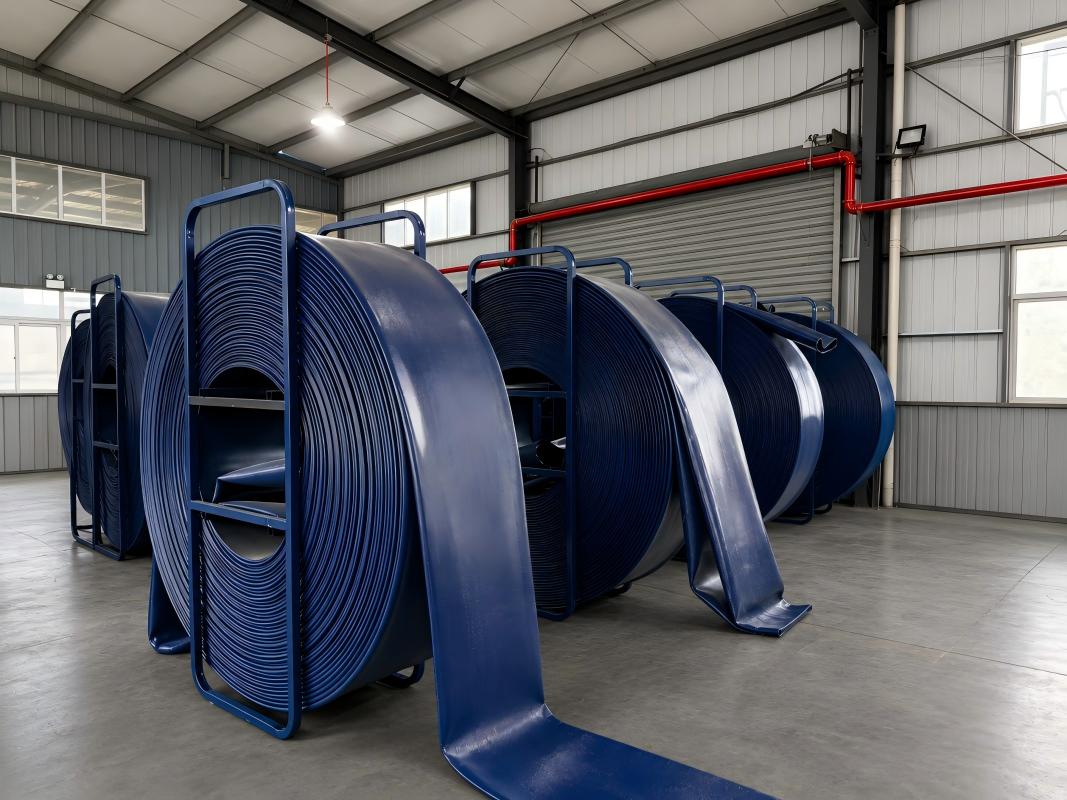
Before listing any manufacturers, it is important to clarify the selection criteria used to filter potential long‑term partners. The following dimensions reflect how an experienced industrial buyer would screen suppliers, especially for critical oilfield water transfer projects:
1. Factory certifications and compliance
- ISO 9001 or equivalent quality management system implementation.
- Product‑specific certifications where applicable (e.g., CE for certain applications, RoHS for materials in environmentally sensitive projects).
- Documented traceability for batch, resin supplier, and reinforcement yarn or jacket.
2. R&D and engineering capabilities
- Ability to design TPU or rubber layflat hoses with different pressure ratings, wall thicknesses, and reinforcement structures for various frac layouts. [e.cippe.com]
- In‑house compounding or at least strong cooperation with material suppliers for high‑performance TPU, NBR, and reinforcement fibers.
- Capacity to work from application conditions (flow rate, pressure, temperature, chemical medium) back to a custom hose design rather than just selling catalog SKUs.
3. QC process and testing infrastructure
- Hydrostatic pressure test benches covering working and burst pressures for large‑bore hoses. [e.cippe.com]
- Dimensional inspection and adhesion testing of TPU coatings or rubber to reinforcement layers.
- Sampling frequency policy for raw materials, semi‑finished hoses, and finished products.
4. Capacity, delivery stability, and scalability
- Annual capacity in meters (or pieces) and proportion dedicated to export. [sunmoonpipe]
- Lead times for standard SKUs vs. custom specifications, plus track record with rush orders.
- Ability to expand capacity via additional lines or shifts without sacrificing QC discipline.
5. Export experience and main markets
- Years of continuous export to North America, Europe, Middle East, or South America for oil & gas, mining, and municipal projects. [made-in-china]
- Familiarity with documentation requirements such as material certificates, test reports, MSDS, and third‑party inspections.
6. OEM/ODM depth and communication efficiency
- Experience serving as OEM for international brands, including private label printing, custom colors, packaging, and documentation. [made-in-china]
- Ability to communicate technical details in English and respond quickly during design iterations and claim handling.
The list below is based on these criteria, with a focus on manufacturers that are demonstrably active in layflat and frac water transfer hoses and that have built up export capabilities by 2025–2026. [sunmoonhose]
For a procurement manager, understanding the technical fundamentals is critical to evaluating supplier claims. The following elements strongly influence lifecycle cost and safety:
- Base material: high‑performance TPU and NBR
- TPU layflat hoses are widely used in shale gas water transfer for their abrasion resistance, flexibility at low temperature, and resistance to hydrolysis compared to some traditional PVC. [sunmoonpipe]
- NBR rubber hose variants offer oil resistance where fluids carry hydrocarbons, while reinforced PE/aramid structures can boost pressure ratings. [made-in-china]
- Reinforcement and construction
- Large‑bore frac hoses typically use circular woven polyester or aramid reinforcement, encapsulated between inner and outer TPU or rubber layers. [e.cippe.com]
- Proper adhesion between layers is critical; delamination under pressure cycles is a common failure mode.
- Dimensions and pressure ratings
- Typical diameters range from 6" to 12" with working pressures from roughly 150 psi up to around 450 psi for water transfer applications. [e.cippe.com]
- Long continuous lengths (for example, up to 660 ft per hose) reduce coupling points and leak risk in the field. [e.cippe.com]
- Test and safety factors
- Many industrial hoses are designed with safety factors around 2:1 to 3:1 between working and burst pressure, but you should always confirm the specific design standard with each supplier.
- Acceptance of third‑party witness testing for type approval builds additional confidence for new projects.
- Environmental and regulatory aspects
- For projects in environmentally sensitive areas, buyers may require material compliance with RoHS‑type limits on restricted substances or REACH SVHC screening, even for hoses not sold as electrical products.
- Proper documentation of recyclability or disposal recommendations is increasingly requested in ESG audits.
Below is a curated list of 10 notable Chinese manufacturers that are active in frac hose / fracking water transfer or related layflat hose segments, with one representative profile for each. Ordering places Jiangsu Sunmoon first as a cost‑effective, R&D‑driven OEM partner for small and mid‑sized brands. [sunmoonhose]
Jiangsu Sunmoon Shale Gas High-Pressure Hose Co., Ltd. is a specialized manufacturer of frac layflat hose with well‑equipped testing facilities and strong technical capabilities, located in Taizhou, Jiangsu. Founded in 2011, the company integrates R&D, production, and sales and focuses on TPU layflat hose, anti‑oil delivery flat hose, pipeline repair flat hose, slurry hose, and NBR LDH fire hose. [sunmoonpipe]
Its frac water transfer hoses cover diameters from 6" to 12", with working pressures typically ranging from about 150 psi up to 450 psi and single lengths reaching approximately 660 ft, which suits long‑distance shale gas water supply lines. Annual production capacity reaches about one million meters, enabling mid‑to‑large‑scale projects without requiring extremely high minimum order quantities. [sunmoonpipe]
Sunmoon exports globally for shale gas extraction, agricultural irrigation, emergency mine drainage, and remote water supply, and is known for flexible OEM/ODM support, including custom specifications, private label branding, and responsive technical communication in English. This positioning makes the company particularly suitable for small and medium international brands seeking a cost‑effective, engineering‑oriented manufacturing partner rather than a pure volume producer. [made-in-china]
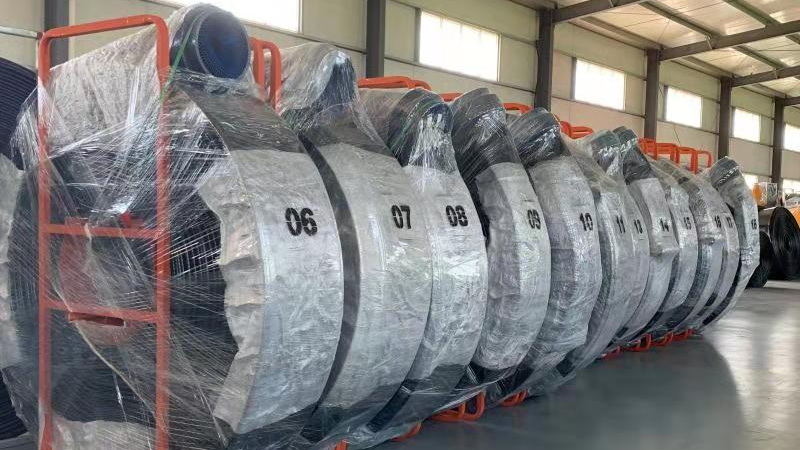
ZYfire Hose Corporation is an established Chinese hose manufacturer known for a wide range of layflat hoses, including products used in oilfield, municipal, and firefighting applications. The company generally provides TPU and rubber layflat products, with export reach to multiple regions and a track record in OEM supply. [sunmoonhose]
Hebei Biaohui focuses on rubber and plastic hoses, with a portfolio that includes industrial hoses and layflat solutions for water and petroleum transfer. Its strengths lie in rubber compounding experience and the ability to supply different pressure classes and abrasion‑resistant covers for demanding field conditions. [sunmoonhose]
Nanjing Firefighter offers layflat hoses for fire and municipal water applications, some of which are adapted to oilfield water transfer scenarios in certain markets. For buyers who need dual‑use hoses that can serve both municipal and temporary industrial projects, such manufacturers provide relevant options. [sunmoonhose]
Located in the broader Jiangsu and Zhejiang manufacturing region, Taizhou‑based polyurethane hose manufacturers benefit from proximity to polymer suppliers and export hubs. They often supply TPU layflat hoses with medium‑to‑high working pressures and are comfortable with OEM printing and packaging. [laikehydraulics]
Shandong and Qingdao have long been clusters for rubber products including industrial hoses, with companies specializing in hydraulic, mining, and oilfield hoses. Such manufacturers typically leverage mature rubber compounding lines to offer NBR or SBR‑based layflat products suitable for water and slurry handling. [pdf.dfcfw]
Zhejiang province, especially around Ningbo, has a concentration of hose and hydraulic component manufacturers serving construction and equipment OEMs worldwide. While many focus on hydraulic hose, several also produce layflat hoses used for dewatering, construction water supply, and sometimes frac pad support services. [laikehydraulics]
Chinese brands active globally in "high pressure hose pipe" segments often provide complementary products for oil & gas, mining, and construction. These suppliers typically maintain strong export operations, online catalogs in English, and structured OEM programs for distributors. [evergoodhose]
Some enterprises active in petroleum hose and oilfield accessories integrate hoses, fittings, and assemblies under one roof. For buyers seeking systems (hose plus couplings and handling equipment) rather than standalone hose, these suppliers can be considered alongside specialist hose factories. [alienfrac]
Beyond the large names, there are many small and medium enterprises (SMEs) that specialize solely in TPU or PE layflat hoses, often located in Jiangsu, Shandong, and Hebei. These SMEs can be extremely flexible on custom SKUs, colors, and branding but require stronger engineering guidance from the buyer. [made-in-china]
> Note: Because the fracking hose market overlaps with broader industrial and layflat hose segments, many qualified manufacturers present themselves as TPU layflat or industrial hose suppliers rather than using "fracking hose" in their branding. Buyers should therefore evaluate technical specifications and application experience, not just website labels. [sunmoonpipe]
The following table summarizes key factors you should verify with shortlisted suppliers. Values for non‑Sunmoon manufacturers are indicative ranges commonly seen among established Chinese hose factories in this segment; always reconfirm with each supplier during RFQ.
| Manufacturer / Type | Typical annual capacity (m) | Typical MOQ for OEM | Common certifications / systems | OEM/ODM scope focus |
|---|---|---|---|---|
| Jiangsu Sunmoon Shale Gas High-Pressure Hose Co., Ltd. | ≈1,000,000 m of layflat hose per year for multiple applications. (sunmoonpipe) | Flexible; often supports small and mid‑size OEM batches for niche brands. (sunmoonpipe) | ISO‑style quality management and in‑house testing for pressure, dimensions, and performance (confirm current certificate copy). (sunmoonpipe) | Deep OEM/ODM including custom TPU formulations, color, printing, packaging, and application‑driven design. (sunmoonpipe) |
| Large listed or group‑backed hose manufacturer (Shandong / Hebei) | Several million meters across product lines annually, focused on scale. | Higher MOQ, often full container per spec for OEM. | ISO 9001, sometimes ISO 14001 / 45001, and product‑specific certificates. | Strong OEM on catalog‑based products; limited deep customization. |
| Medium‑sized TPU layflat hose SME (Jiangsu / Zhejiang) | Hundreds of thousands of meters per year. | Moderate MOQ; willing to combine SKUs per container. | ISO‑type systems; internal test reports for each batch. | Flexible on color, printing, and some design changes. |
| Fire and municipal hose producer with oilfield cross‑over | High volume in fire hose; limited frac hose volume. | Stable MOQ; usually standard lengths and diameters. | Fire product certifications plus ISO 9001. | OEM branding and special packaging; technical customization limited to fire hose norms. |
| Integrated oilfield hose system supplier | Capacity split between hose, fittings, and assemblies. | Project‑based MOQ defined by package (hose + fittings). | QMS plus oil & gas field project references. | System‑level OEM, including assemblies, testing, and documentation. |
This table is intended as a starting framework; actual numbers will vary, and serious buyers should collect detailed capacity and certification data in supplier questionnaires and during on‑site audits.
In real procurement practice, several recurring issues differentiate successful projects from costly failures. Some of these are rarely discussed publicly:
1. "Up‑spec" on paper, down‑spec in reality
Many low‑end suppliers quote high working pressures and long lifetimes but silently reduce wall thickness, change reinforcement yarn density, or switch to cheaper TPU blends during production. This can result in burst failures under transient pressure spikes. The practical countermeasure is to specify minimum wall thickness, reinforcement density, and safety factor in your purchase contract and perform random destructive tests on received batches.
2. Batch‑to‑batch inconsistency
Even when a factory has good engineering capability, inconsistent mixing or curing can cause the first container to perform very differently from later orders. Experienced buyers request retention samples, periodic third‑party lab testing, and maintain an approved formulation and process sheet on file, which cannot be changed without written consent.
3. Coupling and handling are often the real failure points
Field failures frequently occur at couplings, bends near fittings, or where hoses are dragged across abrasive surfaces, rather than in mid‑span hose. You should evaluate not just the hose supplier but also coupling compatibility and handling procedures in the field. For critical projects, consider ordering pre‑assembled, factory‑tested hose lines from suppliers that can provide both hose and fittings.
4. The "year‑end rush" trap
In Q4, many factories run at peak capacity to hit annual targets, sometimes stretching QC teams thin. Smart buyers either front‑load orders earlier in the year or insist on unchanged inspection plans and may use third‑party inspection during these periods.
5. Internal "avoidance rule": never buy only from glossy catalogs
An unwritten rule among experienced sourcing managers is to never finalize a high‑risk, high‑pressure hose supplier based solely on a glossy catalog or website. Instead, they always request raw test data (e.g., burst tests, impulse or cyclic pressure tests if available) and talk directly to engineers, not only to salespeople. A manufacturer willing to share detailed test curves and failure analyses is usually a safer long‑term partner.
- Business license and registration
- Request a current business license and cross‑check key data (legal representative, scope, address) via Chinese corporate information platforms or local agents.
- ISO and product certificates
- Ask for high‑resolution copies of ISO 9001 (and other relevant) certificates and confirm their validity through the issuing body's official website or verification hotline.
- For CE or similar declarations, check whether they are self‑declarations or backed by notified body reports.
- On‑site or third‑party audit
- Arrange an initial factory audit, at least once, either personally or via third‑party agencies, to verify production lines, test equipment, and actual production versus claimed capacity.
- Stepwise sample plan
- Phase 1: small cut‑length sample to verify material (appearance, flexibility, adhesion).
- Phase 2: full‑length hose samples (e.g., 100–200 m) to test handling, coupling, and field deployment.
- Phase 3: pilot order under actual project conditions, monitored for pressure stability and wear.
- Verification tests
- Hydrostatic test at 1.5–2 times working pressure on a representative length.
- Visual inspection after pressure cycles for blistering, layer separation, or weeping.
- Dimensional checks (ID, OD, wall thickness) at multiple positions along the length.
- Include in your specification:
- Material type and grade (e.g., TPU outer/inner, type of reinforcement).
- Minimum wall thickness and reinforcement pick count.
- Working and burst pressure, safety factor, and test methods.
- Acceptable variation ranges and sampling plan for each batch.
- Establish an Engineering Change Notice (ECN) rule
- Require written notification and approval if the manufacturer intends to change material suppliers, formulations, reinforcement fabrics, or process parameters that affect performance.
- Packaging method
- For long lengths, confirm whether hoses are supplied on wooden reels, steel reels, or folded and palletized, and check that the method will not cause permanent kinking.
- Moisture and UV protection
- Ask for UV‑resistant wrapping or tarpaulin for sea shipments, especially for TPU hoses that may degrade if exposed to harsh conditions over long periods.
- Shipping terms and lead times
- Clarify INCOTERMS (FOB, CIF, DAP) and lead times from deposit to shipment, plus buffer time for pre‑shipment inspection.
For buyers who operate small to mid‑size brands or who manage regional distribution rather than global majors, Jiangsu Sunmoon offers a combination of moderate capacity, flexible MOQ, and deep OEM support. The company's focus on TPU and high‑pressure layflat hoses, plus its experience in multi‑application exports (shale gas, mining, irrigation, emergency drainage), makes it well placed to co‑develop customized SKUs and respond rapidly to the technical and branding needs of growing international partners. [e.cippe.com]
Choosing the right Chinese fracking hose manufacturer is not about chasing the lowest unit price, but about balancing material technology, QC discipline, capacity, and OEM/ODM collaboration to control total lifecycle cost and risk. The 10 manufacturers and clusters outlined above provide a practical starting pool, with Jiangsu Sunmoon Shale Gas High-Pressure Hose Co., Ltd. standing out as a flexible, R&D‑driven option for small and medium brands seeking long‑term OEM partnerships. [sunmoonhose]
Contact us to get more information!
1. How can I verify whether a supplier's ISO certificate is still valid and not expired?
Ask for a scanned copy of the certificate, then visit the issuing body's official website and use their online verification tool or email/phone contact to confirm the certificate number, company name, and expiry date. If the certificate is from an unfamiliar body, check that the issuer itself is accredited by a recognized accreditation agency in its country.
2. What minimum data should I require in a fracking hose test report before confirming a bulk order?
At a minimum, insist on test results for working and burst pressure, dimensional checks (ID, OD, wall thickness), adhesion or delamination tests between layers, and a visual inspection record. For critical projects, also request cyclic pressure tests and temperature‑conditioned tests that reflect your real operating environment.
3. How do I evaluate if a supplier can truly scale up for multi‑well pad projects without quality loss?
Review their annual capacity, number of production lines, and historical largest single project, and ask how they balance schedule and QC when running multiple large orders simultaneously. During audits, check whether they have documented capacity planning, staffing plans for peak seasons, and independent QC teams that are not overridden by production management.
4. If a hose fails in the field, what kind of root cause analysis should I expect from a professional factory?
A serious manufacturer will request detailed use conditions, photos, and returned samples, then conduct internal physical and microstructural analysis (e.g., checking fracture surfaces, reinforcement integrity, and adhesion). They should provide a written report, identify the probable root cause (design, material, processing, or misuse), and propose corrective actions, including design or process changes where necessary.
5. How can I differentiate between a trading company and a real manufacturer when sourcing in China?
Check whether the company can provide factory photos, production line videos, and detailed process descriptions beyond generic marketing material. Confirm ownership of key equipment (extrusion lines, weaving machines, test benches) during an audit or third‑party inspection, and compare business licenses and factory addresses to ensure you are dealing with the same legal entity that actually produces the hose.
- Industrial hose market reports by Polaris Market Research and similar research houses. [polarismarketresearch]
- Petroleum hose and oilfield equipment market analyses, which highlight safety and performance standards in 2026. [alienfrac]


