

Views: 222 Author: Loretta Publish Time: 2026-01-23 Origin: Site


Content Menu
● How Does a Suction Hose Work?
● Main Benefits of Using Suction Hoses
● Common Types of Suction Hoses
>> PVC Steel Wire Reinforced Suction Hose
>> PVC Fabric Reinforced Suction Hose
>> PVC Spiral Suction and Discharge Hose
>> UHMWPE Chemical Suction Hose
● TPU Layflat Hose vs Conventional Suction Hoses
● Typical Applications of Suction Hoses
● Key Technical Features to Consider
● How to Select the Right Suction Hose
● Best Practices for Installing and Using Suction Hoses
● Maintenance Tips to Extend Service Life
● When TPU Layflat or TPU‑Based Solutions Make Sense
● Take the Next Step for Reliable Suction Performance
>> 1. What is the main purpose of a suction hose?
>> 2. What is the difference between a suction hose and a discharge hose?
>> 3. Can the same suction hose handle chemicals and water?
>> 4. How do I know what size suction hose I need?
>> 5. How often should suction hoses be replaced?
A suction hose is a reinforced flexible hose designed to draw liquids, slurries, or particles into a system under negative pressure (vacuum) without collapsing. It is widely used in industry, agriculture, construction, environmental management, and sanitation wherever reliable fluid intake is critical.

A suction hose is a flexible pipeline engineered to withstand external atmospheric pressure while a pump or vacuum creates negative pressure inside the hose. Unlike ordinary discharge hoses that mainly handle internal positive pressure, suction hoses must resist collapse when pressure inside the hose drops below the surrounding air pressure.
- The hose is usually connected to pumps, vacuum systems, or process equipment.
- It transfers media such as water, sewage, slurry, chemical solutions, oils, or granular materials from a static source into a system.
The defining structural feature is a reinforcement layer, often spiral steel wire, rigid PVC helix, or strong textile, that maintains the hose cross‑section under vacuum.
When a pump or vacuum source operates, it creates a region of negative pressure inside the hose relative to the surrounding atmosphere. Atmospheric pressure then pushes the fluid from the source into the hose and up toward the pump.
Key working principles include:
- Vacuum rating: Industrial suction hoses are rated for specific vacuum levels, up to near full vacuum in heavy‑duty designs.
- Reinforcement: Spiral wire or helix reinforcement resists radial collapse, while textile reinforcement helps maintain dimensional stability and flexibility.
- Flow optimization: Smooth inner walls minimize friction losses, helping the system maintain required flow rates at lower energy consumption.
A simple schematic diagram showing “fluid source → suction hose → pump → process or discharge” would be an effective visual to explain the working principle.
Modern industrial suction hoses deliver a combination of safety, performance, and cost advantages.
- Strong vacuum resistance to work under negative pressure without kinking or collapsing.
- Lightweight and flexible designs compared with rigid pipes or heavy rubber, simplifying handling and installation.
- Efficient fluid transfer thanks to smooth bores that reduce pressure loss and minimize clogging.
- High customizability with a wide range of diameters, materials, and construction options.
- Cost efficiency through easier installation, lower maintenance, and flexible replacement options.
A bar chart comparing weight per meter, vacuum rating, and temperature range between PVC, rubber, and TPU‑based suction or layflat hoses would visually highlight these benefits.
Rubber suction hoses typically use an elastomer tube with textile plies and embedded steel wire for negative‑pressure resistance.
- Ideal for heavy‑duty, high‑pressure, and abrasive applications such as slurry, mud, and construction dewatering.
- Offers excellent mechanical strength, impact resistance, and flexibility over a wide temperature range.
PVC steel wire suction hose uses a soft PVC wall with embedded spiral steel wire.
- Good transparency allows visual inspection of the medium and detection of blockages.
- Suitable for water, light chemicals, industrial waste liquids, dust, and non‑high‑corrosive oils.
- Optional copper wire can be included to dissipate static electricity in potentially flammable environments.
This design wraps inner and outer PVC layers around a polyester fiber braid to form a strong yet flexible hose.
- Well suited to positive pressure or mild negative pressure uses such as agricultural irrigation, washing systems, and low‑pressure liquid transfer.
- Excellent bending performance and easy routing around equipment due to its soft structure.
PVC spiral suction hose combines a soft PVC body with a hard PVC spiral rib as skeleton reinforcement.
- Works as a dual‑purpose suction and discharge hose for water, fertilizers, pesticides, and similar media.
- Features a smooth bore, flexible body, and good anti‑kink performance for low maintenance operation.
UHMWPE suction hoses use an ultra‑high molecular weight polyethylene liner for high chemical resistance.
- Suitable for highly corrosive acids, alkalis, and solvents in chemical plants, tank trucks, and marine loading systems.
- Maintains good flexibility, pressure capacity, and aging resistance even under demanding chemical exposure.
Traditional suction hoses are usually corrugated or helix‑reinforced round hoses, while TPU layflat hoses provide a different option, especially for high‑flow water transfer and dewatering. TPU layflat is not a direct replacement for every suction application, but it is highly relevant in modern fluid transfer systems.
Hose type | Structure and shape | Key strengths | Typical use cases |
PVC suction hose | Soft PVC with steel or PVC helix | Lightweight, transparent, economical | General water, light chemicals, agriculture |
Rubber suction hose | Rubber tube with textile and wire reinforcement | Heavy-duty, high pressure, abrasion resistant | Construction, mining, slurry transfer |
UHMWPE suction hose | UHMWPE liner with textile and wire reinforcement | High chemical resistance | Chemical transfer, tank trucks, marine loading |
TPU layflat hose | Thermoplastic polyurethane layflat construction | Ultra-light, high pressure, excellent wear resistance | Long-distance water transfer, firefighting, dewatering |
Key TPU advantages for fluid transfer include:
- Lower weight than comparable rubber hose, reducing manual handling effort and system load.
- High burst pressure, supporting high‑pressure pumping and extended hose runs.
- Wide operating temperature range and excellent resistance to many oils and fuels.
A comparative chart showing pressure rating, weight, and expected service life for PVC, rubber, and TPU layflat hoses will strongly support material selection decisions.
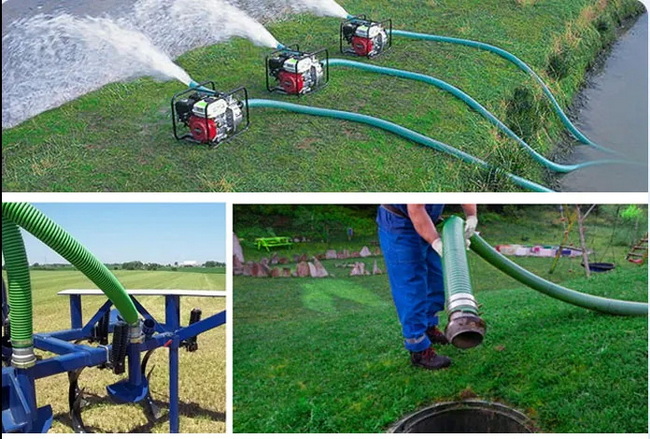
Suction hoses are widely used across many sectors and systems.
- Agriculture: Irrigation intake from ponds or wells, transfer of fertilizers, manure slurries, and animal waste.
- Construction and mining: Site dewatering, slurry removal, sand and gravel transfer, and handling of concrete residues.
- Industrial processing: Transfer of process water, oils, coolants, chemicals, and slurries between tanks and equipment.
- Environmental management: Flood control, emergency drainage, and wastewater collection.
- Automotive and marine: Fuel, coolant, and bilge water handling in vehicles, ships, and boats.
A process‑flow diagram that maps “source → suction hose → pump → treatment → discharge” can help users quickly visualize how the hose fits into their system.
When evaluating or specifying a suction hose, engineers and buyers should focus on several critical technical characteristics.
- Vacuum rating: Maximum safe negative pressure, which must match the pump and system design.
- Temperature range: Minimum and maximum ambient and media temperatures, including any cleaning or sterilization cycles.
- Chemical compatibility: Resistance of hose materials to the specific chemicals, oils, fuels, or slurries being conveyed.
- Abrasion resistance: Required wear resistance where sand, gravel, slurries, or other solids are present.
- Anti‑kink and anti‑collapse design: The quality and geometry of helix or wire reinforcement, as well as specified minimum bend radius.
A small parameter table summarizing typical values for each hose family (PVC, rubber, UHMWPE, TPU) will allow readers to compare options at a glance.
A structured selection process reduces failure risk and total cost of ownership.
- Define medium and environment
Identify whether the medium is water, slurry, oil, chemical, or food‑grade fluid, and consider UV exposure, ozone, oils, and mechanical abrasion on site.
- Determine pressure and vacuum conditions
Confirm required vacuum level and any positive working pressure the hose must handle, along with suitable safety factors.
- Size the internal diameter
Match internal diameter to flow rate and acceptable pressure drop; undersized suction hoses can cause cavitation and damage pumps.
- Select material and construction
Choose PVC for economical, light‑duty water and light chemicals, rubber for heavy‑duty and abrasive media, UHMWPE or TPU for aggressive chemicals or demanding duty cycles.
- Consider connections and accessories
Use compatible couplings such as camlock or flanges, apply correct clamping torque, and specify built‑in grounding where electrostatic discharge is a risk.
An illustrated decision tree showing “media → pressure/vacuum → environment → recommended hose type” can significantly improve user experience for selection.
Correct installation is as important as correct selection for long, safe service life.
- Avoid sharp bends and kinks, and keep bend radius larger than the recommended minimum.
- Support long runs with saddles or hangers to prevent sagging under the weight of the fluid.
- Protect the hose from abrasion and cuts where it crosses sharp edges or rough surfaces.
- Inspect couplings for loosening, corrosion, and wear, especially in high‑vibration environments.
- Keep operating conditions within rated temperature and vacuum or pressure limits.
Annotated photos or line drawings comparing correct and incorrect routing and support will help users quickly grasp these best practices.
Regular maintenance keeps suction hoses safe, reliable, and compliant with site standards.
- Perform routine visual inspections for cracks, blistering, exposed reinforcement, or flat spots.
- Flush and clean the hose after use, especially when conveying chemicals or slurries that may harden or attack the lining.
- Store hoses coiled without tight kinks, away from direct sunlight, ozone, and extreme temperatures.
- Track operating hours and key conditions to plan proactive replacement before critical failures occur.
A simple checklist graphic or downloadable inspection form can further enhance usability for maintenance teams.
For long‑distance fluid transfer, firefighting lines, and demanding dewatering, TPU layflat hoses or TPU‑lined suction solutions often provide a superior performance‑to‑weight ratio.
- Their combination of low weight, high burst pressure, wide temperature range, and excellent abrasion resistance matches modern high‑duty pumping systems.
- TPU solutions can reduce downtime and replacement frequency, particularly in applications with high cycle counts, rough handling, or aggressive media.
A case‑study style chart comparing downtime, repair frequency, and total cost over several seasons before and after switching to TPU will strongly reinforce these advantages.
If your projects demand reliable suction performance, long service life, and optimized system efficiency, this is the right moment to upgrade from basic hoses to engineered solutions tailored to your operating conditions. Reach out to your hose technology partner today to review your application, compare PVC, rubber, UHMWPE, and TPU options, and configure a suction hose system that delivers safer operation, higher uptime, and a lower total cost over the entire service life.
Contact us to get more information!
The main purpose of a suction hose is to draw liquids, slurries, or particles into pumps or systems under negative pressure without collapsing, enabling reliable fluid intake from static sources such as tanks, pits, or ponds.
A suction hose is designed to withstand vacuum and prevent collapse, whereas a discharge hose mainly handles positive internal pressure and does not usually require heavy anti‑collapse reinforcement.
Some suction hoses can handle both, but chemical service requires materials such as UHMWPE, specialized rubber, or TPU compounds that are compatible with the specific chemicals involved, so compatibility data should always be checked.
The correct size depends on pump flow rate, required vacuum, acceptable pressure drop, and hose length; using manufacturer sizing charts helps avoid undersized hoses that cause cavitation or oversized hoses that reduce efficiency.
Replacement intervals depend on material, operating conditions, and media, but hoses should be replaced immediately when signs of cracking, soft spots, collapse, or chemical attack are detected during regular inspections.
https://www.strongflex.com/what-is-a-suction-hose/
https://www.copely.com/discover/guides/suction-and-discharge-hoses-guide/
https://www.orient-hose.com/tpu-layflat-hose-has-huge-advantages/
https://www.sunhose.com/layflat-hoses-decoded-why-pvc-rubber-and-tpu-cater-to-different-needs/
https://www.somaxflex.com/suction-and-discharge-hose/
https://www.ducting.com/suction-hoses/
https://cntopa.com/pressure-vs-suction-hoses-key-differences-explained.html


