

Views: 222 Author: Loretta Publish Time: 2026-01-09 Origin: Site


Content Menu
>> Diameter and wall thickness
● Common Flexible Hose Materials
>> EPDM (Ethylene Propylene Diene Monomer)
>> TPE (Thermoplastic Elastomer)
>> Silicone
>> Neoprene
>> Steel and textile reinforcement
● PVC vs Rubber vs TPU: Which Is “Most Popular”?
>> Growing adoption of TPU layflat hose
● How to Choose the Best Flexible Hose Material
>> Step 1 – Define your operating conditions
>> Step 2 – Check standards and compliance
>> Step 3 – Evaluate pressure, bend radius, and weight
>> Step 4 – Balance upfront cost with service life
>> Step 5 – Consider upgrading to TPU layflat for demanding duty
● Quick Comparison of Common Flexible Hose Materials
● Get a Tailored TPU Layflat Hose Solution
● FAQs About Flexible Hose Materials
>> FAQ 1. What is the most popular flexible hose material today?
>> FAQ 2. When should TPU layflat hose be used instead of PVC layflat hose?
>> FAQ 3. Which flexible hose materials handle high temperatures best?
>> FAQ 4. How important is chemical compatibility when choosing hose material?
>> FAQ 5. How often should flexible hoses be inspected or replaced?
Flexible hoses are now available in many materials, but PVC, rubber, TPU, and other engineered polymers each offer very different performance, cost, and service life. PVC dominates everyday flexible hose volume, while rubber, PTFE, and TPU layflat hoses serve more demanding, high‑value projects in mining, energy, construction, and agriculture.
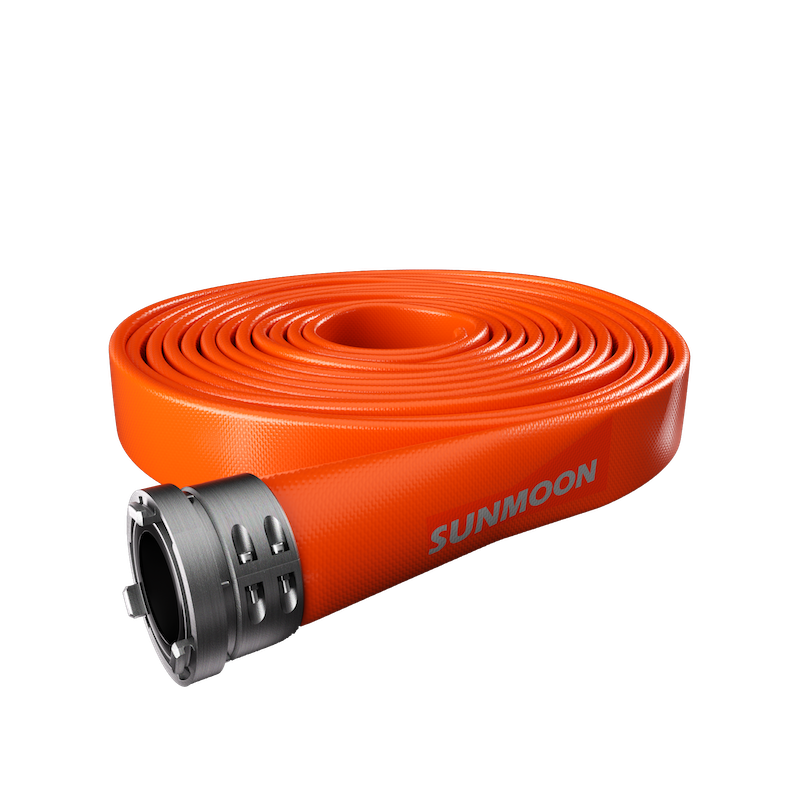
A flexible hose is a bendable conduit designed to route through tight spaces while maintaining reliable pressure, flow, and sealing performance. Most flexible hoses include an inner tube that contacts the fluid, one or more reinforcement layers for strength, and an outer cover that protects against abrasion, UV, and weather.[1]
Flexible hoses are widely used in plumbing, HVAC, automotive, agriculture, mining, food processing, and chemical transfer because they handle vibration and thermal expansion better than rigid pipe. For long‑distance transfer or rapid deployment, modern TPU layflat hoses provide a lightweight, reelable alternative to traditional rubber or PVC hose lines.[1]
Flexible hoses are engineered products, and their flexibility is controlled by design, material, and reinforcement rather than softness alone. Understanding these factors makes it easier to compare PVC, rubber, TPU, and other materials.[1]
The internal structure strongly affects bend radius and kink resistance, even for the same material.[1]
- Spiral hoses use a spring‑like helix for suction and discharge, offering good crush resistance with moderate flexibility.
- Braided hoses use textile or wire braids for high pressure and good flexibility in hydraulic, air, and water systems.[1]
- Corrugated hoses (metal or PTFE) have ridged walls that allow tight bends with stable flow paths.[1]
More reinforcement layers and thicker walls increase pressure capability but reduce flexibility and increase minimum bend radius.[1]
Hose size has a direct impact on handling and flexibility.[1]
- Larger inside diameters generally bend less easily and have larger minimum bend radii.
- Thicker wall sections increase durability and pressure capacity but make the hose stiffer.
For long runs where weight and handling are critical, thin‑wall TPU layflat hose with strong textile reinforcement provides high pressure capacity with manageable flexibility.
Reinforcement turns a soft tube into a high‑performance flexible hose capable of handling pressure and vacuum.[1]
- Steel wire delivers very high pressure and vacuum resistance in hydraulic and suction hoses.
- Textile fibers such as polyester or aramid offer strong yet flexible reinforcement in layflat discharge and TPU hoses.[1]
TPU layflat hoses typically use circular woven polyester reinforcement to achieve high working and burst pressures while remaining light enough for easy deployment.
Multiple materials are used to build flexible hoses, each with distinct strengths and trade‑offs. PVC is the most common for general‑purpose use, while EPDM, TPE, PTFE, PU, silicone, composite, neoprene, and metal‑reinforced designs cover more specialized needs.[1]
PVC is widely regarded as one of the most popular flexible hose materials worldwide due to its low cost and broad availability.[2][3][1]
- Good abrasion and wear resistance for water, air, and some slurries.[3][1]
- Lightweight and easy to handle, install, and replace.
- Reasonable resistance to many mild acids, bases, and salts at room temperature.[4][1]
PVC hoses typically operate in a moderate temperature range and can stiffen in cold weather, which limits their suitability for extreme environments or high‑temperature service. Common uses include garden hoses, general service water hoses, low‑pressure air, and light industrial applications.[5][3][1]
EPDM is a synthetic rubber widely used for outdoor and hot‑water hoses.[6][1]
- Excellent resistance to UV, ozone, and weather, ideal for outdoor use.[6][1]
- Good high‑temperature performance, often from about –40 °C up to around 120–135 °C depending on design.[7][1]
- Stable flexibility and long service life in radiator and heater circuits.
EPDM is commonly used in automotive radiator hoses, heater hoses, and outdoor hot‑water and steam cleaning hoses.[7][1]
TPE combines thermoplastic processing with rubber‑like elasticity, making it suitable for applications requiring both flexibility and clean processing.[1]
- High flexibility and elastic recovery under repeated bending.[1]
- Can be formulated for food, medical, or fuel applications where purity and softness matter.[8][1]
- Often fully recyclable, supporting sustainability goals.[6][1]
TPE hoses appear in food processing, medical devices, and specialty fuel or chemical lines where both flexibility and compliance are important.
Fluoropolymers like PTFE and FEP, along with nylon tubing, are chosen for demanding chemical and temperature conditions.[9][1]
- PTFE and FEP offer outstanding chemical and thermal resistance over very wide temperature ranges.[4][9][1]
- Non‑reactive surfaces help minimize contamination in analytical, semiconductor, and pharmaceutical applications.[8][9]
- Smooth inner bores reduce friction, scaling, and deposits.
These materials are widely used in chemical processing, high‑temperature air and gas transfer, and pharmaceutical systems where purity is critical.[9][8][1]
PU hose is valued for its abrasion resistance and good performance with oils and fuels.[4][1]
- Excellent wear resistance in abrasive dust, chip, and pellet conveying.
- Good flexibility even at low temperatures compared with PVC.[5][4][1]
PU hoses are common in pneumatic tools, vacuum systems, dust collectors, and granular material handling lines.[4][1]
Silicone is a premium rubber for high‑temperature and hygiene‑sensitive applications.[9][1]
- Maintains flexibility over a wide range, often from –60 °C to above +200 °C depending on grade.[7][9][1]
- Can be made odorless and tasteless, suitable for food and pharmaceutical contact.[8][9]
Silicone hoses are used in medical tubing, peristaltic pump lines, food and beverage transfer, and automotive turbo and radiator hoses.[9][1]
Composite hoses combine multiple layers of plastics, rubbers, and fabrics to handle aggressive chemicals, oils, and fuels.[1]
- High chemical resistance with good flexibility, ideal for loading arms and tank truck transfer.
- Suitable for high‑risk fluids in ports, terminals, and refineries.[3][1]
Neoprene is a versatile synthetic rubber with strong oil and weather resistance.[6][1]
- Remains flexible at low temperatures and resists outdoor deterioration.
- Commonly used in fuel hoses, refrigerant lines, and HVAC systems.[7][6][1]
Steel and textile materials form the reinforcement structures rather than the fluid‑contact layers, yet they are essential to hose performance.[10][1]
- Steel wire braids or spirals support very high working pressures in hydraulic and power steering hoses.[10]
- Textile fibers provide a light, strong structure in layflat and medium‑pressure hoses.[11][1]
In TPU layflat hoses, high‑tenacity polyester reinforcement delivers high burst strength while keeping the hose light and easy to handle.
There is no single material that is “best” for all applications; popularity depends on volume, performance, and project value. PVC leads in global volume, but rubber and TPU often dominate in mission‑critical systems where failure costs are high.[3][6]
- PVC hoses dominate low‑pressure, budget‑sensitive water and air applications because they are inexpensive and widely available.[2][3]
- PVC's low raw‑material cost and simple processing make it a default choice for many non‑critical systems.[5][3]
- Rubber hoses such as EPDM and NBR are preferred in high‑temperature, high‑pressure, or dynamic conditions like hydraulics and engine cooling.[10][6]
- PTFE and composite hoses are selected when aggressive chemicals or extreme temperatures must be handled safely.[3][9]
Thermoplastic polyurethane (TPU) is gaining share in layflat hose applications because it combines durability with low weight.[12][13][11]
- TPU layflat hoses offer higher abrasion resistance and longer service life than PVC layflat hoses in high‑duty and high‑pressure applications.[13][14][12]
- TPU provides better low‑temperature flexibility and good resistance to oils, fuels, and many chemicals.[12][13]
In engineering‑driven projects such as mining water transfer, shale gas, irrigation mains, and firefighting, TPU layflat hose is increasingly viewed as the high‑value flexible hose material, even though PVC remains the overall volume leader.[11][13][12]
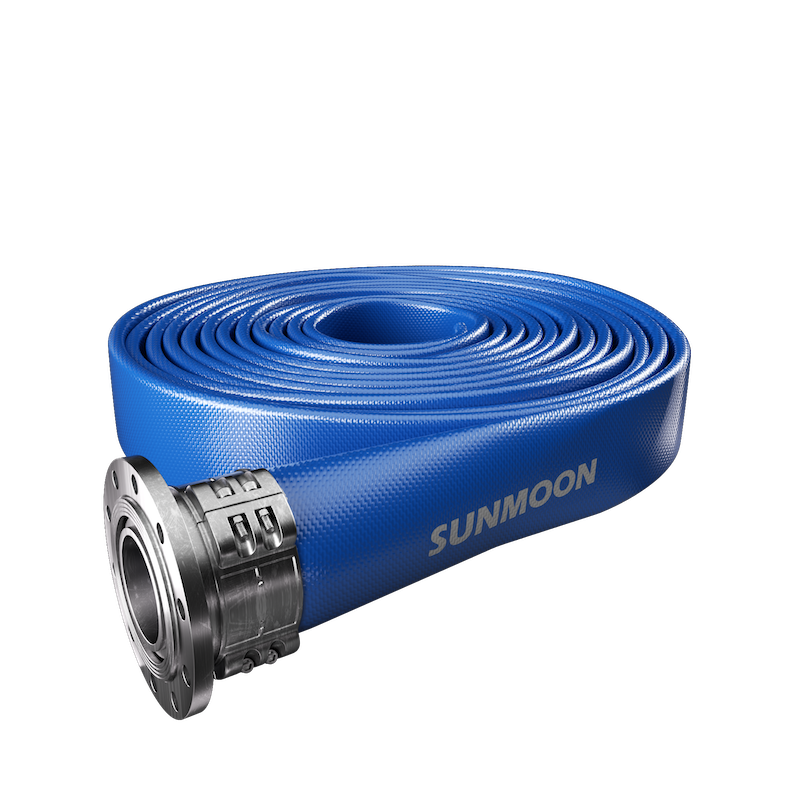
Selecting the best material requires a structured evaluation of fluid, temperature, pressure, standards, and life‑cycle cost. The following steps can guide engineers and buyers.
Clarify fluid, temperature, pressure, and environment before shortlisting materials.[15][1]
- Fluid type and chemistry (water, oil, fuel, slurry, solvents, food, chemicals).
- Working and peak temperatures, including cleaning cycles.
- Working, surge, and vacuum pressures.
- Indoor or outdoor exposure, UV, ozone, mechanical abuse, and possible contamination.
For temperatures above about 100 °C, silicone, PTFE, or EPDM may be more suitable, while PVC, PU, or TPU can be effective at ambient conditions with moderate pressure.[4][9][1]
Many hose applications must comply with ISO, EN, SAE, FDA, EC 1935/2004, NSF or similar standards.[8][10][1]
- Food and beverage hoses may require FDA and European food‑contact approvals.
- Hydraulic hoses must meet SAE or EN specifications for pressure, impulse, and construction.[10][7]
Choosing hoses that are tested to recognized standards improves safety and simplifies audits and certification.
- Verify that working pressure meets or exceeds system requirements with an appropriate safety factor (often 3:1 or 4:1 depending on industry guidelines).[10][1]
- Confirm the minimum bend radius is compatible with routing so you avoid kinking and internal damage.
- Consider weight per meter, especially for long runs, mobile equipment, or frequent deployment.
TPU layflat hoses are often chosen where long runs and manual handling are required because they offer high pressure capabilities with low weight.[13][11]
Initial hose cost often represents only a small portion of total ownership cost.[16][3]
- PVC is highly cost‑effective for short‑term or light‑duty service.
- TPU, composite, or PTFE hoses may offer better value where failure, downtime, or product loss is expensive.[11][12][13]
Evaluating replacement frequency, labor costs, and downtime can justify upgrading to higher‑performance materials.
When existing PVC or rubber hoses fail frequently, are too heavy, or are difficult to deploy, upgrading to TPU layflat hose can significantly improve system performance.[12][13][11]
- Higher abrasion and cut resistance for rough ground and high‑flow operation.
- Easier deployment and retrieval using reels or hose handling systems.
- Suitable for water, many oils, and certain chemicals in mining, construction, agriculture, and emergency response.[16][13][11]
Material | Typical temperature range | Key strengths | Common limitations | Typical applications |
PVC | Approx. –10 °C to +60 °C | Low cost, light, good for light-duty water and air | Stiffens in cold, limited high-temp and solvent resistance | Garden, air, general service water, light industry |
EPDM rubber | Approx. –40 °C to +120–135 °C | Excellent weather and hot-water resistance | Limited compatibility with many oils and fuels | Radiator, heater, outdoor water and cleaning hoses |
Silicone | Approx. –60 °C to +200–230 °C | Wide temperature range, high flexibility, hygienic grades | Higher cost, moderate abrasion resistance | Food, pharma, medical, turbo and radiator hoses |
PTFE / FEP | Approx. –200 °C to +260 °C | Outstanding chemical and thermal resistance | Stiffer, higher cost, often needs braid reinforcement | Chemical, pharma, high-temp gas and fluid transfer |
PU (polyurethane) | Approx. –30 °C to +80–90 °C | Excellent abrasion resistance, good oil/fuel resistance | Sensitive to some hydrolysis and higher temperatures | Pneumatic, dust, chips, pellets, light oil transfer |
TPU layflat | Approx. –46 °C to +80 °C (typical) | High strength-to-weight ratio, abrasion and oil resistance, reelable | Higher purchase price than PVC, needs proper couplings | Long-distance water, mining, agriculture, fire, oil and fuel transfer |
This type of comparison table makes it easier for engineers and buyers to screen materials before going into detailed datasheets.
Choosing the most suitable flexible hose material is critical for safety, uptime, and total cost of ownership, especially in large‑scale or remote projects. When you need to compare PVC, rubber, PU, and advanced TPU layflat hoses for water, oil, slurry, or chemical transfer, engineering support makes a measurable difference in system reliability.
If you are planning a new project or upgrading existing hose networks, share your fluid data, temperatures, pressures, lengths, and installation conditions with an engineering‑driven TPU layflat hose manufacturer. A dedicated technical team can propose optimized hose structures and materials, recommend coupling solutions, and help you validate performance before large‑scale deployment, so your next hose system is safer, lighter, and more durable from day one. Contact us to get more information!

PVC is one of the most widely used flexible hose materials globally because it combines low cost, ease of processing, and adequate performance for many light‑duty water and air applications. In more demanding environments, rubber, PTFE, composite, and TPU layflat hoses are often preferred despite higher purchase prices because they provide longer service life and better safety margins.[2][13][12][3][9][1]
TPU layflat hose is recommended when systems need higher pressure capability, long continuous runs, frequent deployment and retrieval, or resistance to abrasion, oils, and chemicals that quickly damage PVC hoses. In mining, energy, firefighting, and large irrigation projects, TPU layflat hoses can significantly reduce downtime and replacement frequency compared with PVC layflat solutions.[13][16][11][12]
Silicone and PTFE stand out for extreme temperatures, typically handling ranges from well below freezing to around +200–260 °C depending on the formulation. EPDM rubber also performs well in hot‑water and steam service at more moderate high temperatures, while PVC and standard PU are usually limited to lower ranges and should not be used near their softening points.[3][7][9][4][1]
Chemical compatibility is critical because an incompatible hose can swell, harden, crack, or leach contaminants, leading to leaks, failures, or product quality issues. Engineers typically consult chemical resistance charts to match fluids to materials such as PTFE, FEP, TPU, or specific rubbers before finalizing a hose specification.[15][9][4][1]
Inspection frequency depends on application severity, but many industrial users visually inspect hoses at least monthly and perform detailed checks during scheduled maintenance. Replacement intervals are shaped by pressure cycles, temperature, chemical exposure, and external wear, and preventive replacement policies are often adopted to avoid unplanned downtime and safety incidents.[7][10]
[1](https://rentonehose.com/blog/what-is-the-most-popular-material-for-flexible-hose)
[2](https://kas.com.tr/en/blog/what-material-is-flexible-hose/)
[3](https://www.sunhose.com/the-most-popular-materials-of-flexible-hose/)
[4](https://www.tubes-international.com/technical-information/table-of-hose-material-chemical-resistance/)
[5](https://www.copely.com/articles/pvc-vs-pu-hose/)
[6](https://www.strongflex.com/types-of-flexible-hose-materials/)
[7](https://hydraulichose.cn/ultimate-guideline-to-select-water-rubber-hose/)
[8](https://www.mkfluidicsystems.com/blog/tubing-material-selection/)
[9](https://rubberandspecialties.com/hose-material-guide-types-chemical-resistance-properties/)
[10](https://www.tecalemit.com/en/industrial-hoses/technical-guide-for-rubber-hoses.html)
[11](https://www.sunhose.com/tpu-layflat-hose/)
[12](https://www.sunhose.com/layflat-hoses-decoded-why-pvc-rubber-and-tpu-cater-to-different-needs/)
[13](https://www.orient-hose.com/tpu-layflat-hose-has-huge-advantages/)
[14](https://www.papagenogroup.com/news/Differences-between-PVC-Layflat-Hose-and-TPU-Layflat-Hose-173.html)
[15](https://tameson.com/pages/hosing-and-tubing-materials)
[16](https://cnhoseflex.com/layflat-hose-material-overview-pros-and-cons-of-pvc-pe-and-tpu/)


