

Views: 222 Author: Sunmoon Publish Time: 2026-04-15 Origin: Site


Operating hoses in the Arctic is unforgiving: if a line kinks, cracks, or turns rigid at -50 °C, entire drilling or dewatering campaigns can stall. TPU layflat hoses engineered for extreme cold give operators a realistic way to keep fluid transfer safe and predictable when winter refuses to cooperate. [zyfire]
In Arctic and sub‑Arctic projects, hose failures are rarely "just" maintenance issues; they can halt fuel logistics, water transfer, and well control, and they often happen during the coldest, darkest shifts. When fuel or produced water cannot move, rigs burn more time, risk more incidents, and face higher environmental exposure. [zyfire]
From my experience working with field engineers on winterized frac and dewatering systems, three realities stand out:
- Standard PVC layflat hoses stiffen and crack near freezing, making -30 °C to -50 °C service completely unrealistic. [m.alibaba]
- Conventional rubber hoses can stay flexible longer, but they are heavy, cumbersome to deploy, and costly over long distances. [sunhose]
- Modern TPU layflat hoses bridge the gap: they remain flexible across a wide temperature range while delivering high pressure ratings and excellent chemical resistance. [strongflex]
For truly Arctic campaigns, this low‑temperature behavior is not a "bonus feature" – it is the central design requirement for a hose system that operators can trust at -50 °C and below. [sunmoonhose]
Thermoplastic polyurethane (TPU) is a segmented block copolymer that behaves like an elastic rubber at service temperatures but processes like a thermoplastic during manufacturing. For hose engineers, TPU's low glass transition temperature and tunable hardness are what make it so valuable in Arctic service. [orient-hose]
Key cold‑climate properties of TPU hoses:
- Low glass transition temperature (Tg): TPU maintains elasticity well below freezing; it does not go brittle in cold weather like many rubbers and plastics. [shotonhydraulic]
- Adjustable hardness range: By tuning the ratio of soft and hard segments, engineers can design compounds that remain flexible yet strong at low temperatures. [orient-hose]
- Excellent tear and impact resistance: Even when cold, TPU layflat hoses resist cracking from impact, dragging, or coiling on frozen ground. [eymaq]
Leading TPU layflat hose designs for oil, gas, mining, and firefighting typically operate from about -46 °C up to +80 °C, and specialized formulations can push that envelope further for Arctic duty. [strongflex]
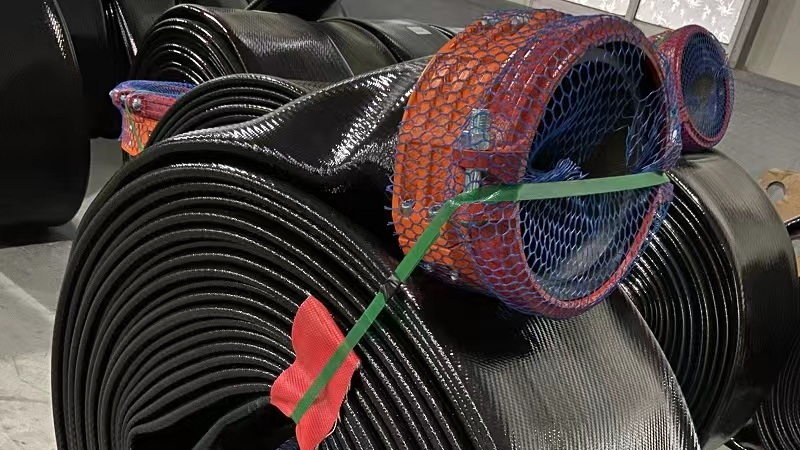
The choice of hose material will define how your system behaves during a sudden temperature drop. Field data and industry experience consistently show TPU outperforming PVC and often matching or surpassing rubber in cold‑weather flexibility when weight and service life are factored in. [sunhose]
| Property / Material | TPU Layflat Hose | PVC Layflat Hose | Rubber Layflat Hose |
|---|---|---|---|
| Typical temperature range | Around -46 °C to +80 °C (application‑dependent) (strongflex) | Above -10 °C recommended; stiff and kink‑prone in cold (sunhose) | Often down to about -40 °C; good heat resistance (jafirehose) |
| Flexibility at -30 °C | Remains flexible, easy to coil and deploy (sunhose) | Hard, prone to cracking and kinking (sunhose) | Still usable but heavier, harder to handle (sunhose) |
| Arctic reliability target (~-50 °C) | Achievable with engineered TPU compounds and reinforced designs (strongflex) | Not recommended | Possible in some EPDM blends, but with significant weight and cost penalties (jafirehose) |
| Weight per meter | Very lightweight, often 0.6–1.0 kg/m (sunhose) | Light to medium (sunhose) | Heavy, especially in large diameters (sunhose) |
| Oil and fuel compatibility | Superior resistance to oils, greases, hydrocarbons (sunhose) | Limited; many oils and fuels cause swelling and embrittlement (sunhose) | Excellent for NBR‑based hoses but more maintenance intensive (sunhose) |
| Service life in harsh use | Long life in abrasive, outdoor, and cyclic duty (sunhose) | Shortened dramatically in cold and UV exposure (sunhose) | Good, but higher cost and handling burden (sunhose) |
From a practical Arctic‑operations standpoint, PVC is off the table, rubber is viable but heavy and expensive at scale, and TPU layflat hoses provide the best balance of low‑temperature flexibility, weight, and chemical resistance. [sunmoonhose]
Across oilfield, mining, and emergency services, TPU layflat hoses have migrated from "alternative option" to default choice for winter lines. Several manufacturers document field use of TPU hoses in fuel transfer, fire protection, and dewatering systems in sub‑zero conditions. [mandals]
Representative Arctic‑style scenarios include:
- Winter fuel transfer for drilling rigs
TPU layflat hoses designed for fuel and oil service maintain flexibility on snow‑packed terrain, allowing temporary fueling lines to be deployed and recovered without cracking, even during extended cold spells. [zyfire]
- Long‑distance water transfer and frac supply lines
Textile‑reinforced TPU hoses provide high working pressure and low friction loss across kilometers of line, performing reliably in highly variable winter temperatures and snow load conditions. [mandals]
- Emergency fire‑fighting and spill response at low temperatures
Fire hoses built with TPU liners and jackets are rated down to roughly -55 °C, giving emergency teams critical flexibility when pumping water or foam in Arctic ports or remote camps. [eymaq]
These examples show why operators increasingly treat TPU layflat technology as the backbone of cold‑climate fluid logistics, especially when systems must work through -30 °C swings and sudden cold snaps. [sunhose]
Sunmoon (Jiangsu Sunmoon Shale Gas High Pressure Hose Co., Ltd.) is a specialized Chinese manufacturer focused on TPU layflat hoses and aramid‑reinforced PE hoses for demanding oil, gas, and industrial applications. [china-layflat-hose]
From an engineering perspective, our Arctic‑oriented TPU hose designs build on several pillars:
- Purpose‑built TPU compounds
We apply TPU formulations targeting low glass‑transition temperatures and high elasticity so the hose stays flexible for handling and coiling in deep winter. [shotonhydraulic]
- High‑strength textile reinforcement
Circular woven polyester or aramid fiber reinforcement provides high tensile strength while keeping weight low, critical in snow‑covered terrain and long water transfer lines. [sunmoonhose]
- Large‑caliber and high‑pressure options
Sunmoon has developed large‑diameter TPU layflat hoses (up to 14–16 inch, with 20‑inch under development) and high working pressure ratings to meet frac water transfer and high‑volume dewatering needs. [sunmoonhose]
- Engineering‑driven customization
The company integrates research, production, and sales, offering customized hoses tailored to specific temperature ranges, pressures, and media for global customers in oilfields, mining, agriculture, and municipal systems. [made-in-china]
As an engineering‑driven supplier founded in 2011, Sunmoon focuses on reliable fluid control solutions for harsh environments, including Russia and other cold‑climate markets. [sunmoonhose]

From field feedback and industry studies, operators consistently point to a few recurring pain points when hoses are exposed to temperatures approaching -50 °C:
- Stiffness and kinking during deployment: Hoses that go rigid require extra manpower and machinery, increasing safety risks on icy surfaces. [m.alibaba]
- Micro‑cracking and sudden leaks: Brittle materials can develop micro‑cracks at folds or impact points, leading to pinhole leaks that are hard to locate in snow. [m.alibaba]
- Coupling movement and seal failures: Large temperature swings between day and night can cause differential contraction between hose and fittings, stressing seals. [eymaq]
TPU layflat hoses, with their low‑temperature elasticity and robust textile reinforcement, are designed to reduce these risks by maintaining a stable inner diameter, resisting kinks, and tolerating repeated coiling and uncoiling cycles on frozen ground. [strongflex]
Even when you choose a high‑performance TPU hose, your on‑site procedures will determine how well the system handles Arctic extremes. In our work supporting winter projects, we encourage customers to think in terms of "system behavior" rather than just hose specs. [sunmoonhose]
- Store hoses in sheltered, temperature‑moderated containers when possible to avoid shock cooling before deployment.
- Uncoil hoses fully and allow them to relax before applying pressure, especially after transport in tightly packed reels at low temperatures.
- Inspect for localized stiff spots or compression marks where hoses were strapped down during transport. [eymaq]
- Avoid dragging hoses over sharp ice edges or frozen gravel; TPU is tough, but abrasion plus impact at -50 °C can still accelerate wear. [eymaq]
- Use moderate, steady pressurization during startup to allow the hose to reach operating shape without sudden shock.
- Plan hose routes to minimize tight bends near couplings and manifolds, where stresses concentrate in cold conditions. [strongflex]
- Drain hoses completely before recovery to prevent ice plugs, which can damage inner liners.
- Coil hoses with consistent, large‑radius loops; avoid tight coils in extreme cold.
- After each Arctic campaign, perform thorough visual inspection and pressure testing before the next deployment cycle. [eymaq]
These steps, combined with a correctly specified TPU layflat hose, significantly improve flexibility and service life in ultra‑low‑temperature operations. [sunmoonhose]
From an industry expert's point of view, specifying hoses for Arctic service is a structured engineering decision, not a catalog pick. The best practice is to align TPU hose design with the specific fluid, pressure, and temperature envelope of your project. [shotonhydraulic]
When working with a hose manufacturer like Sunmoon, you should clarify:
1. Temperature envelope
- Expected minimum ambient and fluid temperatures (for example, down to -50 °C).
- Rate and frequency of temperature cycling during the season. [strongflex]
2. Media and chemistry
- Whether the line will carry produced water, brine, fuel, chemicals, or slurry.
- Required resistance to oils, hydrocarbons, and additives; TPU typically offers superior resistance to oils and greases versus PVC. [sunhose]
3. Pressure and distance
- Maximum working pressure, surge conditions, and required safety factors.
- Total distance of the transfer line, which affects diameter selection and friction loss. [sunmoonhose]
4. Deployment environment
- Whether hoses will be laid on ice, tundra, roadways, or floated in water.
- Expected traffic, abrasion, and UV exposure during the season. [eymaq]
Engineers can then recommend specific TPU compounds, reinforcement styles (polyester vs aramid), diameters, and pressure classes optimized for your Arctic operation. [sunmoonhose]
For global customers, choosing a hose supplier is ultimately about risk management. Sunmoon's specialization in TPU and high‑pressure layflat hoses, combined with customization capabilities and experience in cold‑climate markets, makes it a strong partner for Arctic operations. [china-layflat-hose]
Working with Sunmoon offers:
- Focused expertise in TPU and aramid‑reinforced layflat hose design for oil and gas, mining, agriculture, and industrial sectors. [made-in-china]
- Custom engineering for temperature, pressure, and media requirements, including Arctic‑oriented TPU formulations. [sunmoonhose]
- Scalable production capacity in China with competitive lead times for large‑volume, large‑diameter projects. [china-layflat-hose]
- Global project support, including Russian and other cold‑region deployments where low‑temperature performance is critical. [sunmoonhose]
If you are planning or upgrading an Arctic fuel, water, or slurry transfer system, the next logical step is to engage Sunmoon's engineering team with your detailed temperature and pressure requirements so we can design a customized TPU layflat solution that stays flexible at -50 °C and beyond. [made-in-china]

1. Can TPU layflat hoses really stay flexible at -50 °C?
Properly formulated TPU hoses are designed to remain elastic well below freezing, with typical operating ranges down to about -46 °C and specialized designs extended for Arctic use; real‑world flexibility at -50 °C depends on compound and reinforcement selection, which is why engineering input is essential. [orient-hose]
2. Are TPU hoses better than rubber hoses for Arctic projects?
Rubber can deliver strong low‑temperature performance but is heavier and less convenient for long layflat runs, while TPU combines good low‑temperature flexibility with low weight and excellent oil resistance, often giving it an edge for portable fuel and water transfer systems. [jafirehose]
3. How do TPU layflat hoses compare to PVC hoses in cold climates?
PVC layflat hoses become stiff and kink‑prone in cold weather and are not suited for deep‑winter or Arctic operations, whereas TPU retains flexibility, resists cracking, and offers better resistance to oils, greases, and hydrocarbons. [m.alibaba]
4. What information does Sunmoon need to design a customized Arctic hose?
You should provide minimum and maximum operating temperatures, media type (water, produced water, fuel, chemicals), maximum working and surge pressures, line length, and deployment environment so Sunmoon's engineers can specify TPU compounds, diameters, and reinforcement structures optimized for your project. [china-layflat-hose]
5. What maintenance practices extend the life of TPU hoses in Arctic service?
Best practices include storing hoses in sheltered areas, avoiding tight coils in extreme cold, preventing dragging over sharp ice, draining lines completely before recovery, and carrying out regular visual inspections and pressure tests between campaigns. [shotonhydraulic]
1. ZYFIRE. "ZYFIRE TPU layflat hose: The Ultimate Winter Fuel Transfer Solution for temporary oil delivery." [https://www.zyfire.com/news/zyfire-tpu-layflat-hose-the-ultimate-winter-fuel-transfer-solution-for-demanding-drilling-operations] [zyfire]
2. StrongFlex. "TPU Layflat Hose – Construction and Temperature Range." [https://www.strongflex.com/project/tpu-layflat-hose/] [strongflex]
3. Sunhose. "PVC vs. Rubber vs. TPU Layflat Hoses – Key Differences." [https://www.sunhose.com/layflat-hoses-decoded-why-pvc-rubber-and-tpu-cater-to-different-needs/] [sunhose]
4. Sunmoon. "Types of Flexible Hose Materials: The 2026 Expert Guide (With TPU Layflat Hoses)." [https://www.sunmoonhose.com/types-of-flexible-hose-materials-the-2026-expert-guide-with-tpu-layflat-hoses.html] [sunmoonhose]
5. Jiangsu Sunmoon Shale Gas High Pressure Hose Co., Ltd. Company Profile. [https://china-layflat-hose.com/about/] [china-layflat-hose]
6. Jiangsu Sunmoon Shale Gas High Pressure Hose Co., Ltd. Company Introduction. [https://www.made-in-china.com/showroom/kevin9277/] [made-in-china]
7. Sunmoon. "Customized TPU Layflat Hose, Oil and Gas Hose, Dewatering Hose …" [https://www.sunmoonhose.com] [sunmoonhose]
8. Sunmoon. "TPU Layflat Hose – Product Page." [https://www.sunmoonhose.net/tpu-layflat-hose/] [sunmoonhose]
9. Alibaba. "TPU Layflat Hose for Oil Field." [https://www.alibaba.com/showroom/tpu-layflat-hose-for-oil-field.html] [alibaba]
10. Alibaba. "6 inch TPU lay flat hose pipe – Key Advantages." [https://m.alibaba.com/showroom/6-inch-tpu-lay-flat-hose-pipe.html] [m.alibaba]
11. Orientflex. "Differences between PU hose and TPU hose." [https://www.orient-hose.com/differences-between-pu-hose-and-tpu-hose/] [orient-hose]
12. Shoton Hydraulic. "Exploring Hydraulic Hose Materials: Rubber vs Polyurethane vs PTFE." [https://shotonhydraulic.com/exploring-hydraulic-hose-materials-rubber-vs-polyurethane-vs-ptfe/] [shotonhydraulic]
13. Mandals AS. "Mertex – High‑Quality Textile Hose with TPU Lining." [https://mandals.com/mertex/] [mandals]
14. Eymaq / Mandals. "World Class Lay‑Flat Hoses – Mining" (Brochure). [https://eymaq.com/wp-content/uploads/2024/03/Mandals-Brochure-052024_c.pdf] [eymaq]
15. Jafirehose. "EPDM vs Rubber/TPU Fire Hoses: Key Differences Explained." [https://www.jafirehose.com/news/industry-news/epdm-vs-rubber-tpu-fire-hose-differences.html] [jafirehose]


