

Views: 222 Author: Sunmoon Publish Time: 2026-05-25 Origin: Site


Long, continuous fracking hose runs using TPU layflat hose can significantly reduce leak risks, installation time, and lifecycle cost compared with traditional modular piping—when they are correctly engineered, monitored, and matched to site conditions. For shale gas and unconventional oilfields that need rapid deployment and frequent relocation, long-run TPU layflat hose systems are emerging as a safer, leaner alternative to rigid pipe strings in many applications. [china-layflat-hose]

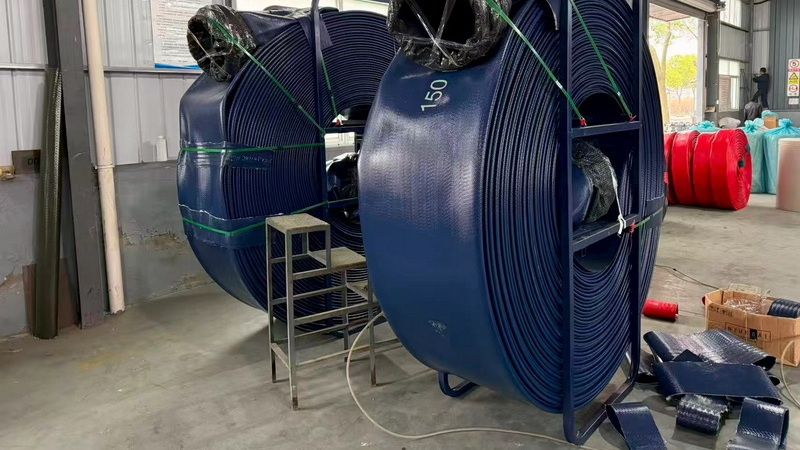
In hydraulic fracturing and produced-water transfer, operators typically choose between long-run layflat hose strings on reels and modular rigid piping (e.g., steel, HDPE, or composite sticks joined with couplings). TPU layflat hose is a flexible hose built from thermoplastic polyurethane with a woven polyester or aramid reinforcement, designed to be deployed in long continuous lengths for high-pressure water and chemical transfer. [sinopulse]
Modular piping systems, by contrast, are made of shorter sections (commonly 6–12 m) connected with couplings, flanges, or threaded joints, which create many more mechanical interfaces along the run. Every connection in a modular system is a potential leak path, which means leak risk depends heavily on assembly quality, thermal movement, and corrosion control. [sciencedirect]
Key takeaway: Long runs of TPU layflat hose reduce the number of mechanical joints, which directly affects leak probability along kilometers of surface transfer line. [china-layflat-hose]
Modular piping leaks usually originate at discontinuities—especially joints and fittings. Common leak mechanisms include: [scholarhub.ui.ac]
- Gasket or seal failure at flanged or grooved couplings due to incorrect compression, thermal cycling, or chemical degradation. [linkedin]
- Threaded connection leaks from galling, vibration, or make-up torque outside specification.
- Corrosion and erosion at elbows, reducers, and low points where solids deposition and turbulence concentrate. [jurnal.sttmcileungsi.ac]
- Fatigue cracks in welds or pipe walls induced by cyclic pressure and dynamic loads, especially on uneven terrain or near pump units. [sciencedirect]
- Thermal expansion stress in long straight runs without enough expansion loops or offsets, leading to overstress and joint opening. [facebook]
Because oil and gas piping leaks can cause severe environmental and financial damage, pipeline risk analysis and risk-based inspection (RBI) methods such as Monte Carlo simulations are widely used to model probability of failure and plan inspection intervals. [scholarhub.ui.ac]
Long runs of TPU layflat fracking hose have different weak points:
- Couplings and end connections (camlocks, crimped fittings, integral couplings) where the hose interfaces with pumps, manifolds, and steel transitions.
- Abrasion damage from dragging over rocks, sharp edges, or traffic crossings, which can thin the wall and create pinhole leaks if not shielded. [sunmoonhose]
- UV and chemical attack if the jacket and TPU compound are not specified for local sun exposure and chemical mix. [sinopulse]
- Kinking and over-bending, especially at road crossings or tight turns, which can damage reinforcement fibers over time.
However, the hose body itself is continuous over long distances, and high-quality TPU layflat hose is engineered for resistance to abrasion, UV, and chemicals—reducing leak probability in the straight sections of the line. [sunmoonhose]
From a leak-risk engineering standpoint, three factors matter most: number of joints, load conditions, and environment. [facebook]
For a given total length (for example, 5 km of transfer line):
- Modular piping may have hundreds of joints and fittings, each with a small but non-zero probability of leak per operating year. [sciencedirect]
- TPU layflat hose on reels can reach hundreds or even thousands of meters per hose segment, dramatically reducing joint count along the straight run. [marketresearch]
If you assume a similar failure probability per connection, a system with fewer connections will statistically have fewer leaks over time, all else equal. This is a primary reason continuous pipelines that minimize field welds and flanged joints are preferred in high-integrity applications. [linkedin]
Both systems experience dynamic loads from:
- Pump start‑stop cycles and pressure surges.
- Ground settlement, traffic, and equipment crossings.
- Thermal expansion and contraction as fluids and ambient conditions change. [facebook]
Rigid modular piping needs carefully designed expansion loops, anchors, and guides to avoid overstress and joint opening; these are standard practice in high-integrity piping design. TPU layflat hose, on the other hand, inherently absorbs movement because of its flexibility, reducing stress concentration at any single point—provided the hose is not restrained in a way that forces bending at a sharp edge. [sinopulse]
Steel and some rigid composites are vulnerable to internal corrosion from produced water, CO₂, H₂S, and solids, and to external corrosion in wet or saline soil. Effective corrosion control requires coatings, cathodic protection, and periodic inspection. [jurnal.sttmcileungsi.ac]
TPU layflat hose is non-metallic, so it avoids external metal corrosion, and its inner TPU liner is formulated to resist many fracturing fluids, produced water, and chemicals. It still needs chemical compatibility verification, but the corrosion mechanisms are different and usually less severe than for carbon steel piping. [sunmoonhose]
Sunmoon's TPU layflat hose is built specifically for high-pressure, long-distance, large-flow fluid transfer in shale gas, oil exploitation, mine dewatering, fire-fighting, and emergency drainage. Several design features directly impact leak risk in long fracking runs: [china-layflat-hose]
- TPU inner and outer layers: High-quality TPU provides strong abrasion resistance, flexibility, and chemical resistance over a wide temperature range. [sinopulse]
- Woven polyester or aramid reinforcement: This reinforcement gives the hose its high working pressure capacity while allowing controlled expansion and flexibility. [china-layflat-hose]
- Long-length production in rolls: Advanced manufacturing allows the hose to be supplied in large continuous lengths, minimizing field connections and, therefore, potential leak points. [marketresearch]
- Cold-weather performance: TPU maintains flexibility and mechanical integrity at low temperatures, avoiding cracking that could lead to leaks during cold-weather operations. [sunmoonhose]
Because Sunmoon focuses on high-pressure flat hose TPU and PE in rolls and has specialized technology for shale gas and oil exploitation, the company can match hose design to fluid, terrain, and climate, which is essential for managing leak risk. [china-layflat-hose]
Despite the advantages of long-run hose, modular piping is not obsolete. In certain conditions, it can still offer lower leak risk and better integrity control:
- Very high pressure or temperature services that exceed hose ratings.
- Permanent or multi-decade facilities where buried or supported pipe is protected and inspected regularly. [linkedin]
- Extremely aggressive chemistries where specialized alloy or lined pipe is required.
Rigid pipe systems can integrate engineered supports, expansion loops, and stress analysis tools like CAESAR II to manage thermal and mechanical stresses, which is standard practice in refineries and power plants. In these settings, with rigorous design and RBI programs, pipe leaks can be minimized to very low levels—though never to zero. [scholarhub.ui.ac]
Drawing on pipeline risk research and field experience, operators can evaluate leak risk between long-run hose and modular piping with a simple structured approach inspired by formal risk-based methods. [sciencedirect]
1. Define service conditions
- Maximum working pressure, surge pressure, temperature, and fluid chemistry.
2. Quantify joint count
- Count all couplings and transitions per kilometer for both modular pipe and long-run hose layouts.
3. Identify environment and terrain
- Note ground abrasiveness, traffic crossings, UV exposure, and cold-climate conditions.
4. Assess historical leak data
- Use internal incident logs and industry benchmarks where available to estimate failure probability per joint type. [scholarhub.ui.ac]
5. Select mitigation measures
- For hose: abrasion sleeves, proper routing, and coupling torque control.
- For pipe: corrosion protection, expansion loops, and weld quality control. [facebook]
6. Model risk and cost
- Combine probability of failure with consequence (spill volume, cleanup cost, downtime) to compare lifecycle risk between options. [sciencedirect]
This kind of structured analysis mirrors how Monte Carlo–based RBI methods evaluate pipeline risk, though in daily field decisions a simplified, deterministic version is often enough to guide whether long-run hose or modular pipe offers lower leak risk in practice. [scholarhub.ui.ac]
| Factor | Long Runs TPU Layflat Hose | Modular Piping System |
|---|---|---|
| Number of joints per kilometer | Low – long continuous segments reduce connections sinopulse | High – many flanges, couplings, welds sciencedirect |
| Primary leak locations | Couplings, abrasion-damaged spots sinopulse | Joints, fittings, welds, corrosion hot spots sciencedirect |
| Sensitivity to soil corrosion | Non-metallic hose body, lower corrosion risk sinopulse | High for carbon steel without protection sciencedirect |
| Flexibility and movement absorption | High – follows terrain, absorbs vibration sinopulse | Low – needs engineered loops and supports facebook |
| Cold-weather leak behavior | TPU keeps flexibility at low temperature sunmoonhose | Steel susceptible to brittle failures if not specified sciencedirect |
| Inspection approach | Visual inspection of hose body and couplings | RBI, NDT, and stress analysis common in permanent systems sciencedirect |
| Typical deployment duration | Temporary, seasonal, relocatable lines china-layflat-hose | Semi-permanent or permanent installations sciencedirect |
In shale gas pads and long-distance water transfer, operators often need several kilometers of line from water sources to fracturing sites. Here, long-run TPU layflat hose offers tangible leak risk advantages: [china-layflat-hose]
- Fewer connections mean fewer opportunities for human assembly error and mechanical failure. [sciencedirect]
- The flexible hose can be rerouted around sensitive areas, reducing the consequence of any potential leak.
- Non-metallic construction avoids many external corrosion issues seen in temporary steel pipe laid on the surface. [sinopulse]
Market analysis shows that the TPU layflat hose segment is growing globally as operators seek high-pressure, long-distance, and rapidly deployable fluid transfer solutions, particularly in oil and gas, agriculture, and emergency services. Sunmoon's focus on shale gas high-pressure hose aligns directly with this demand, combining manufacturing capability with application-specific experience. [marketresearch]
Because no two fields are identical, custom engineering is critical to leak prevention for long-run hose systems. As a Chinese manufacturer specializing in TPU layflat hose and other flat hoses, Sunmoon provides: [china-layflat-hose]
- Custom diameters and pressure ratings matched to pump curves and pad layouts.
- Tailored reinforcement (polyester or aramid) for higher pressure, longer runs, or special safety margins. [china-layflat-hose]
- Application-specific outer layers optimized for abrasion, UV, and chemical exposure in shale gas, mining, or emergency drainage operations. [sunmoonhose]
- Integrated hose system design advice on coupling selection, deployment practices, and storage to maximize leak-free service life. [china-layflat-hose]
In practice, this means operators can work with Sunmoon's engineering team to design a hose system that not only meets flow and pressure targets but is also optimized for leak risk under real field conditions. [china-layflat-hose]
To fully realize the leak-risk advantages of long-run TPU fracking hose over modular piping, operators should adopt disciplined best practices drawn from pipeline risk management. [sunmoonhose]
Key operational practices:
- Use correct couplings and assembly torque specified for the hose and service pressure.
- Avoid sharp bends and kinks with proper routing, turning radii, and temporary supports where needed.
- Protect against abrasion with sleeves, ramps, or cable trays at road crossings and rocks. [sinopulse]
- Inspect before and after each deployment, focusing on couplings, outer cover abrasions, and any discolored or swollen sections.
- Implement pressure monitoring and surge control at pumps to avoid pressure excursions beyond hose rating. [sciencedirect]
When these measures are applied consistently, TPU layflat hose systems can deliver sustained, leak-free performance across multiple campaigns, often with lower total spill volume and repair frequency than comparable modular pipe strings used in the same temporary service. [china-layflat-hose]
If you are planning a long-distance fracking water or produced-water transfer line, or replacing aging temporary modular piping, it is worth evaluating TPU layflat hose as a primary option for leak risk reduction. Sunmoon's specialization in high-pressure TPU layflat hose in long rolls and its experience in shale gas, oil exploitation, mining, and emergency drainage put the company in a strong position to support your risk assessment and system design. [china-layflat-hose]
You can involve Sunmoon early in your project to:
- Review your existing modular piping leak history.
- Compare hose versus pipe layouts with joint counts and risk implications.
- Specify a customized TPU layflat hose system optimized for your pressure, terrain, and climate.
Reach out to Sunmoon's engineering team to discuss your next water transfer or fracking hose project and request a custom leak risk and lifecycle cost comparison between long-run TPU layflat hose and your current modular piping approach. [china-layflat-hose]

1. Is TPU layflat hose safe for high-pressure fracking water transfer?
Yes. High-quality TPU layflat hose with woven reinforcement is specifically engineered for high-pressure water transfer in shale gas and oilfield applications, provided the hose is correctly sized and installed according to manufacturer recommendations. [sinopulse]
2. How does leak risk compare over several kilometers of line?
Over multi-kilometer distances, long-run TPU hose generally has lower leak probability in straight sections because it uses fewer mechanical joints than modular piping, which concentrates leaks at couplings and fittings. [scholarhub.ui.ac]
3. Can TPU layflat hose handle cold-weather operations?
Yes. TPU layflat hose maintains flexibility and mechanical integrity at low temperatures, reducing the risk of brittle failures and leaks in cold climates when compared with some standard plastics and improperly specified metals. [sunmoonhose]
4. What inspection strategy is recommended for long hose runs?
A practical approach combines pre-deployment visual inspection, routine walkdowns focusing on couplings and high-abrasion areas, and pressure monitoring during operation to detect anomalies before they become leaks. [scholarhub.ui.ac]
5. When should I still choose modular piping instead of hose?
Modular piping remains preferable for permanent or very high-pressure, high-temperature services, or where aggressive chemicals require specialized alloys and long-term RBI programs, such as in refineries or power plants. [jurnal.sttmcileungsi.ac]
1. Dynamic loads on energy pipelines: origins, mitigation strategies and risk considerations – ScienceDirect. https://www.sciencedirect.com/science/article/pii/S2096249525001292
2. TPU Layflat Hose – construction, temperature range, applications – Sinopulse. https://www.sinopulse.cn/pvc-lay-flat-hose/tpu-layflat-hose/
3. Comparative analysis of innovative coal pipe and sealpot designs – Journal article. https://jurnal.sttmcileungsi.ac.id/index.php/jttm/article/view/1840
4. About Us – Jiangsu Sunmoon Shale Gas High Pressure Hose Co., Ltd. https://china-layflat-hose.com/about/
5. Function of loops in pipeline installations – discussion of U- and Z-shaped loops. https://www.facebook.com/groups/1511279735770917/posts/6645900255642147/
6. Cold Weather Performance: TPU vs. PVC Layflat Hoses at -40°C – Sunmoon technical article. https://www.sunmoonhose.com/cold-weather-performance-tpu-vs-pvc-layflat-hoses-at-40-c.html
7. Pipe System Design and Analysis – LinkedIn engineering article on expansion loops and thermal stress. https://www.linkedin.com/top-content/engineering/nuclear-engineering-plant-design/pipe-system-design-and-analysis/
8. Company Profile – China TPU Layflat Hose Supplier (Sunmoon). https://china-layflat-hose.com/about/company-profile/
9. Pipeline Risk Analysis Optimization with Monte Carlo Method – Journal of Mechanical and Energy Engineering. https://scholarhub.ui.ac.id/jmef/vol2/iss3/5/
10. Global TPU Layflat Hose Market Analysis and Forecast 2024–2030 – APO Research. https://www.marketresearch.com/APO-Research-Inc-v4273/Global-TPU-Layflat-Hose-Forecast-38899630/


