

Views: 222 Author: Sunmoon Publish Time: 2026-05-23 Origin: Site


In modern shale plays, TPU frac water hoses and NBR fracking hoses are the two dominant layflat hose materials for high-volume water transfer and slurry handling, but they behave very differently in the field. For operators and project owners, choosing between them is no longer a generic "rubber vs plastic" decision—it is a lifecycle, safety, and total-cost-of-ownership decision that directly impacts uptime and spill risk. [jafirehose]

Thermoplastic polyurethane (TPU) and nitrile butadiene rubber (NBR) are both proven hose materials in oilfield and mining operations, but they are engineered in very different ways. [hoseinc]
- TPU layflat hoses are typically made using an "extrusion through-the-weave" process, where a TPU cover is extruded around a circular woven polyester reinforcement, forming a single homogeneous structure without glue. [jafirehose]
- NBR fracking hoses combine nitrile rubber with reinforcement (often polyester or synthetic yarns), offering strong resistance to oils, fuels, and chemicals, making them widely used for hydraulic fracturing fluids and oil-contaminated water. [hoseinc]
From an engineering standpoint, TPU is lighter, more abrasion resistant, and more kink-resistant, while NBR offers excellent oil and chemical resistance with a proven record in harsh hydraulic fracturing environments. [zyfireuae]
Shale plays like the Permian Basin, Eagle Ford, and Bakken rely on long-distance water transfer and high-pressure fracturing operations, where hoses may handle millions of gallons of water per project. [linkedin]
- Frac hoses are dragged over gravel pads, sharp rocks, and steel structures, exposing them to constant abrasion, UV, and temperature cycling. [jafirehose]
- Failures lead to water loss, potential chemical spills, downtime, and safety incidents, which regulators and operators increasingly scrutinize. [pmarketresearch]
Industry research shows that around 65% of U.S. onshore operators now rely on specialized frac hoses rather than improvised piping, driven by higher safety standards and rising shale activity. This makes the TPU vs NBR choice central to project engineering and risk management. [datainsightsmarket]
From a field engineer's perspective, mechanical durability is often the first lens for comparing TPU frac water hoses and NBR fracking hoses. [hoseinc]
Independent and manufacturer-level testing consistently highlights high abrasion resistance of TPU when hoses are dragged across rough surfaces or used in mining and dewatering. [sinohose]
- TPU layflat hoses used in mining and shale water transfer have demonstrated longer service life compared to nitrile/PVC hoses, especially in drag and deployment applications. [zyfireuae]
- TPU's smooth outer cover and tough thermoplastic structure help resist surface wear, gouging, and micro-cracking. [sinohose]
NBR hoses still provide robust abrasion performance, but in many independent comparisons, TPU is favored where hoses are frequently moved, dragged, and redeployed. [jafirehose]
In shale pads with tight bends around tanks and manifolds, kink resistance directly affects flow rate and pressure stability.
- TPU layflat hoses, especially those built via through-the-weave extrusion, tend to kink less and recover shape more effectively, maintaining a wide internal flow path. [sunmoonpipe]
- This translates into smoother flow and reduced pressure losses across long transfer lines. [jafirehose]
NBR hoses can be reinforced for high-pressure performance, but their elastomeric nature may lead to more pronounced kinking under tight radius bends, especially if older or partially degraded. [hoseinc]
Shale operations do not only handle clean water; they also manage chemical-laden frac fluids and produced water containing hydrocarbons, biocides, and solids. [datainsightsmarket]
- NBR is renowned for its resistance to oil, fuels, and many chemicals, which is why NBR-type hoses are projected to see strong growth in hydraulic fracturing applications. [hoseinc]
- This makes NBR fracking hoses a natural choice where the hose will be frequently exposed to hydrocarbon-rich fluids or oil-based muds. [datainsightsmarket]
TPU offers excellent resistance to many water-based chemicals and is widely used for chemical-laden water transfer in oilfield applications, but NBR still has an edge in heavy hydrocarbon environments. [hoseinc]
Modern TPU frac hoses are designed to operate in a temperature range from approximately -50 °C to +80 °C (about -58 °F to +176 °F), enabling use in cold climates and hot desert pads. Comparable NBR hoses also target harsh environments, but TPU's published low-temperature flexibility is frequently highlighted in oilfield hose literature. [alibaba]
For operators in extremely cold shale regions, TPU's flexibility at low temperatures can translate into easier deployment and fewer cracks or stiffness-related failures. [sunmoonpipe]
From a procurement and operations lens, the true cost of a frac hose shows up over multiple wells and campaigns, not just on the initial invoice. [linkedin]
- TPU hoses used in fracking water transfer have been reported to provide service lives that justify higher upfront cost, particularly when compared to nitrile and PVC hoses in drag-intensive applications. [zyfireuae]
- Market analyses indicate that operators are shifting toward more durable, high-performance hoses to comply with stricter safety and environmental standards, even when capital costs are higher. [pmarketresearch]
NBR hoses remain cost-competitive and are often chosen when oil resistance is prioritized over ultra-long drag life, or where hoses see more static service with limited relocation. [zyfireuae]
Shale operations are under constant pressure to reduce setup time and manpower, especially when multi-well pads and zipper fracs are involved. [jafirehose]
- TPU layflat hoses are generally lighter than comparable rubber hoses, which simplifies manual handling, reduces lifting strain, and allows longer lengths to be deployed per reel or truck load. [jafirehose]
- This lower weight contributes directly to faster deployment, fewer crew members per line, and lower fuel consumption in logistics. [jafirehose]
NBR hoses can be heavier and bulkier, especially at high pressure ratings, which can slow down deployment and retrieval in field operations. [datainsightsmarket]
Both TPU and NBR layflat hoses are designed to be flattened and coiled for compact storage. However, TPU's combination of thin yet strong walls often allows for denser packing, which is helpful for operators with limited yard space or mobile fleets. [sunmoonpipe]
Recent reports on hydraulic fracturing hose markets show strong global growth driven by rising energy demand, stricter safety regulations, and technological advancements in hose materials. [linkedin]
- The hydraulic fracturing hose market is projected to reach hundreds of millions of USD to around 1.8 billion by the mid‑2020s, growing at a mid‑single-digit to high‑single-digit CAGR. [pmarketresearch]
- North America remains the dominant region, with shale plays demanding high-pressure, durable hoses for multi-well pad operations. [linkedin]
Within this trend, NBR-type hoses are expected to grow due to their superior oil and chemical resistance, while TPU-based hoses continue gaining traction in water transfer and hybrid applications where abrasion and drag life are critical. [sinohose]
From the perspective of an industrial hose specialist working with global shale operators, the choice is rarely "TPU or NBR everywhere". Instead, it is about matching hose material to application. [sinohose]
TPU is often the superior choice when:
- The hose will be dragged repeatedly across rough terrain for long-distance water transfer. [hoseinc]
- The fluid is primarily water or water-based fracturing fluids with limited hydrocarbon content. [jafirehose]
- Operations take place in cold climates requiring low-temperature flexibility. [sunmoonpipe]
- Deployment efficiency and lightweight logistics are top priorities. [jafirehose]
NBR is often preferred when:
- Fluids carry high levels of oil, fuels, or hydrocarbon-rich produced water. [hoseinc]
- The hose is used in static or semi-static high-pressure fracturing lines, with less dragging but continuous exposure to chemicals. [hoseinc]
- The operator follows established specs and standards long based on rubber hoses, and chemical compatibility is the critical constraint. [zyfireuae]
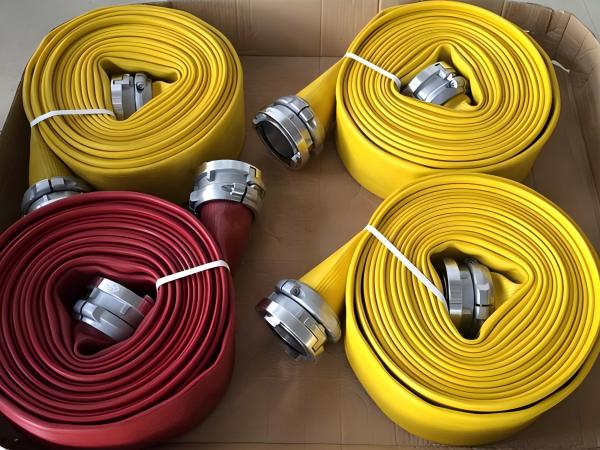
SUNMOON, founded in 2011, is an ISO 9001, ISO 14001, and ISO 45001 certified manufacturer focusing on engineering-grade TPU and NBR layflat hoses for oil & gas, mining, construction, and municipal applications. [linkedin]
- The company operates three workshops with multiple production lines, integrating reinforcement weaving, extrusion, and full-length pressure testing to ensure consistent quality. [linkedin]
- Products include high-pressure TPU layflat hoses specifically designed for shale gas water supply, mine dewatering, and emergency drainage, with 100% pressure testing at 1.5 times working pressure before shipment. [sunmoonhose]
From Sunmoon's engineering team perspective, TPU frac water hoses are often recommended for long-distance shale water transfer, while NBR options are supplied for customers requiring high oil resistance or adherence to existing rubber-based specifications. [sunmoonhose]
Durability Focus: TPU Frac Water Hose vs. NBR Fracking Hose
| Aspect | TPU Frac Water Hose | NBR Fracking Hose |
|---|---|---|
| Core material | Thermoplastic polyurethane jafirehose | Nitrile butadiene rubber hoseinc |
| Abrasion resistance | Very high, excellent for drag operations jafirehose | High, but often outperformed by TPU in drag-intensive use jafirehose |
| Kink resistance | Good kink resistance, fast recovery jafirehose | Good but can kink more under tight bends hoseinc |
| Chemical resistance | Strong for water-based chemicals and many industrial fluids hoseinc | Excellent for oil, fuels, and hydrocarbons hoseinc |
| Temperature range | Approx. -50 °C to +80 °C hoseinc | Wide range, but product-specific hoseinc |
| Weight | Lighter, easier handling jafirehose | Heavier at equivalent pressure zyfireuae |
| Typical shale use | Long-distance water transfer, drag lines jafirehose | High-chemical or oil-contaminated fracturing fluids hoseinc |
To make a practical, evidence-based decision for a shale project, engineers can follow a simple selection framework:
1. Define your fluid
- Is it fresh water, recycled water, or oil-contaminated produced water? [hoseinc]
- For predominantly water-based fluids with limited hydrocarbons, TPU is often the logical starting point. [hoseinc]
2. Map line routing and handling
- If the hose will be dragged and redeployed repeatedly across rough terrain, prioritize TPU for abrasion and kink resistance. [jafirehose]
- For more static manifold connections with high oil exposure, consider NBR. [datainsightsmarket]
3. Check ambient and operating temperatures
- In environments with extreme cold or heat, verify the published TPU or NBR temperature ranges and factor in safety margins. [alibaba]
4. Evaluate lifecycle cost
- Calculate expected service life vs. purchase cost based on prior field data or supplier references. [pmarketresearch]
- Consider that fewer replacements and less downtime often outweigh a higher upfront price. [hoseinc]
5. Align with standards and supplier capability
- Work with ISO-certified manufacturers who provide full test reports, pressure test data, and customization options. [linkedin]
- Ensure couplings, fittings, and accessories are compatible with your chosen hose type and pressure rating. [linkedin]
As a Chinese manufacturer specialized in TPU layflat hoses and NBR hoses, Sunmoon supports global oil & gas contractors with configurable solutions for different shale plays. [sunmoonhose]
- Custom diameters and pressure ratings for frac water lines and high-pressure segments. [alibaba]
- Color coding for quick field identification of water, chemical, and blended lines. [alibaba]
- OEM/ODM services to align with operator specifications and regional standards. [sq.tpulayflatpipe]
For global buyers, partnering with Sunmoon means engaging with a vertically controlled, ISO-certified factory that can deliver TPU and NBR hose solutions tailored to specific shale field conditions and durability targets. [linkedin]
Choosing between TPU frac water hoses and NBR fracking hoses is a strategic decision that affects durability, safety, and total cost in your shale operations. If you are planning a new pad or upgrading an existing water transfer system, Sunmoon's engineering team can help you: [zyfireuae]
- Evaluate TPU vs NBR options based on your fluids, pressure, and terrain. [sunmoonhose]
- Design custom layflat hose solutions with tested performance and ISO-backed quality. [sunmoonpipe]
Contact Sunmoon today to discuss your shale play requirements and explore how high‑pressure TPU layflat hoses and NBR hoses can work together to deliver durable, safe, and cost-effective fluid transfer. [sunmoonhose]
1. Is TPU always better than NBR for frac water applications?
No. TPU offers superior abrasion resistance and lighter weight, which is ideal for long-distance water transfer and drag lines, but NBR is often better for high oil and chemical exposure. [jafirehose]
2. Can TPU hoses handle chemical-laden water in shale plays?
Yes. TPU hoses are widely used for chemical-laden water transfer due to their leak-proof and chemical-resistant properties, especially with water-based fracturing fluids. [hoseinc]
3. How does temperature affect TPU vs NBR hose performance?
TPU hoses are designed to operate roughly between -50 °C and +80 °C, maintaining flexibility in cold climates and stability in heat, while NBR hoses also cover wide ranges but must be checked per product. [alibaba]
4. What certifications should I look for in a hose supplier?
Look for ISO 9001, ISO 14001, and ISO 45001 certifications, as well as documented pressure testing and material traceability from the manufacturer. [linkedin]
5. Does Sunmoon supply both TPU and NBR hoses for shale projects?
Yes. Sunmoon offers a full portfolio of TPU high-pressure layflat hoses and NBR hoses, along with custom configurations, to meet diverse shale field requirements. [sunmoonhose]
1. Jafire Hose – *TPU Lay Flat Hose vs Nitrile Rubber for Mining Dewatering*
<https://www.jafirehose.com/news/industry-news/tpu-lay-flat-hose-vs-nitrile-rubber-mining-abrasion.html> [jafirehose]
2. Jafire Hose – *TPU Lay Flat Hose for Shale Gas Fracturing Water Transfer*
<https://www.jafirehose.com/news/industry-news/tpu-lay-flat-hose-shale-gas-fracturing-water-transfer.html> [jafirehose]
3. HoseInc – *TPU Hose, Lay Flat Hose, Fracking Hose*
<https://www.hoseinc.com/tpu-layflat-hose.html> [hoseinc]
4. HoseInc – *TPU Fracking Hose*
<http://www.hoseinc.com/tpu-fracking-hose.html> [hoseinc]
5. ZYfire – *Rubber Hose vs TPU Layflat Hose for Frac Water Applications*
<https://www.zyfireuae.com/Rubber-Hose-vs-TPU-Layflat-Hose-for-Frac-Water-Applications-id41801065.html> [zyfireuae]
6. Sinohose – *TPU vs. Nitrile Rubber: Which Material Offers Better Abrasion Resistance?*
<https://www.sinohose.com/tpu-vs-nitrile-rubber-which-material-offers-better-abrasion-resistance-for-firefighting.html> [sinohose]
7. LinkedIn – *United States Oilfield Frac Hose Market Size 2026*
<https://www.linkedin.com/pulse/united-states-oilfield-frac-hose-market-size-2026-mmu1f> [linkedin]
8. PW Consulting – *Hydraulic Fracking Hose Market*
<https://pmarketresearch.com/chemi/hydraulic-fracking-hose-market/> [pmarketresearch]
9. Data Insights Market – *Innovation Trends in Hydraulic Fracturing Hose*
<https://www.datainsightsmarket.com/reports/hydraulic-fracturing-hose-1076357> [datainsightsmarket]
10. Sunmoon – *How Sunmoon's High‑Pressure TPU Layflat Hose Transforms Shale Gas Water Supply Operations*
<https://www.sunmoonhose.com/how-sunmoon-s-high-pressure-tpu-layflat-hose-transforms-shale-gas-water-supply-operations.html> [sunmoonhose]
11. Sunmoon – *Company and Product Pages (TPU Layflat Hose)*
<https://www.sunmoonpipe.com/tpu-layflat-hose/sunmoon-12-inch-250psi-tpu-layflat-mine-rescue-emergency-drainage-hose.html> [sunmoonpipe]
12. Sunmoon – *Company Profile (LinkedIn)*
<https://www.linkedin.com/company/sunmoon-layflathose-manufacturing> [linkedin]
13. Sunmoon – *High Precision Large Diameter TPU Layflat Hose (Alibaba listing)*
<https://www.alibaba.com/product-detail/SUNMOON-high-precision-large-diameter-10_60750637941.html> [alibaba]


